Author: Badri Matlock

  • The Altar of the New Year

    The Altar of the New Year

    The sun has now set on 2025, and the horizons of 2026 are opening bright and broad before us. It is not for us to know what the coming year will bring—personally, spiritually, materially, or globally. Truly great blessings are coming, without any doubt, as are many difficult trials and challenges. Our part is to reflect thoughtfully on what has come to pass, and to renew our spiritual efforts with courage and strength for what is to come. In the all important words of Sri Yukteswar “everything in future will improve if you are making a spiritual effort now.” This offering on the altar of the new year will bring the grace of God, with joy and blessings, to us all.

    Paramhansa Yogananda encouraged all spiritual seekers to use the transition of the new year as an opportunity to rededicate our efforts to “win” the search for God through the vigorous use of will power, and through the divine grace of our Gurus and God. In January 1938, he wrote to students and friends:

    “Let us make up our minds that we will win, focusing all our concentration on ceaseless efforts to succeed in the New Year, and we will surely be victorious.”

    How can we afford to maintain anything less than cheerful optimism in the new year? God is sat-chit-ananda—existence, consciousness, bliss—and the latter Yogananda qualified as ever-new bliss or joy. Yogananda said that “trying to seek happiness outside ourselves is like trying to lasso a cloud,” but that “your soul, being the reflection of the ever-joyous Spirit, is happiness itself.” Then let us seek and live in the happiness of the soul.

    The winds of change are blowing many cross-currents of global events, personal karmas, and life circumstances hither and thither. Like an ancient, steadfast oak tree in the wind, however, the one great purpose of life is forever and only to find God. Every lesser purpose is fulfilled with joy and meaning in that grand design. Let us re-dedicate our efforts in meditation, devotion, joyful service, and maintain an ever-positive outlook on whatever comes our way.

    With the coming of the new year we also celebrate the January 5 birthday of Paramhansa Yogananda with millions of devotees around the world. This, too, is a celebration of Spirit and ever-new joy. The message and blessings of the Master are as vital and present as ever. Our own lives are immeasurably blessed by our attunement to Yogananda, and the world turns on its axis by the same power of God that flows through Christ, Babaji, and our Masters, who bless and watch over it.

    May the altar of the new year be richly decorated with our love for God, our fellowship and satsang with devotees, and our dedicated efforts to seek and serve God and Guru. As we keep the candles of hope and love burning, our hearts will be filled with that ever-new joy of God and the blessings of all that is to come.

    “The New Year has come to greet you…with new hopes, new determination, new will-to-achieve, new activities. In the Temple of the New Year renew your reverence for the unlimited hidden power of God within you.” —Paramhansa Yogananda

  • Yogananda India Pilgrimage #2

    Yogananda India Pilgrimage #2

    A mild typhoon preceded our arrival in Puri via the Bhubaneshwar airport in the state of Odisha. The humidity and occasional downpour was a welcome change in weather for most pilgrims, and the seaside accommodations enjoyable for everyone. We stopped for another delicious lunch en route to our classy beachside hotel, the Mayfair. 

    Although our pilgrimage to places of great spiritual power continued, the general distinction between the teeming city of Varanasi and our relaxing beachside resort in Puri was a stark contrast: we arrived at the Mayfair with a big collective “relax and feel” breath. 

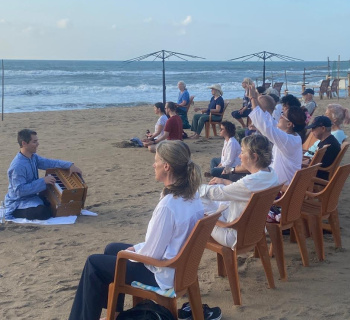
    Visiting the Karar Ashram of Sri Yukteswar is the spiritual highlight for the Yogananda devotee in Puri, however it is a city of great spiritual power and rich with the history of many yogi-saints and great devotion. Our glorious morning routine included sunrise energization, a bit of yoga/pranayam, chanting and meditation on the beach. Morning visits to pilgrimage sites gave way to free time in the afternoon for more yoga, relaxation, spa and gym time etc. The food was over-the-top and many pilgrims may have over-indulged in that department!
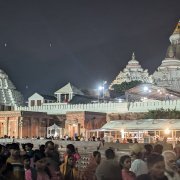
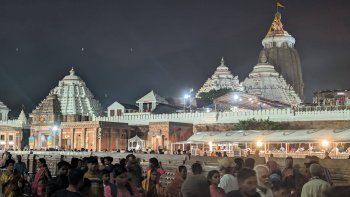
    Other highlights in Puri included a visit to the enormous Jagannath temple. Although foreigners are not permitted inside, we circumambulated the temple complex to our great enjoyment and amusement. Over 10,000 priests serve here and up to a thousand cooks can serve upwards of 50,000 meals here daily! Jagannath is a form of Lord Krishna who is an incarnation of Vishnu, more recently incarnating as Mahavatar Babaji in our line of Gurus. Ultimately all is the One Spirit, but this special deity has tremendous spiritual power and millions upon millions of devotees come here to worship each year.
    From Puri we made our way to Kolkata, my personal favorite place of pilgrimage. Besides being the home of our guru Paramhansa Yogananda, it has an especially unique cultural and spiritual environment. Through the centuries this area and city in West Bengal has been home to many saints, enlightened scholars, scientists, authors and sages. Yogananda’s own childhood stories in Autobiography of a Yogi are rich with many such mahatmas, or great souls, with colorful and fascinating context for the making of the great world Master that Yogananda would become.

    The undeniable highlight for every Yogananda devotee here is the busy little neighborhood in which the great guru’s ancestral home, and that of his boyhood spiritual friend Tulsi Bose, sit just a half a kilometer apart. Both locations are supermagnets for countless streams of devotees who come seeking the blessings of prayer, meditation and reverence where Yogananda and many other great saints experienced the samadhi of enlightened oneness with God.
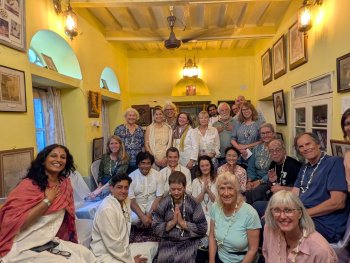
    An unlikely meeting came together at our Kolkata hotel one evening when, with a little coordination, we were able to bring together three coinciding devotee groups: pilgrims from Ananda LA and Ananda Village, our pilgrims from Ananda WA and Ananda Portland, and several of the local devotees connected to our Ananda Kolkata center. We sang chants in Bengali, Hindi and English together, and felt tremendous inspiration at the spontaneous, international group of devotional hearts joining together. Murali and I shared about the work of Paramhansa Yogananda both as a personal and universal avatar for this age, and a Sat Guru of divine love, joy and wisdom. And off course a large and boisterous feast of joy and Indian food followed as our brief and delightful encounter with these international friends and gurubais came to a close.

    Our final major pilgrimage stop in Kolkata sits across the Ganges river: the famous Dakshineshwar Kali temple where the spiritual powerhouse Sri Ramikrishna resided and worshipped for some 40 years. A fascinating feature of Ramakrishna’s life was the samadhi or oneness with God he sought by mystically delving deep into the major religious traditions of the world including Hinduism, Islam, Christianity and others. Although his realization of God ultimately transcended all forms, he long preferred to worship Divine Mother in the form of the goddess Kali and would ecstatically interact with her living presence. Years later Yogananda visited and also directly experienced the presence of the Divine Mother here. My own experience of visiting traditional Hindu temples, especially with such mystical power and history as Dakshineswar, is that the pilgrim or seeker can tap into the spiritual power there tangibly with focused attention before, during and after the ceremonial visit among throngs of people worshipping and seeking the blessing of darshan from the presiding deity.

    Our final leg of the pilgrimage brought us to the Ranikhet region of the scenic Himalayan foothills, but not before a brief stop back in Delhi to regroup, see a few pilgrims off and gain a few more, and set off for a very long day of travel aboard train and bus. Leaving the poison air and pandemonium of the Delhi railway station behind we made our way some 5 hours to Kathgodam by rail, to board our bus and ascend another 6-7 hours up winding mountain roads. Many hours of devotional chanting and a spontaneous choir group filled our bus as we at last arrived at our final accommodations: the illustrious Dunagiri Retreat. This magical place sits just a few kilometers from our primary place of pilgrimage here, the sacred Babaji’s cave where Lahiri Mahashay was reunited with the deathless guru in 1862 and Kriya Yoga was reborn for millions of spiritual seekers in this era.

    The fresh and frigid mountain air was a marvelous change, and the stunning views, sunsets and grounds of Dunagiri a feast of beauty for the eyes and heart. The food too (yes, the food again!) proved to be the most wholesome and enjoyable of our many wonderful places of nourishment, with many fresh, homegrown and local vegetables and traditional homemade hearty dishes. The proprietor was a splendid host and immediate friend to all, a kriya yogi of Yogananda and Babaji himself, who also worked at the World Bank in the USA for some 15 years before starting the humble Dunagiri retreat grounds 20 years ago. A daily toil of labor and love has made it the beautiful sanctuary it is now, including a Babaji meditation temple, spacious yoga hall, large and gorgeous atrium dining hall, sprawling terraced landscape and flower gardens, and comfortable if rustic accommodations.
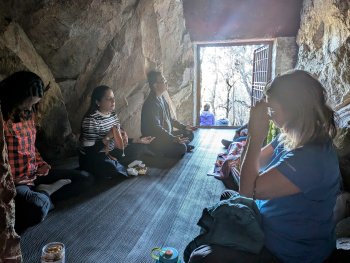
    Two consecutive mornings we hiked up to Babaji’s cave to meditate for hours within and along the beautiful hillside nearby. Our hiking was mostly in silence, practicing japa and devotional chanting to drink in the beauty of God in nature and the special blessings of the immortal Babaji. Many pilgrims experience profound meditation and spiritual communion here.

    Finally we visited a nearby temple atop another towering hill, of the same name, Dunagiri, as our retreat. Legend says this special temple was also a meeting site of Babaji and his chief disciple Lahiri Mahashaya, as well as another ancient and sacred site of the Divine Mother in the small temple itself. Visiting these beautiful and powerful sites for just one or two hours, although remarkably special, would sometimes leave pilgrims pining to spend hours longer in devotional silence and meditation there.
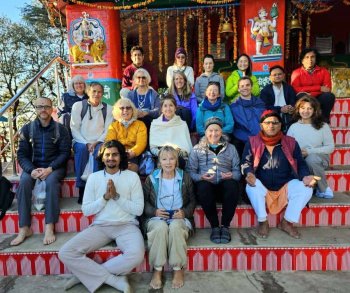
    We finished our time at Dunagiri with a fire ceremony in the special Babaji temple, chanting the ancient Mahamritunjaya Mantra 36 times with deep concentration, prayer and blessings filling our hearts. It was hard to leave and the bittersweet feelings continued as we retraced our route by bus and train back to Delhi for our closing satsang together. The blessings of this pilgrimage were so potently felt by everyone present. 

    Spiritual friendships and experiences were forged deeply in all hearts, and renewed inspiration and divine strength continues to blow like a mighty wind at the backs of all our pilgrims. Parting ways with our 20-day journey and one another proved hard on everyone, but the overwhelming feelings of gratitude, joy and blessings are the wings each pilgrim felt soaring their ways home. As a result, a rare spiritual gift like a precious gemstone now adorns each of our hearts forever.
  • Yogananda India Pilgrimage #1

    Yogananda India Pilgrimage #1

    A fiery floating lantern and popping fireworks adorn the cacophonous festival of thousands worshipping the goddess Ganga nearby. Smoky skies preside over the placid gray Ganges River this evening atop the River Rhythm Hotel—only footsteps from a stretch of holy-beyond-holy land. Few places on earth carry a spiritual power so ancient and immense.

    Rewind five days: the bulk of our 24 pilgrims from (mostly from Ananda Portland & Ananda Washington) landed in Delhi for the start of our Yogananda India Pilgrimage—three weeks in four segments, visiting extraordinary historical and spiritual places that hold special meaning for devotees of Self-Realization and disciples of Paramhansa Yogananda and our line of Gurus. Our Ananda Center in Delhi provided the perfect home base: a restful day to adjust our bodies and minds to India, to enjoy spiritual friendships, nourishing food, and an opening ceremony to set our intentions and deepen our connections for the journey ahead.

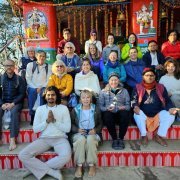
    Pilgrims at sacred Sarnath

    A domestic flight to Varanasi introduced us to the cultural adventure of travel within India: friendly, disorganized, and mostly pleasant transitions from place to place. A friend and gurubhai from South India met us at the airport with smiles to serve as our local guide and fixer. A comfortable one-hour bus ride with a delicious meal (a constant throughout our days!) brought us to Sarnath, a sacred site of Buddhism rich with archaeological treasures, spiritual history and power. Here the enlightened master Buddha delivered his first sermon.

    Our pilgrimage is unique in that we seek to tune into the living presence of saints and Masters whose vibration remains at these holy sites, for those receptive souls who seek it. A lovely walk and guided tour ended with a brief meditation beneath a descendant of the Bodhi Tree, whose ancestor sheltered Prince Siddhartha before he emerged the illumined Buddha. Another short drive brought us to our River Rhythm Hotel in the heart of Varanasi, where a restful night gave way to an early morning.

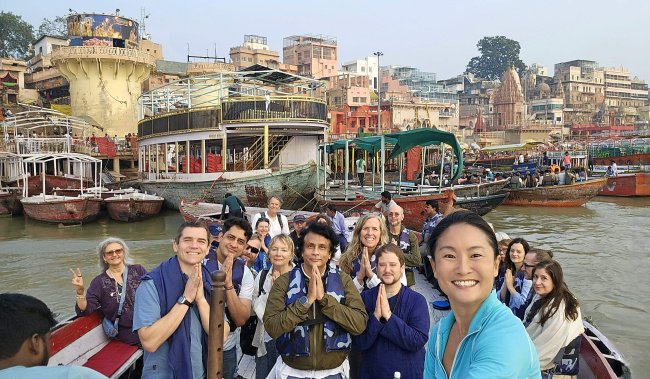
    Morning boat ride on the Ganges

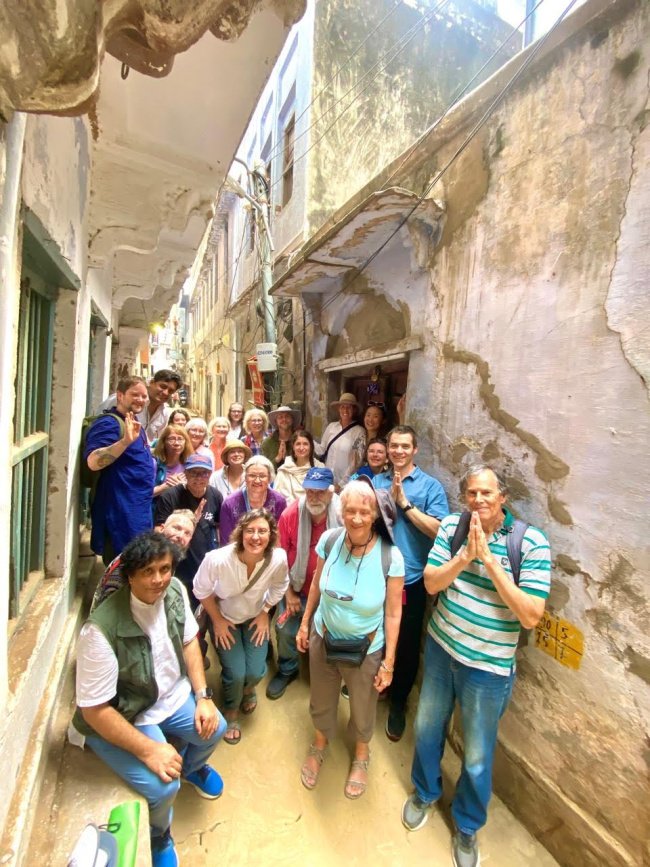
    For two days, sunrise boat rides along the sacred Ganges brought us to special places for meditation and devotion. Varanasi is more peaceful by boat—removed from the teeming chaos of traffic and crowds. Docking and ascending the steep ghats (riverside embankments used for worship and daily life) leads into narrow lanes lined with ancient temples, ashrams, and colorful shops, side-by-side with humble homes and every shade of human existence.

    People are everywhere—thousands upon thousands—busy living their lives. Beneath the craziness, especially in a supernally sacred city like Varanasi, most people seem fundamentally peaceful, happy, and kind. Many visitors and locals flow in a constant stream of devotion and worship that has continued here unbroken for many hundreds of years.

    Pilgrims visiting Lahiri Mahasaya’s home

    It was in the nearby Bengali district here in Varanasi where a sixteen-year-old Mukunda (Paramhansa Yogananda) first met his Guru, Sri Yukteswar. Their hearts melted in a divine reunion of eternal Guru-disciple bond. They walked together to a nearby residence, where Sri Yukteswar was visiting his mother, and spent hours conversing and meditating. My friend and co-leader, Murali Venkatrao, has been carefully researching details of Yogananda’s life while writing a manuscript for an Autobiography of a Yogi mini-series in development. He was able to confirm with high confidence that room 205 in the now Dwivedi Hotel is that sacred site of that first meeting. Our pilgrims were blessed to be the first group from Ananda to visit and meditate in this special place. Because we had booked the room, I seized the opportunity to stay overnight and meditate extra hours there!

    The next day we visited the ashram of Trailanga Swami—a contemporary saint of Lahiri Mahasaya—renowned for his miracles and towering spiritual greatness. Later, with a smaller group, we explored the Durga Mandir, built by the maharani of Varanasi in the 18th century—practically new by Indian standards! We enjoyed a nearby meal fit for royalty and later joined the arati worship of Hanuman (and thereby Lord Rama) at another local temple—Jai Sita Ram! Jai Hanuman! On the way, our adventurous group tried meetha paan, a sweet betel leaf filled with rose petal jam, fennel seeds, dried fruits, and coconut—WOW! A wild ride for the palate and mind.

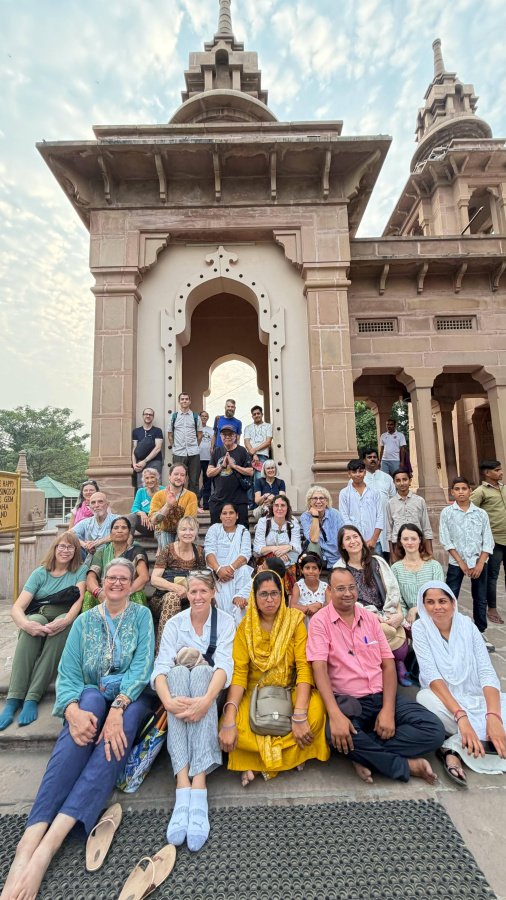
    Pilgrims at Durga Mandir

    That evening, we returned to the Ganges for a boat ride to witness the world-famous arati at Dashashwamedh Ghat. This is where Babaji met other great Masters and promised to remain in his physical form forever. Countless saints and Masters have hallowed this riverbank for centuries, most likely millenia. The daily arati continues without fail—its devotion still strong, despite huge crowds, bright LED screens, and a more recent and distinct Bollywood edge.
    Evening arati at Dashashwamedh Ghat

    Later an unexpected devotional festival brought a night of endless fireworks, drums, crowds, and clamor. Sleepless after 2 a.m., I went to the roof to energize and meditate. Hundreds of fireworks lit the sky and riverbanks for miles all through the night, while I chanted to Divine Mother. I could feel Spirit celebrating all night long through the hubub—rejoicing in life’s glory, variety, and sometimes wild chaos.

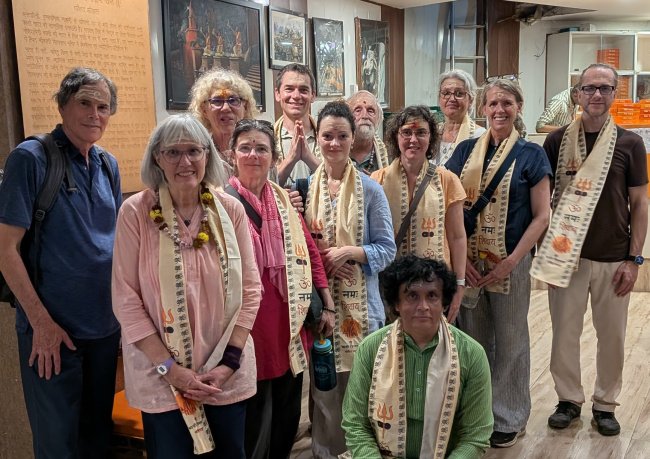
    Our final day in Varanasi brought us to the ashram of Anandamayee Ma, the bliss-permeated Mother saint also described in Autobiography of a Yogi. Our chanting and meditation there were joyful and deep, with a tangible presence of her vast spiritual love. In the afternoon we made a ceremonial visit to the extraordinary Kashi Vishwanath Temple—a sacred and powerful shrine of Lord Shiva, destroyer, transformer, and maha yogi aspect of God.

    Pilgrims at Kashi Vishwanath Temple

    Next, we travel south to Puri in the state of Odisha for a more relaxed pace along the Bay of Bengal, with more time for yoga and pranayama. Stay tuned for Yogananda India Pilgrimage #2! Sending many prayers and blessings to all.

  • The War in Portland

    The War in Portland

    Our humble and beautiful city of Portland, Oregon, is once again making national news with politics and controversy in the headlines. The state military has been federalized, and protestors are taking to the streets—yes, in chicken costumes, clown makeup, and more (after all, it is Portland)—to exercise their rights.

    This is not to make light of current events, the horrors of real war, or the many difficult issues and concerns facing our government and society today. It is, rather, to frame the inner war of Light versus Darkness taking place not in Portland or Washington, but in the human heart. The outer conflicts and wars of this world are reflections of that inner struggle, and resolution must come from each heart seeking that “peace which passeth all understanding” (Philippians 4:7).

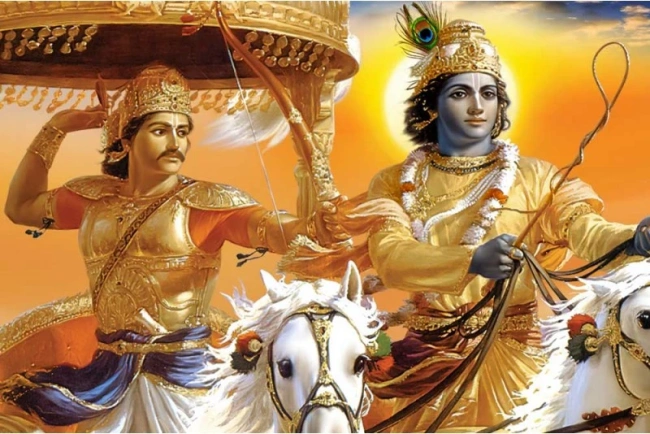
    There are many harmful weapons, words, and strategies causing great suffering in the outer world. Most of us are ill-equipped to respond in a meaningful or effective way outwardly, but would do well to follow the heart in the path of right action described by Krishna in the Bhagavad Gita:

    “It is better to die while trying to accomplish one’s own duty than to settle for another’s [though safer and easier], which course is filled with danger and uncertainty.” (3:35)

    The real battle must be fought on the level of consciousness, where its origins lie: “Arise, O Arjuna! Take up your bow of discrimination and fight the inner battle!”

    Paramhansa Yogananda’s own counsel to the yogi in battle is:

    “Be calmly active and actively calm.”

    This simple statement offers the profound key to victory. Daily meditation, spiritual discrimination, and intuition form the troops of our will and feelings into battle formation. Far greater than bombs or guns, the weapons of compassion and love wield a power infinitely stronger in this world. The little figure of Mahatma (Great Soul) Gandhi emanated greater power and peace than most kings, warriors and politicians down through history.

    The chaos, division, and pain we are witnessing around us mirror the collective consciousness of the people within it. When the light of our spiritual power burns brightly, the world around us is filled with greater hope and harmony. To heal the pain and suffering in Portland, in the United States, in Palestine, Ukraine, and throughout the world, we must first heal the souls of people everywhere.

    The power to change oneself through yoga, the power of prayer, and the grace of great Masters and Saints move divine currents across this world. Ocean waves may ebb and flow, heave and subside, but the silent depths contain the ocean’s real power. Every soul attuned to the ocean of Spirit has the power to bring divine peace and harmony to the world.

    Portland is not at war—but there is a war raging in our consciousness. Let us fight that battle on the front lines of our hearts and minds, that we may win victory in the soul.

    Each one has to win his own victory. Make up your mind that you are going to be supremely victorious. You don’t need an army or money or any other material help to gain the highest victory attainable; just a strong determination that you are going to win. All you have to do is sit still in meditation, and with the sword of discrimination cut off, one by one, the advance of restless thoughts. When they will all be dead, God’s kingdom of calm wisdom will be yours.         –Paramhansa Yogananda

  • Your True Self

    Your True Self

    “This above all: to thine own self be true,
    And it must follow, as the night the day,
    Thou canst not then be false to any man.”

    This well-known phrase from Act I of Shakespeare’s Hamlet is spoken by the king’s minister, Polonius, as part of a blessing and advice to his son departing for university. But what does it mean to be true to one’s own self? And how does one go about it?

    Paramhansa Yogananda aligned his mission and life’s work with the term “Self-Realization.” This is the highest expression of the word “self,” used to denote the oneness of the individual soul-self with the infinite Divine Self. Yoga philosophy and practice provide us with an experiential framework to test Self-Realization—both scientifically and spiritually. Those who know, know: this is the only purpose of life. Yogananda described it this way:

    “Self-realization is the knowing in all parts of body, mind, and soul that you are now in possession of the kingdom of God; that you do not have to pray that it come to you; that God’s omnipresence is your omnipresence; and that all that you need to do is improve your knowing.”

    Improving one’s knowing is a mystical, challenging journey that pays rich spiritual dividends. Practically speaking, daily meditation is the indisputable foundation of this journey—but more is needed. Let’s consider three essential keys to deepening our knowing of the divine Self:


    Remembering the Self

    Everyone in the world is suffering from a profound case of spiritual memory loss. A pathologist might treat memory loss with cognitive training and lifestyle changes. Devotees, by contrast, use japa, chanting, affirmation, and other yoga practices to reawaken the divine memory latent in the soul. Yogananda advised:

    “Dwell always in the Self. Come down a little bit when you have to—to eat, or talk, or do your work; then withdraw into the Self again.”


    Loving the Self

    God is Love and must be sought through love, the most powerful force in creation. Swami Kriyananda explained that love and kindness are Satcitananda (ever-existing, ever-conscious, ever-new bliss) in motion. As we expand our sense of self, our actions and relationships will increasingly reflect divine love—through deep respect, compassion, and kindness toward God in all beings, everywhere.


    Serving the Self

    Life is full of unavoidable activity. Sri Yukteswar taught that all who live in this world are obligated to “render grateful service.” When we combine our service to others with our loving remembrance of God, it is we ourselves who receive the greatest blessing. As Yogananda said:

    “Never neglect to do what you can for yourself in the form of others.”


    This world is complex and chaotic. Our own consciousness—our self—is the only thing we truly have agency over. Life will bring joys and sorrows, heartbreak and deep love. In the birth of a child, in the loss of a loved one, in the pain and suffering of others, the one Self remains. To quote the great saint Anandamayee Ma:

    “…Though the dance of creation changes around me in the hall of eternity, I shall be the same.”

    By remembering, loving and serving God always, it must follow, as the day the night, that we will know our own true Self. 


  • Ananda Politics

    Ananda Politics

    “Never the twain shall meet.” This well-known line from Rudyard Kipling’s 1889 poem The Ballad of East and West depicts incompatible differences. The poem tells a story of a British colonel’s daughter kidnapped by an Afghani bandit and rescued by a brave soldier. The two adversaries fight a fierce battle, and despite their opposition, develop a mutual respect for one another’s honor and bravery. This is an important spiritual value: we can find common ground even amongst incompatible circumstances.

    We are living in an age of political and social turmoil, which ebbs and flows according to the mass karma of the globe, its nations, populace, and leaders. The term and concept of politics comes from ancient Greece, referring to the affairs of “polis,” meaning cities or states. From a spiritual perspective, the functions of government powers and policies—despite their many real and lasting impacts on individuals—are relatively superficial compared to the far greater and more lasting work of raising one’s consciousness and that of the world. How can we reconcile human suffering and problems with lofty spiritual ideals?

    Ananda is a spiritual family, community, and organization devoted to the mission and teachings of Paramhansa Yogananda, as expressed by his direct disciple Swami Kriyananda. This path of Self-Realization is universal because absolute: it transcends every definition of religion, race, credo, or other separating factor. Thus, Ananda is inherently non-political in the traditional sense of directly endorsing or engaging with any political party or dialogue. God is love, truth, and bliss—far beyond any conceivable human construct. “Never the twain shall meet” except to find a harmonious blend of living right spiritually in this imperfect world.

    Within this modern arc of national and global politics and karma, we are now looking down the barrel of an extended turbulent, possibly even violent period. People everywhere, especially those lacking strong moral and spiritual foundations, are being swept up in powerful currents of polarized thinking and behavior. By many objective accounts, this karma will get worse before it gets better.

    The other side of the coin reveals that such karmic periods are accompanied by profound spiritual opportunity. If we keep our spiritual practices and principles in order, we can maintain our inner peace and act rightly in every circumstance. Some twenty-five years ago, during another period of karmic unrest, Swami Kriyananda outlined a powerful yet simple list of priorities for Ananda:

    1. Our inner relationship with God and Guru

    2. Our service to them

    3. The friendship we have with one another

    4. Our need to meet dharmically the tests life has given us

    5. Yogananda’s advice “You must be practical in your idealism” *Adding that while practicality is important, faith is the most practical thing of all.

    This little blueprint gives us the Ananda recipe for not just weathering but thriving through a difficult time. There will always be exigencies and personal hardships to bear, but it is helpful and important to keep coming back to these essential priorities. In a way, these are the Ananda “politics” that guide the governance of our organization, communities, and members. As long as we stay true to these essentials, Ananda will always be a divine light shining in whatever darkness prevails and a safe haven for storm-tossed spiritual seekers everywhere.

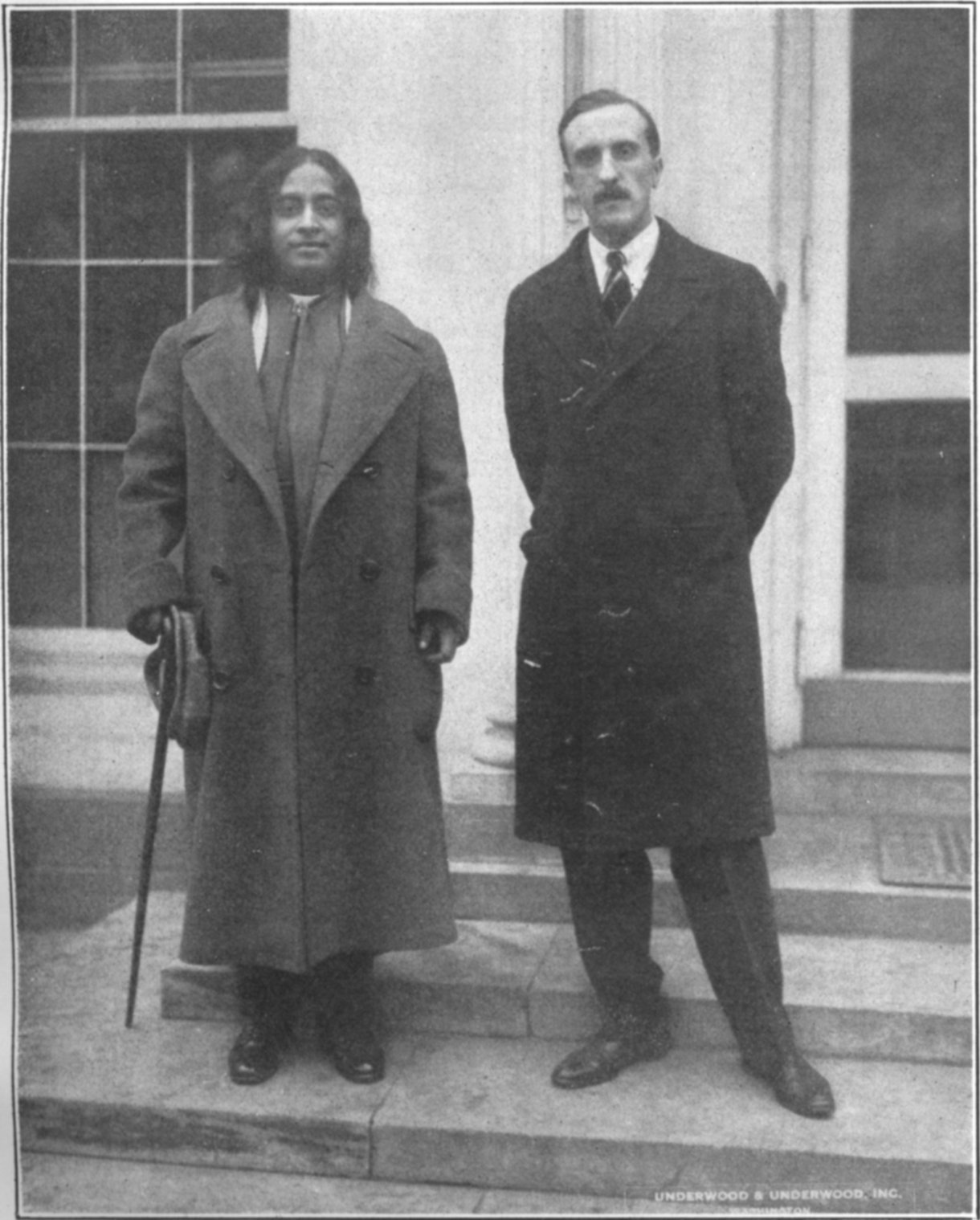
    Paramhansa Yogananda influenced many powerful people in his life and beyond it, including politicians and business magnates, scientists and artists, and mystical saints of east and west. Yet his power of influence was beyond anything of this world, directly from God. That same supreme power continues to guide and influence all those who, avoiding the many lesser streams of influence of this world, seek and strive to be in tune with God.

    Yogananda at the White House during a 1927 visit with US President Calvin Coolidge

    If we quell the cross-currents of news headlines, social media, and politics, we are left with the simple fact that these are human issues concerning the well-being of individuals. Ananda too is concerned above all, spiritually, with the well-being of the individual. Ananda’s spiritual politics are not a dismissal or means of negating the many important and challenging issues we are faced with. They simply provide a framework of priorities for how to successfully navigate, individually and collectively, through the political tempest.

    We celebrate Easter to remember the resurrection of Christ–a sybmbol of the hope and transcendent power of Spirit over every human suffering and hardship. “Seek ye first the kingdom of God, and all these things shall be added unto you.”

    In a certain sense, Ananda is doing the greatest political work of all: raising mass consciousness by wholehearted dedication to the spiritual welfare of individuals everywhere. This is a divine ray of out great gurus including Paramhansa Yogananda, Jesus Christ, and our founder and guiding light Swami Kriyananda. Our mission finally is simple but not easy, unwavering through every possible karmic challenge: to bridge the gap of living above all in attunement with God through this ray, and meeting the challenges of the day with the right spirit.

  • Through The Storms

    Through The Storms

    Recent years and present times have seen the storms of the pandemic, natural and manmade disasters, political and economic upheaval, global unrest and many more such challenges. A mighty natural storm might uproot trees, destroy homes and lives, and lash the seas to heaving. And so today might seem like the breaking point of something significant, and maybe it is. When will it let up? Will it get better or worse? What is going to break down and when? We can speculate but cannot answer these questions; the real power we have is to exercise our “rights” of self-control, centeredness in God, and sharing God’s light in thought, will and activity.

    These recent storms are new but not unprecedented difficulties facing our nation, our globe, and the human race. On an individual level there must be some coping mechanisms to weather the storms of life. A certain dynamic tension is unavoidable, even necessary for progress and growth, but excessive stress left unchecked on a system or an individual will ultimately be detrimental and destructive.

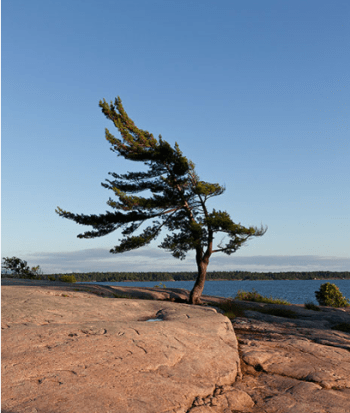
    We learn valuable lessons from the elements and features of nature, Spirit expressed through the phenomena and beauty of the natural world. The same powerful storms which batter and break even the mightiest trees will strengthen them, even as the great American environmentalist John Muir observed, “some pines six feet in diameter will bend like grasses before a mountain gale”. Swami Kriyananda expresses this power of the trees in another way in the song Channels: 

    Trees standing firm hold the secret of inner power

    Give us when tested, strength to endure

    The tree that grips tightly to the earth, yet sways flexibly through even the most raging winds, will bend and shake but never break. Strength is needed, ultimately through the grace of God, to weather the mightiest storms of life. The Ananda Yoga affirmation for garudasana or eagle pose is perhaps most apt for these times: “At the center of life’s storms, I stand serene.”

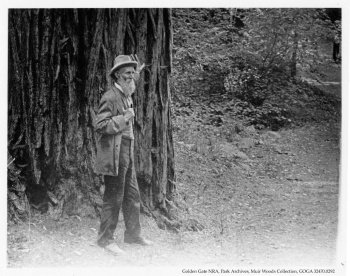
    John Muir with a mighty redwood tree

    Sometimes we may need to embrace these storms like John Muir in one of his many daring adventures (what he playfully called scootchers) when he famously climbed a 100-foot pine tree to revel for hours in a furious windstorm, drinking in it’s power and glory. (A Windstorm in the Forest, 1984) . There are many more subtle, and less risky ways to turn the storms of difficulty into opportunities for spiritual adventures of courage and joy. In another of his countless melodic poetries, Kriyananda illustrates this carpe diem sentiment vitally:

    Sing when the sun shines, sing when the rain falls, sing when your road seems strange;

    In a tempest seize the lightning flash, and ride the winds of change!

    In many ways we must simply accept the fate and karma of the world, and ourselves, with the serenity as Paramahnsa Yogananda advised to let “what comes of itself, let it come”. The yoga principles and practices give us the tools then to make the most of what comes, and ultimately to find freedom and joy in the process.

    There is unmistakable hope, peace and joy in this world, battered and broken though it is. We must look and listen beyond the problems and chaos for the strains of the divine music that pervades all creation and its myriad happenings.  To quote the great John Muir once more, perhaps at least as much enlightened mystic as environmentalist:

    “This grand show is eternal. It is always sunrise somewhere; the dew is never all dried at once; a shower is forever falling; vapor is ever rising. Eternal sunrise, eternal sunset, eternal dawn and gloaming, on seas and continents and islands, each in its turn, as the round earth rolls.”

    May the sunrise of God’s presence always shine on, and bless us. And may we remain centered, courageous and spiritually adventuresome in the face of all the comes.

  • The Inner Door

    The Inner Door

    It’s now Christmas time: the greatest, most holy time of year. We celebrate with so many traditions all over the world, including many other holy days and observances unrelated to the birth of Jesus Christ. But it is universally recognized as the sacred season where even the astronomical and astrological phenomenon align with an increase of light in the darkest of times. Every tradition, culture and expression in some way relates to the deeper meaning of Christmas time: not only the birth of the universal, divine Christ consciousness, but the awakening of that same divine light in everyone and everything. One of the most extraordinary special traditions is Paramhansa Yogananda’s 8-hour Christmas meditation, practiced at Ananda Portland and by devotees all over the world, meditating deeply to awaken in Christ’s light.

    This world is both matter and Spirit, and the awakening Christ in all every thing, and each individual, is the scintillating super highway to become a Christ oneself and realize that divine consciousness everywhere. Swami Kriyananda wrote a beautiful song in which each line beautifully describes this path of awakening in Christ’s light:

    When human hopes toward Thee aspire, dark woods of grief are set afire. When someone, anyone, consciously aspires towards higher consciousness and God, that same lamp of devotion ignites the fire that eventually transmutes all human grief, sorrow and suffering. Yogananda said: “Remember that finding God will mean the funeral of all sorrows.” The conflagration of these very real and difficult human experiences goes up in self offering, the rising smoke of blissful freedom in its release. 

    Beyond all reach of earthly skill, Thy love alone our hearts can fill. Nothing in this human experience can fill our hearts: relationships, money, travel, lavish gifts…this world is an unfortunate combination of endless pleasures (and pains) which will never, ever fill the void in our hearts. We may imagine or construct a series of false joys, but in the end we will always be insecure, lonely, fearful or otherwise incomplete without God. Fortunately it is a two way street: when we finally seek God earnestly with devotion, our hearts gradually and spontaneously become full with God-happiness and peace. In the prayerful words of St. Augustine “Thou hast formed us for Thyself, and our hearts are restless till they find rest in Thee.”

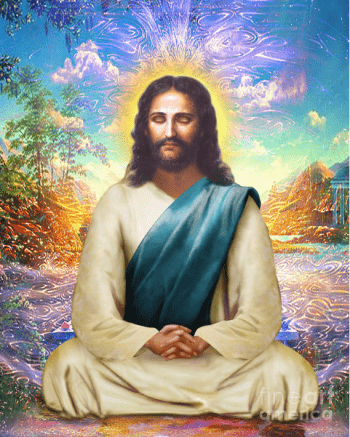
    Christ’s light that shone on earth from heaven opened for us the inner door. The guru or avatar, most famously represented beautifully as Christ, opens the inner door for us to enter the realms of divine consciousness. We cannot get there without kriya yoga: the practice of transmuting our inner energies by pranayam and Guru’s grace. Yogananda describes the path through the inner door as “deeper, longer, Guru-given meditation”, where at least comes the “celestial Samadhi”, final union with God through Christ.

    To all who love the gift is given: joy and freedom evermore! Love is only a humble word which hints at the divine, cosmic power underlying and overarching everything in this universe and far beyond. Love is synonymous with God, and is the final answer and only solution to everything in this world. Sri Yukteswar said that “Divine love is without condition, without boundary, without change. The flux of the human heart is gone forever at the transfixing touch of pure love.” This is the love of God and Guru, the real and only summum bonum of this world, through which our own steadfast seeking, meditation and loving, will give us the ultimate gift of joy and freedom, evermore.

  • Yogananda in California

    Yogananda in California

    Last week twenty-five pilgrims from Oregon and Washington (plus one who snuck in from Texas) embarked on a journey to visit six holy sites of Paramhansa Yogananda in California over three days: Encinitas Hermitage, Mt Washington, Forest Lawn, Biltmore Hotel, Hollywood Temple and Lake Shrine. Yogananda spent a great deal of time in these places and countless spiritual lessons, stories and memories reside there. Rather than present a timeline or historical review of this powerful pilgrimage, the following is a brief flow of inspiration relevant to each location, along with a few stories and extraordinary blessings received.

    Encinitas Hermitage

    Encinitas Hermitage: This idyllic spiritual hermitage, with it’s stunning gardens overlooking the edge of sixty million miles of ocean, is a kind of paradise of serene loveliness and peace. Yogananda wrote his unparalleled masterpiece Autobiography of a Yogi here, along with such priceless spiritual jewels as Cosmic Chants and Whispers from Eternity. Thousands upon thousands of visitors come here to meditate, bathe in natural beauty, and gaze upon one of Master’s own favorite phenomenon: the horizon meeting of infinite sea and sky.

    Although a spiritual master far beyond ordinary human comprehension, Yogananda also had a happy, wise and playful human nature as well. A local resident in Encinitas recounted his father’s brief tale, who lived in Yogananda’s time as a young boy. The hermitage swimming pool in those days was one of the only pools for miles around, and sometimes intrepid children would sneak onto the property for a swim. This 10-year-old boy stole onto the grounds one night and approached the pool; Yogananda emerged quietly from nearby and said simply, “Jump!” and the boy ran off, never to encounter the master again. Although a trivial story, it reminds us of the bold and childlike spirit which can balance the mighty scales of a great saint’s spiritual magnetism and power.

    in the glorious Temple of Leaves where Yogananda meditated and encouraged others to do so

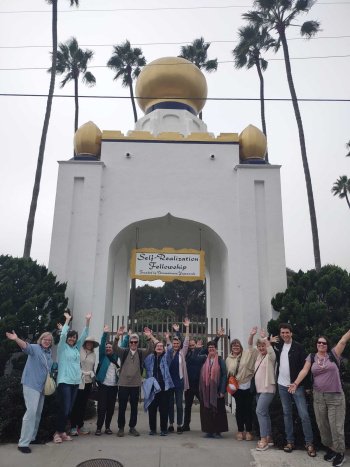
    Mt Washington: this Los Angeles hilltop serves as the all-important international headquarters of Self-Realization Fellowship. Yogananda’s residence, spiritual power and work are powerfully embedded in the main building and beautifully landscaped grounds. Devotees may be permitted to visit Yogananda’s carefully preserved bedroom and sitting room upstairs, where many experience powerful spiritual vibrations beyond adequate description. Although the spirituality and divine work continue as the main focus here, there is also a museum-like quality to the atmosphere, where firm guidelines of quiet, no pictures or loitering, no chanting or singing are maintained. Despite these impositions, which SRF is somewhat notorious for, seeming to oppress Yogananda’s ebullient blissful spirit, there yet remains an otherworldly beauty and peace everlasting. All who visit are blessed.

    devotion at Yogananda’s great mausoleum

    Forest Lawn: Paramhansa Yogananda’s physical body was interred here in 1952, first in a crypt for twenty years, and then (as now) in a great marble mausoleum. Twenty days after his passing his body had not decayed, nor had it deteriorated notably after those first twenty years! These strange mystical phenomena may take place in the life and death of a saint, and hint at the supernatural state of the soul or the body in which it resided. Regardless of any outer form, the sincere disciple who sings softy with devotion in this place, meditates on Yogananda’s ever-living presence, and places his forehead to the cold stone only inches from the master’s physical form, once again cannot but feel, or depart without, some magnificent spiritual blessing from God.

    meditation at the Biltmore Hotel site of Yogananda’s mahasamadhi

    Biltmore Hotel: Yogananda like many great mystical beings anticipated, and essentially planned out, the exact nature of his death. Instead of making some grandiose spiritual exit from this world, such as entering into silent fasting and supernal meditation in some remote temple or cave, Yogananda died of a heart attack at a banquet in downtown LA. Like a Hollywood movie the elements of drama were all in place, but a much deeper and more conscious screenplay was also perfectly executed by the Heavenly Director-Producer God. Visiting the 100-year old hotel, which retains is elegant grandeur, one now sits innocuously in the place of Yogananda’s passing where a remodeled lobby now greets hotel guests and visitors. This is another strange testament to Yogananda’s mysterious greatness: his humility and divine role is beyond comprehension, and yet perfectly natural and at ease in our everyday midst.

    Yogananda’s prayer enshrined at Hollywood Temple

    Hollywood Temple: Here again we find a pillar of Yogananda’s great spiritual work and presence in the most unlikely of places: Sunset Boulevard in Hollywood, California, the entertainment capital of the world. Visiting this humble and beautiful temple, its gardens and grounds, and the adjacent India Hall is a looking glass into another fascinating portal. Yogananda did unthinkable things here, transporting the temple building itself from some twenty miles away and completely retrofitting it during the dark and difficult years of World War II. He had the monks dig—by hand!—an entire basement below the India Hall café building to create Lower India Hall where events and ceremonies are held. And he mixed and mingled with all manner of Los Angelenos here, sending his blissful smiles and blessings into hearts and minds near and far from this unusual locale. The man and spirit called Yogananda defy all logic and form, preferring instead to forever emanate creative spiritual energies of joy and dynamism from center everywhere, circumference nowhere.

    a glimpse of Lake Shrine’s splendor

    Lake Shrine: Like Encinitas Hermitage this place sits like a flawless jewel of Yogananda’s crown for countless visitors and spiritual seekers to enjoy. It’s stunning gardens and pretty features are a source of endless peacefulness and serene beauty to appreciate. But once again there is more than meets the eye: here too Yogananda consciously and powerfully implanted extraordinary spiritual blessings of universal love and God-consciousness. One chilly day in February long ago, he swam out into the middle of the lake and entered Samadhi (a profound spiritual state beyond body and mind) for some forty-five minutes. He said on more than one occasion that the waters and surrounding areas there were forever sanctified for all to come and be blessed by. The curious origins of the Lake Shrine came when the property’s previous owner, a Texas oil magnate had a powerful dream that the place was to be a universal center for all religious faiths. Looking up SRF in the phone book, he somehow encountered Yogananda over the phone who was expecting his call, and graciously received the extraordinary property by donation. Yogananda’s vision is exemplified there: a place of deep spiritual power, beauty and a symbol of universal religious spirit.

    One thing that becomes apparent on a pilgrimage of this magnitude is that the veils of time and space become thinner. The physical and spiritual journey creates a sort of timeless process, where the busyness of travel fades into the background of powerful spiritual energies coursing through and around the pilgrim. And although visiting the pilgrimage sites yields potent blessings, the pilgrim becomes aware that these spiritual forces are not limited by any physical location, time or circumstance. These blessings live on and course through our lives like the ebbing and flowing tide, affected by some greater energy and power than our own. Let us then, like Yogananda in California, live for some greater purpose and power, dedicated to Self-realization and the united temple of divine love in all hearts, everywhere.


  • Alone Together

    Alone Together

    Everyone is alone. Alone with their thoughts, problems, joys and sorrows. Everyone is born alone and helpless, and leaves this world in similar fashion. And yet, everyone is together in this aloneness: sharing experiences, ideas and support. We are born into a family, move through life with friends, and leave with the support of our loved ones at the end. These two realities of aloneness and togetherness are completed by a third, all-pervading reality of oneness in Spirit.

    Spirit is the link between energy and matter. Spirit is also the underlying connection between aloneness and togetherness. One can be completely and utterly alone, but perfectly happy and at peace. Or one can be together with others and feel miserably lonely. In his poem, I Am Lonely No More Paramhansa Yogananda writes “I am not lonesome in the chamber of loneliness, for Thou are always there. I am lonely amidst an uproarious crowd where Thy Silence slips away in noise like a fast-footed, startled, large-eyed deer.”


    The perfect balance of being “alone together” is the blend of living, serving and worshiping God with others doing likewise. Then all spiritual practices, experiences, karma and aspirations are all blessed by the combined strength of our mutual efforts. All of life is happier, stronger and better with friends seeking God.

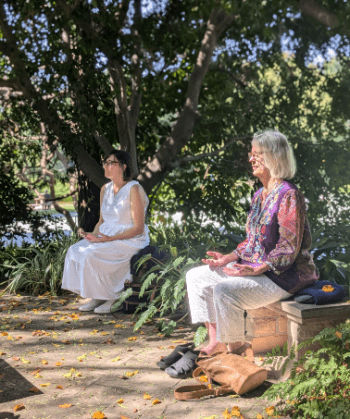
    This week some 24 Ananda Portland friends completed Paramhansa Yogananda’s 9-Day Diet Cleansing and Revitalizing Diet. Instead of being together on a retreat, we all went about our busy lives, connecting on Zoom and Whatsapp to share the experience together. Obviously the abundance of fresh, whole foods plus abstinence from the usual suspects like sugar, starches and caffeine yields many healthy benefits. But some of the deeper blessings of this practice include: an increased feeling of lightness and energy in body and mind, strength of discipline and power of will, and freedom from attachments and habits. 

    The experience of doing something “alone together” has been a unique and enjoyable blend of self-effort and will, with the conscious, tangible support and encouragement of friends. Although our circumstances vary, together we find ourselves stronger, more joyful and increasingly aware of greater realities than our own. Together in Spirit is the greatest reality of all: to see oneself in others, to feel their realities deeply inside, and to behold the one spirit of God shining through every form. Then, no matter our circumstances, we feel the presence of God guiding and blessing every footfall.

    painting by Nayaswami Jyotish

    In the last analysis we are never alone. Paramhansa Yogananda promised “to those who think me near, I will be near”. Jesus said “I will be with you always, until the end of time.” (Matthew 28:20) And Sri Krishna offers these precious words in the Bhagavad Gita: “One who beholds My presence everywhere, and all things dwelling equally in Me, he never loses loving sight of Me, nor I of him, through all eternity.” (Chapter 60, stanzas 30-32)

    So often alone, but at last together with God we march on to final freedom and bliss. In his divine life, music, and writings Swami Kriyananda emphasized the need to “go on alone” seeking and living for God, holding nothing back. When we seek and love God this way, with all our heart, mind, soul and strength, we blaze the final trail to oneness in Spirit alone, but ever together in Spirit.