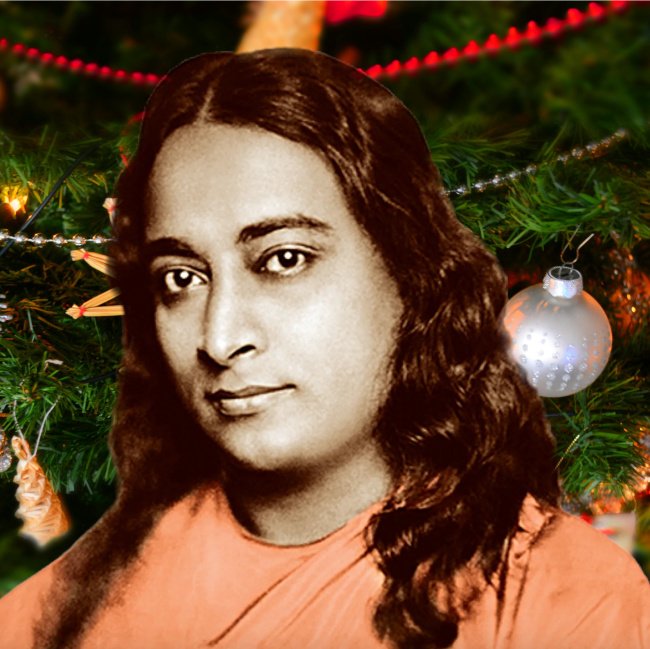
“From today until Christmas pray deep and long until every day becomes a true Christmas day of Christ-communion.” – Paramhansa Yogananda
Christmas is many people’s “favorite time of the year,” and disciples of Yogananda are no exception. Even as we string lights and garlands in celebration, nature itself calls us inward. The leaves fall, the air grows still and cold, and plants retreat to the warmth of the earth. So too are yogis invited to garland their altars and withdraw into the inner silence.
Yogananda loved Christmas. He embraced what he called “social Christmas” as a time to share gifts, feast, and enjoy his large spiritual family. There are countless stories of the care that the Master put into the selection of gifts for his disciples at social Christmas. He would shop months in advance to find just the right thing.
On one Christmas night, Yogananda handed his disciple Mr. Dickinson a square box by the Christmas tree. As Mr. Dickinson opened it, he experienced a dazzling flash of inner light. Forty-three years before that fateful night, another yogi-saint, Swami Vivekananda had told Mr. Dickinson that his Guru would make himself known with the gift of a silver cup. Even as Mr. Dickinson dedicated years of loving service to his guru Yogananda, no such cup had been gifted until that fateful night.
But for Yogananda, “spiritual Christmas” was even more meaningful than the outward festivities. On December 23rd, one day before the social celebrations, he would gather his disciples for an all-day meditation. Stories of his bliss on this day abound. Again and again he would slip into Samadhi, uplifted in divine communion in the presence of hundreds. Near the end of the meditation he often played The Blue Danube, explaining that its joy mirrors the celebration of the Masters and angels when so many souls unite in deep meditation. They dance for joy!
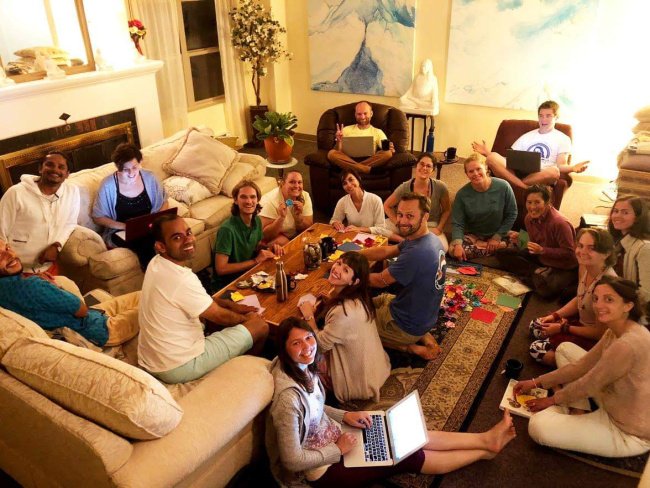
The All Day Meditation, 8 hours of inner communion, has continued as a spiritual tradition of Self-realization seekers around the world. Thousands gather together in temples and homes to meditate for one full day each year. Here at Ananda Portland, we gather for this sacred event on the Saturday before Christmas, which lands this year on December 20th.
Eight hours of meditation can be intimidating. But, asanyone who has tried it can attest, there is a grace about this meditation that makes it different from any other. It feels, for just one day, that all the world is going inward and the soul rejoices in the silence. Newcomers often find comfort in the periodic chanting and stretching breaks, offered every one to two hours, which help the body adjust to the long periods of quiet.
Yogananda urged us: “Let us make this Christmas a real celebration of the birth of the holy child by striving to realize the consciousness which He attained.”
I hope you can join Ananda for some or all of this sacred celebration of Christ consciousness!
At Ananda, we often speak of the blessings that come from living in intentional communities rooted in high ideals and simple living. Paramhansa Yogananda envisioned these “world brotherhood colonies” as models for sustainable living in Dwapara Yuga. As he prophesied, “World brotherhood colonies will spread like wildfire!”
Community creates social connections that have a measurable impact on our health and wellbeing. Small, intentional communities allow for greater shared resources and a lesser impact on the environment. Intergenerational communities make caregiving less isolating and nurture friendships between the young and the old. For Ananda, community most especially supports our desire to center God in our lives.
Rarely will you hear one of us at Ananda speak of the challenges that community living brings to our lives. And yet we know as seekers of Self-realization that challenge is an important catalyst for spiritual growth. So, what are the hardest parts of living in a community? What can we learn from them? How can we overcome them?
Othering
This is one of the more recent criticisms of communities by scholars on the subject. Critics argue that communities, by nature, draw boundaries that create insiders and outsiders. While there’s some truth to this, it’s equally true of families, cultures, or any form of group identity.
Othering is something we must overcome if we are to experience our oneness with the Divine, which is the whole purpose of yoga. In his series of speeches titled, A World Without Boundaries, Paramhansa Yogananda lays out the road map to overcoming this human tendency. We begin, he suggests, within our own selves. We shed light on the prejudices that our personal experiences, family and society lodged within us. We release them in the realization that we are all children of God. Next, we expand our love until we love all the world as our family. To do this, we meditate to expand and uplift our consciousness.
In creating Ananda Village, Swami Kriyananda made it an early order of business to create a retreat center for people to stay and receive what we have to share. This was no accident. Ananda’s early and lasting emphasis on sharing the teachings is a positive, outward pulling force that helps our communities constantly seek to serve others beyond our ‘membership.’ Swami traveled the world, wrote books, lectured publicly, and touched everyone he met with his warm smile. He encouraged us to start schools, businesses, and philanthropic endeavors.
Here in Ananda Portland, we do this through our seva with local nonprofits and, like Swami, with our events, writings, classes and by supporting interfaith events aimed at uplifting consciousness. Community, by its nature, has a boundary yes, but that does not mean we cannot consciously expand ourselves to include others in meaningful and uplifting ways. As Swami says in his book Education for Life, maturity is,”the ability to relate appropriately to other realities than one’s own.”
Collective Over Individual
As a highly individualistic society, the idea that one might place the collective good ahead of our own self interest is seen as oppressive and absurd. And yet, the consequences of this extreme adherence to individual interest is a root cause of our social and environmental crisis today.
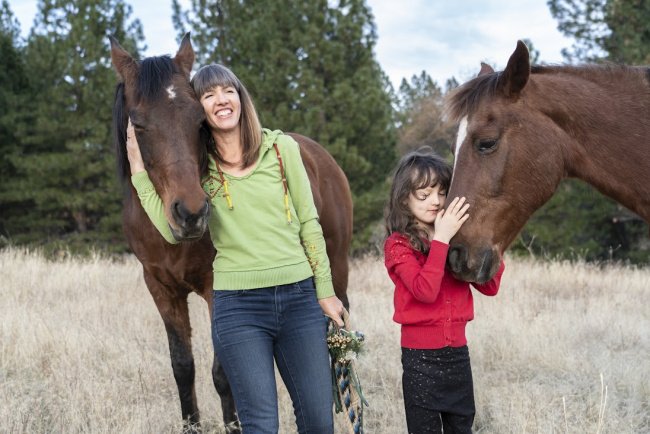
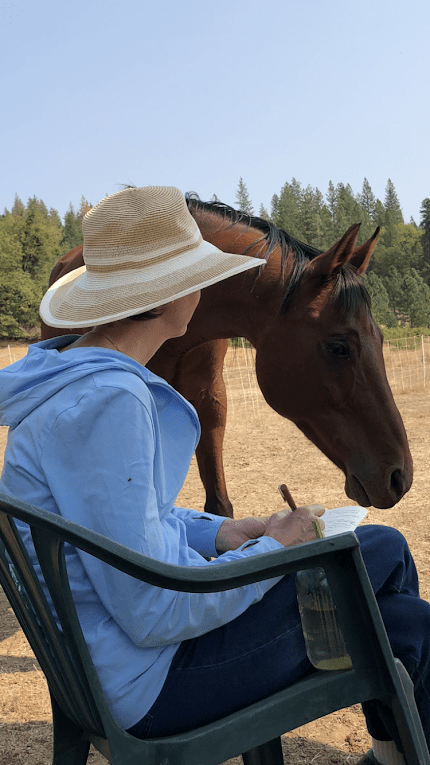
I study and teach wild horse behavior for precisely this reason. By understanding the social structure of horses, I see more objectively how a healthy community thrives when the collective good is placed first. Horses have roles, but not hierarchy. The roles exist for the health and safety of the herd. When a lead horse is injured or needs to rest, another will graciously take its place until the original horse is ready to serve. How is leadership assigned? By consensus, the herd follows the horse with the most consistent good judgement.
As with all things, the Buddha’s wisdom applies here, “the middle path is the way.” Through trial and error, those of us living in community learn that we cannot and should not suppress our individuality or abandon our own inner knowing. But we also learn that if we do not consider the impact our decisions have on the collective, for better or worse, we soon find ourselves walking away from our community entirely.
I recall a time when I was working with a mentor in my equine assisted learning practice who said to me, “when you talk about your life, it’s as if Ananda is another person in your nuclear family.” This was an astute observation. What we learn, if we are to make community living last, is that we do well to consider how our personal choices impact the whole because they do. The more we live in that knowing, the more we live congruent with this Divine truth: we are one.
Harmony Over Conflict
When we enter the social contract of community, much like marriage, we discover that what we say matters. There are no take backs. With our spouses and children, we learn very quickly that there are times to speak up, times to listen, and times to live and let live. An excellent rule of thumb offered by Swami Kriyananda when deciding whether to say what you see is this, “Is it true? Is it helpful?”
Through the course of community living we find ourselves faced with opportunities to decide what we will say, to whom, and how. It may be something small, like an annoyance from a neighbor. It may be more significant, like the observance of someone’s risky behavior.
During the pandemic, I sometimes received calls from fellow community members concerned about my choices. My family had created a small pod with a few other households to care for our young children. Though we kept public contact minimal, some still viewed our approach as risky and let us know. I didn’t love receiving those calls—but I reminded myself: this was a friend, afraid. I, too, was afraid. I made the best choices I could for my family, took precautions, and did my best to respond with kindness.
Another horse wisdom mentor of mine once said, “harmony is the resolution of conflict, not its absence.” This hit home as a balance point to the desire to maintain harmony over honesty. It is okay to disagree and have challenging conversations. Just pick your battles with discernment and remember that harmony is the goal. To achieve resolution, we should listen with an open mind and speak with an open heart.
The wedding vows that Swami Kriyananda wrote sum this up exceptionally well, “I will respect your right to see truth as you perceive it, and to be guided as you feel deeply within yourself.”
“You get your bachelor’s degree and think you know it all. Then you earn your master’s and realize you know only a little. But when you get your PhD, you understand you know nothing.”
One of my professors shared this with me long ago, and it struck such a chord that I both laughed and pondered it often in the years that followed. Over time, I began to wonder: what if we applied this same concept to the spiritual path?
In the pursuit of Self-realization, it might go something like this: You get initiated into Kriya Yoga and think enlightenment is just around the corner. Then, after a decade of daily practice, you know the technique, but your inspiration has run dry. If you remain determined, you seek further training, take deeper vows, redouble your efforts, and absorb all the wisdom you can find, only to realize you’ve been practicing just 1% of what your guru recommended, and even that imperfectly.
And then, finally, you smile. Because you understand that this is the Soul’s work, an undertaking that spans the vast cycles of time. It will take as long as it takes.
The journey to Self-realization is long, but the path becomes increasingly sprinkled with joy as we begin to experience life through the lens of Spirit. Many of us are empaths, deeply attuned to the suffering in the world: fear, anxiety, cynicism, and rage, often for good reason. Walking this path requires tenderness: to move through the suffering with an open heart while recognizing that each person is a fellow soul on their own journey. Some may be more lost than you. Others have found a better way—follow them. As Maya Angelou wisely said, “Do the best you can until you know better. Then when you know better, do better.”
Paramhansa Yogananda’s Psychological Chart offers profound insight into this journey, mapping the development of human consciousness on the path to enlightenment. It is a powerful tool for Swadhyaya (introspection) , an essential step in Patanjali’s eightfold path of yoga. Certain qualities, he teaches, indicate an elevating consciousness. Some of them may surprise you:
Dutifulness—out of love, out of respect
Acting in accordance with the suggestions of superior minds
Quiet
Faithful
Patient
Amiable
Having a sense of propriety
At first, I wondered—why these? While undeniably noble, some might be perceived as weakness in certain contexts. But as I reflected, I saw their deeper significance. These qualities mirror the wisdom in my professor’s words: the more we learn on the spiritual path, the more we realize how little we truly know.
Ultimately, our own willpower and experience will take us far—but not all the way to liberation. To reach ultimate freedom, we need a guide. And to accept such guidance—to surrender to Divine wisdom—we must cultivate great humility.
In Michelle Obama’s most recent book The Light We Carry she recalls how she dealt with the early days of the pandemic. The world had suddenly jerked off course and nothing felt safe. At that moment, she began to knit for the first time. Knitting, she explained, was a way to keep her hands busy doing something small when everything else felt too large to handle. And, bonus, she made some great gifts for friends and family! I recall her words at times like these, when everything seems too large to handle. Small, intentional actions, whether knitting or meditating or washing the dishes, can bring us back to the present and help us reclaim inner peace.
Paramhansa Yogananda taught continuously the usefulness of meditation to dispel fear and find peace, especially when things seem too large to manage. I wove these two seemingly different threads of wisdom and discovered: the most powerful small thing we can do is focus on the daily refinement of our meditation practices. One day it may be putting more focused attention on energization exercises. The next day, it may be sitting an extra ten minutes in silence. Yet another day, it might be more prayers for the healing of others. The list of ways to bring attention to daily sadhana is endless and with every microadjustment, you will find your mind and heart returning to peace.
“Meditation is the real panacea by which you can permanently cure yourself of the daydream of matter and all its evils, and realize yourself as pure Spirit,” Yogananda explains.
We can focus on the small things off the meditation cushion as well, of course. We legitimately need ways to unwind and relax when the day is done. Preferably activities that support our desire to find inner joy and rejuvenate us when the day’s work is done.
Returning to Michelle’s choice of knitting with her abundance of free time imposed by the pandemic, there are two deeper reasons that this small thing brought her solace. First, knitting is a creative endeavor and true creativity requires attention to the present moment. Swami Kriyananda, a direct disciple of Yogananda once explained, “One of the secrets of creativity is to live in the moment, and in the work of the moment. A work of art must be a projection outward from one’s center within.”
Secondly, knitting is an act of service because the completed project is likely a useful item for yourself or someone else be it socks, hats, gloves, scarves, or blankets. And when we feel overwhelmed or fearful, Yogananda explains that an act of service is often key to redirect our energy into a positive direction.
“Life should be chiefly service. Without that ideal, the intelligence that God has given you is not reaching out toward its goal. When in service you forget the little self, you will feel the big Self of Spirit. Rather than always striving for personal happiness, try to make others happy,” Yogananda explained.
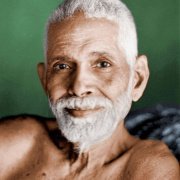
On service, let us also keep the counsel of another great saint, Ramana Maharshi, “Your own Self-realization is the greatest service you can render the world.”
This is day two of a devastating fire event in Southern California. As I watch the suffering on the tiny screen in my palm, my heart aches for the tens of thousands affected directly as well as the millions of us with secondary levels of impact. Homes, businesses, churches, schools, all gone. People fleeing down windy canyon roads, sometimes on foot, sometimes with a dog, a cat, a child, or a horse in tow.
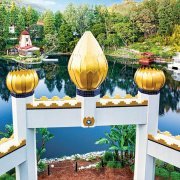
This fire has a particular pain for the millions who love Paramhansa Yogananda. The Palisades Fire, the first of several to break out on that windy, dry day in January, is home to a pilgrimage destination for Self-realization aspirants – Lake Shrine.
Long before Yogananda dedicated Lake Shrine, Native Americans recognized the sacred energy of this land. Later, in the 1920s, it became a movie studio project before falling into disrepair during the Great Depression. In 1949, Yogananda acquired it, dedicating it as a ‘Church of All Religions’—a sanctuary for seekers of every faith. For thousands, it has been a place of peace, reflection, and spiritual renewal. For me, it was a place of refuge and spiritual support during the seven years that I lived nearby.
You don’t have to be a disciple of Yogananda to love Lake Shrine. More than anywhere, Lake Shrine is a physical manifestation of Yogananda’s vision for world unity. The site hosts a beautiful memorial to Mahatma Gandhi, including some of his ashes. The gardens are sprinkled with uplifting quotes, symbols, and statues from all the major religions. Tucked within the glory of mother nature, it seems easier for the visiting throngs to receive his message of the universal one-ness of all truth.
At a time when the world feels so divided, Lake Shrine stands as a reminder of what unites us: our shared humanity, our quest for truth, and the beauty of nature as a reflection of the divine.
In 2002, after graduating from nearby Pepperdine University, I had the great blessing to live in the closest possible apartment to Lake Shrine. Nestled on the southeastern edge of the property, I could walk from my apartment to the temple for services in less than 5 minutes.
Watching the Palisades Fire swallow everything in its path, including all of the classic Pepperdine haunts, and lap angrily at the edges of Lake Shrine has forced me to sit with the fear of its potential loss. The loss of something sacred, something I thought was invincible.
As I lean into the possibility, I am reminded of a truth that: loss is not a condemnation, it is part of the natural cycle of life. The temple in Israel fell, the Parthenon was bombed, Notre Dame burned viciously. Out of these tragedies, the human spirit rose to meet the day.
Whether or not the fires consume Lake Shrine, what it represents cannot be destroyed. Yogananda’s vibrations will endure, just as the message of universal truth has outlasted temples, cathedrals, and sacred sites throughout history. From loss comes renewal, and from ashes, beauty can rise.
May the tragedies of these fires be softened by the outpouring of love, unity, and support—reminders that no fire can ever consume the sacred within us.
I just finished a novel about the pandemic that brought back waves of memories from that time. It remains surreal to me that on March 11, 2020, the world simply stopped. One day to the next, schools closed, businesses shuttered, and airports emptied. We couldn’t find toilet paper and scrambled to buy dry goods, just in case. Remember the bidet toilet fad? And then the hospitals in New York City swelled. Then New Orleans, Chicago, and Detroit. We all lost someone or something dear to us. A job, a loved one, a wedding, a funeral. Plans changed.
Three months ago, I found myself in the backseat of a cab in NYC for the second time post-pandemic, feeling simultaneously heartbroken by the scale of human tragedy experienced there and inspired by the resilience on full display on that warm spring day. Among the flood of memories, I began to wonder about uncertainty, how much of it we faced, and what we learned.
Yoga teaches us that the ego is the soul identified with the body. When the body feels threatened, the ego revolts. The ego’s inclination is to seek an answer, to find some explanation or enemy whose defeat will bring certainty back. Perhaps that is why we have seen a rise in populist nationalism on a global scale. It takes very little study of history to discover that great human-induced tragedies come on the heels of social instability and prolonged periods of uncertainty.
Paramhansa Yogananda counseled that when facing uncertainty, we should maintain an openness to the good while being willing to question. In that way, one sees God in all things, opens with humility to the lessons, and through calm perception, finds the dharmic response to any circumstance. Swami Kriyananda further advised taking uncertainty one battle at a time, one day at a time.
This attitude would have brought about different results had we collectively applied it during the pandemic. What if we had focused on the helpers, seen the highest in each other, and taken a day-by-day response to our brave new world? What if we had prayed Yogananda’s prayer: “O King of kings, train thou, in the camp of discipline, the nobilities of self-control and calmness in me. Be Thou their Divine General, like Krishna of yore, against the invading hordes of darkness, passion, and greed.”
I am certain that some of us did just that. Sadly, too many were caught up in the wave of ego-affirming separateness. For most of us, the pandemic was a wake-up call, but what we awoke to seems extremely varied.
As I am often inspired to do, I look to the animal kingdom for alternative ways to approach life. Horses, when faced with uncertainty, instinctively gather together and determine the best course of action. Their leaders take the input from the collective and choose a path that seems most safe, adjusting constantly as new information comes into their awareness. Trees send vital energy through their roots to their vulnerable neighbors. Birds call cries of warning, and the squirrels, rabbits, and foxes all listen.
It is the human, when acting from the ego self, that scurries into hiding and isolation in times of uncertainty. We hoard treasure. We use our intellect and our power to win against a perceived threat. The pandemic required our isolation, pushing many of us toward our lower instincts.
The battle of life is fought largely in the mind and heart. When we learn to calm them both, see from the highest vantage point we can, and listen for the whispers of truth in all of nature and in each other, we find our way forward one step at a time. When we come from that place of calmness, we are able to help others find that strength within themselves.
As we face the uncertainties in our times, may we return to Paramhansa Yogananda’s prayer for a united world,
“Let us pray in our hearts for a League of Souls and a United World.
Though we may seem divided by race, creed, color, class,
and political prejudices, still, as children of the one God
we are able to feel brotherhood and world unity.
May we work for the creation of a United World
in which every nation will be a useful part,
guided by God through man’s enlightened conscience.”
In the midst of today’s chaotic world, I find solace in the practice of introspection, a tool that not only grants self-awareness but also fosters a deeper understanding of others. Known in Sanskrit as swadhyaya, meaning “self-study”, introspection is one of the steps along the eightfold path of yoga taught by Patanjali.
Introspection has saved me in the face of conflict many times. In moments when I want to react to someone with a smart quip and a sharp tongue, it is the practice of introspection that has taught me to pause, notice my reactivity, and allow the time needed before deciding how to act. I’m by no means perfect at this, but concerted effort is bearing fruit, just ask my family!
In this practice, there are a few essential qualities that I have found invaluable to unlocking higher potential. Those qualities include self compassion, acceptance, calmness, humility, and honesty.
A few years ago, I got a lesson in the importance of these qualities to unlock truly transformational introspection. I stood across a horse arena, quietly observing my equine coaching client as she walked a horse around the circle. She talked as she walked, explaining to the horse her feelings of jealousy, judgemental thoughts, and her constant striving and failing at perfection. The horse said nothing of course, he just walked calmly by her side.
When she stopped, he offered her a gentle exhale with his big head resting against her chest. She quieted and they stood there for some moments. I watched her shoulders soften, her breathing slow. She turned to me, tears in her eyes and explained that she’d never felt so loved and accepted by another, even as she shared her most shameful thoughts and feelings. She left feeling resolved to work on her issues with greater determination.
In observing this interaction, it was crystal clear how self honesty, paired with these benevolent qualities embodied by the horse, made all the difference in the world. Applied in our daily lives, this practice of swadhyaya invites us to notice our thoughts, feelings, and behaviors honestly. In noticing, we must fight the temptation to judge ourselves and instead see with the eyes of the Divine Mother, letting her compassionate heart give us the strength and the hope to improve ourselves.
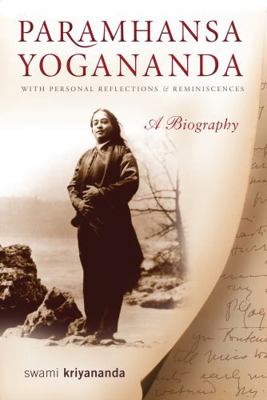
As Swami Kriyananda explains in Paramhansa Yogananda: A Biography, “One who makes it a practice always to analyze his own motives, to catch any self-justification in the bud, and to accept always with an open mind the possibility that he has been wrong, will direct his footsteps unfailingly toward the ultimate Goal. Such a person will act always without personal motive, to please God.”
Yogananda often counseled that to see yourself as a “sinner” is a greater sin than the negative actions themselves. The goal, after all, of Self-realization is to recognize one’s true Divine nature and live that truth wholly. The pitfall of introspection comes when we look through our human eyes alone and see only our imperfections. And as many will attest, what we focus our attention on will increase, not decrease. Let us, instead, view ourselves through the lens of the Divine. Only then can we embrace the entirety of ourselves with love, approach with humility and hope, and subsequently, find the freedom to change.
There is a place on this earth where friends come together, live side by side, and support each other in their individual search for God. Not a cloistered monastery or ashram only for those who renounce the world, a place for everyone. In fact, there are several such places. I have the great good fortune of being born into one such place – Ananda Village, the first of now eight Ananda communities around the world.
It all started on a dark and snowy night, just five years after the whole place had burned to the ground. In fact, because of the fire that tore through Ananda Village in 1976, I was actually born in a make-shift ashram in the nearby town of Nevada City, California. It took another five months for my parents to secure one of the newly built dwellings in Ananda Village proper and move our little family of four into the community.
My early memories are filled with more joy, magic, and adventure than I could possibly share in a single article. Suffice it to say, being raised in a community founded on the principles of Self-realization and filled with the kindness of people seeking a personal relationship with the Divine is a gift that keeps on giving.
Paramhansa Yogananda, whose teachings the Ananda communities are founded, once said, “Environment is stronger than will.” It is a strong statement, and one that has proven true for me again and again. When I set myself in an environment that supports the life I desire, it manifests with greater ease. That’s why I workout better in a gym, sing more beautifully in a temple, study better at the library, and meditate deeper in a sacred place.
This was such a challenge during the pandemic, right? For years, we had to set our homes up as a supportive environment for work, school, rest, and play.
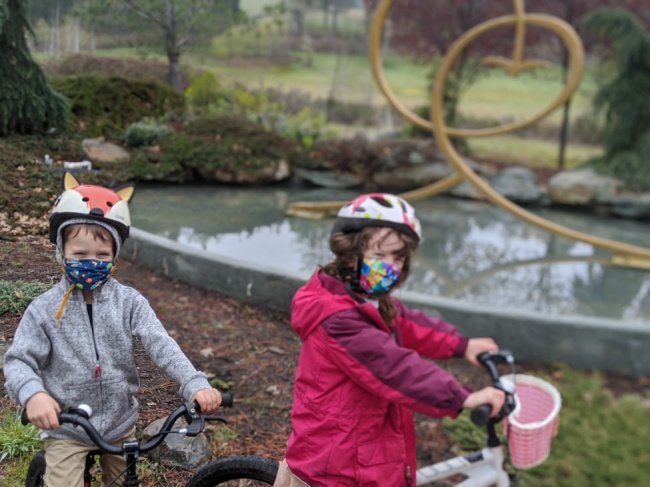
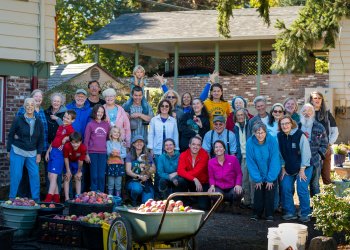
Today, I live in the Ananda Community in Portland Oregon with my family. This is one of the most beautiful places I’ve had the joy to reside. When you enter from the quiet street, you are greeted by the lush landscapes leading up to home-like apartments, each unique yet harmonious. Smiling faces are often seen, as residents of the fifty units come and go in their daily activities. Many of us eat together on Sundays in the Living Joy Center, many meditate together in our little chapel. We host kirtans on the lawn in summer time and annual work days where we spruce up the community together. And while life continues to do its usual ups and downs, we all know that we are surrounded by a community of souls who care for our highest good.
Living in community supports my life in more ways than I can count, but today, I thought to share my top five:
Peaceful vibrations: as soon as I enter the property I can feel the shift. A soft peace and a sweet joy are permeating my surroundings.
Deeper meditations: when I am here, whether in my home or in the chapel, my meditations are deeper. I believe it is a result of 30+ years of meditators who have come before and uplifted the environment here.
Spiritual friendships: whether on this path or another, those who live here are all seekers. Friendships here are rooted in this shared search for the Divine and it makes for lifelong bonds.
Joyful service: there is nothing more fun or bonding than cooking a meal together for twenty, or pruning fruit trees together, or painting signs. My family loves workdays so much, we treat them like a national holiday! We toss on our overalls, pull out our gloves and tools, and are nearly always early to the coffee and muffin gathering and prayerful opening circle.
The long haul: for me, life is about Self-realization, the slow and steady journey toward my truest and highest self. To live among others with a similar purpose helps me remember this when I have become distracted, and be inspired when I need a lift. It’s like my favorite African proverb, “If you want to go fast, go alone. If you want to go far, go together.”
Now is the time of resolutions, a time for making promises that are notoriously broken within weeks. Here in Portland, we’ve had an epic ice storm to contend with as we try to maintain ours! New Year’s resolutions are not simply a social construct. In fact, they are a natural expression of what is happening for us on an energetic level.
January 5th is the celebration of Paramhansa Yogananda’s birthday, a time for renewed inner commitment and fresh starts for many of us. January 14th the sun moves into the sign of Capricorn, which signifies the start to the astrological new year, according to the Vedic tradition. Capricorn starts the new year off with her commitment to hard work and her innate loyalty and ambition. As you can see, it’s a pretty good time to set new resolutions to achieve goals.
Paramhansa Yogananda in his chapter in Autobiography of a Yogi called “Outwitting the Stars” talks with his guru Sri Yukteswar about how a great master is so attuned to the energies of both themself and the universe around them that they know how to flow with the celestial influences, rather than against them.
So, how do we harness the time of Capricorn to actually succeed at these new year’s resolutions, rather than give them up before we’ve entered the sign of Aquarius on February 14th? For this answer, let’s consider both our personal experiences and the wisdom of the ages.
On a personal level, new year’s resolutions are hit or miss for most of us. I remember the year I decided to quit smoking cigarettes (2000). I woke one day in January and decided that they tasted bad and that I wasn’t a smoker. I quit that day. From there, I had to disassociate every activity that I previously associated with smoking – walking, drinking coffee, driving, socializing. It was primarily an exercise of re-visioning my life now as a nonsmoker. Once I had a clear vision of my new self, the habit slowly lost its power.
The teachings of yoga offer many valuable tools on the road to building new habits. Swami Kriyananda taught us that to make meditation a daily habit there are important things we can do such as creating an uplifting space for meditation, committing to certain times of day for our practices, finding others to meditate with, studying the lives of saints and masters, and most of all, cultivating the heart’s devotion to the Divine.
What all of these guidelines suggest is that to succeed at building new habits, it takes more than habit tracker apps. We must cultivate commitment on four levels:
The physical: what structure do we have in place to support the achievement of our new goal?
The mental: what ideas and attitudes are we cultivating to support the achievement of our goal?
The emotional: is our heart in it? Can we light the fire of our desire towards whatever we set out to achieve and then maintain that fire ever-burning?
The spiritual: how is this goal in alignment with our highest Self? What is the driving energy behind it? How is this helping in our soul’s evolution?
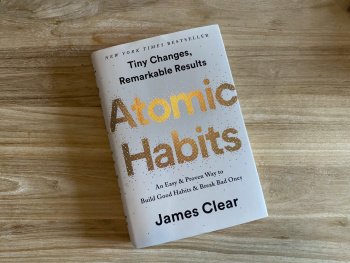
In the popular book Atomic Habits: Tiny Changes, Remarkable Results, James Clear has a number of excellent suggestions about how to make new habits stick. At the heart of his thesis is this universal truth: who you believe yourself to be drives the daily actions that accumulate as habits to create your life.
So, if your resolution is about deepening your spiritual life, it is wise to consider what you believe about yourself as a spiritual being and what you think one ought to look like. One common pitfall on the path to creatinghabits of spiritual practice is the belief that to be successful, one must look a certain way, act a certain way, and feel only certain feelings.
The great saints are excellent teachers on this subject for they come in every imaginable shape and size and personality. As we study their lives and our own, we come to see the Divine dancing through a myriad of forms. Behind each one, we recognize the consciousness that animates the dancer. And thus we begin to redefine what it means to be spiritual and set ourselves up for truly successful resolutions



 In Michelle Obama’s most recent book