Author: Surendra James Conti

  • Many Are the Ways

    Many Are the Ways

    “Seek ye first the kingdom of God.” In these few words, Jesus was offering his single most important instruction, promising that “all things” would accrue to such a seeker, things not of this world but better than anything in it.

    That seeker might well ask, “What is the way? Is there only one?” In truth, the ways are many. We know about prayer and meditation. At least we know they’re the first things we’re told to put first…. as are kindness, generosity, unconditional love, compassion, forgiveness, selfless service, renunciation, adherence to dharma, and willingness to answer the call of need where needed. To practice any one of these is to seek first the kingdom of God, as each leads the way to the others.

    “As above, so below,” Swami Kriyananda reminds us, “for that which works best on one level of life is often the best guide to what will work best on every other level. 

    This is beautifully illustrated in a true story about a humble Scottish farmer who was plowing his field when suddenly cries for help shattered the day’s tranquility. Without a second thought, he raced to where someone was obviously in distress. What he found was a child struggling in a swamp, trapped and in fear of drowning. Without hesitation, the farmer, whose name was Fleming, risked his own life to bring the child to safety. 

    The next day, a luxurious car rolled up to farmer Fleming’s modest home, and out stepped a distinguished gentleman, the father of the boy who was saved. The father offered to repay the farmer handsomely for his brave act of rescue, but Fleming refused the offer. “The rescue was my duty,” he said. “Humanity has no price.”

    Just then, the farmer’s own son appeared at the door. The gentleman said, 

    “Then let me at least do this. I will fund your boy’s education at the finest schools, ensuring that he gets the same opportunities as my own son.”

    Gratefully, the farmer accepted the offer, realizing he could never provide his boy such an opportunity himself. The son, whose name was Alexander, excelled in his studies, went on to attend medical school in London, and in 1928 was responsible for one the important breakthroughs in medical history. Alexander Fleming discovered penicillin, a huge advance against various infectious diseases, and for this he was also awarded the Nobel Prize.

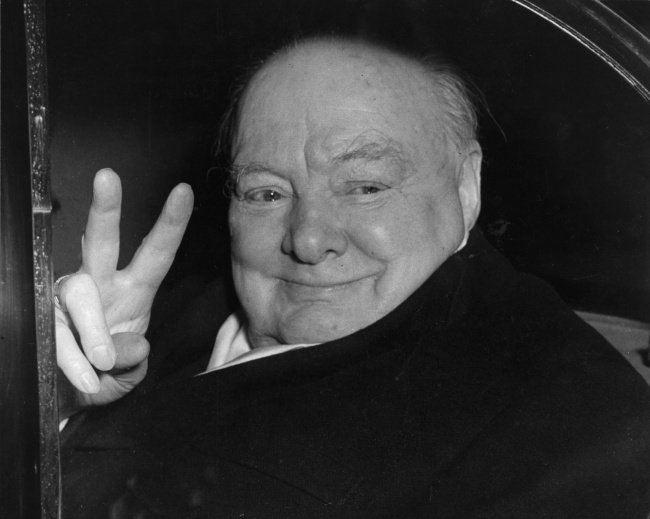
    But here’s where the story comes full circle. Winston Churchill, who would become the British Prime Minister who led his nation through its darkest hours of World War II, once nearly died of pneumonia. Many believe it was penicillin that saved his life. And, even more to the point, Winston Churchill was the boy that farmer Fleming had saved from drowning. 
    First things first. Sometimes it’s an act of courage or kindness that ripples through history, connecting lives in ways we could not imagine. You never know where a selfless act might lead far into the future or even tomorrow. Seek ye first to be as the one who gave this instruction, and all of true worth shall in time be yours.


     

  • Life Is a Stream Dream

    Life Is a Stream Dream

    One of the oldest pieces of American music, which is still sung today, is a simple little
    ditty that every American child learns. It is actually a nursery rhyme that was written in
    the 1850s and was later put to music. If you grew up in the USA, it is one of those songs
    you never forget, even if not having sung it for fifty years.

    Row, row, row your boat,
    Gently down the stream,
    Merrily, merrily, merrily, merrily,
    Life is but a dream.

    You’re probably singing it to yourself right now. The melody and lyrics are light and
    cheerful, seemingly of no significance except for the smiles they invite. But I wonder
    how many of the millions of us who have sung this song have tuned into its profound
    counsel. There is not a wasted word in the whole eighteen. Even those that repeat,
    repeat for a reason.

    “Row, row, row your boat.” Give yourself energetically in body, mind and soul to your
    duties, relationships and responsibilities, and especially to your spiritual life. Rowing
    your boat is devoting yourself to your highest potential.

    “Gently down the stream.” But row relaxed. Enjoy the experience. Steer your course to
    stay in the natural flow of it. Be attentive, attuned and at ease, never tense or resistant.
    “Merrily, merrily, merrily, merrily.” The repetition of this one word is intended to drive it
    deep into the singer’s subconscious mind. We’re affirming a positive outlook, prompting
    ourselves to look for the opportunity and joy in whatever comes our way. Happiness is a
    choice, and we can choose it even in the most difficult situations. Be merry, and you will
    be streaming with a lighter stroke instead of rowing against it in a sweat.

    “Life is but a dream.” It’s a banner line to remind us that nothing sensory, nothing that
    calls us ashore to seek our happiness there, is anything but a bubble that is bound to
    burst. The lure of life beyond the stream – beyond the flow of energy in the astral spine
    – is baited with false promises that are certain to disappoint.

    We are in this dream to meet and merge with the Dreamer, to row with loving care to the
    welcoming Sea of Bliss. Merrily, merrily, merrily, merrily makes it the dream it is meant
    to be.

  • Eyes on the Prize

    Eyes on the Prize

    We live in a world that celebrates multi-tasking. Getting hired for any management position seems to make this a priority skill. The presumption is that it facilitates productivity.


    As any parent or teacher of small children knows very well, situations often arise that interrupt one’s focus. But is multi-tasking an optimal design for attentive living, for managing stress, for achieving success? Consider the creativity, inspirational impact and enormous body of work of Swami Kriyananda – his music, books, lectures, whole communities – all brought to life with total focus, one undertaking at a time.  

    Can you multi-task while meditating? It curses the intended effect. Concentration and stillness flee the scene.


    An axiom often repeated by Paramhansa Yogananda is another key to success: “The greater the will, the greater the flow of energy; and the greater the flow of energy, the greater the magnetism.” Whatever you want, you have to act with commitment, confidence and courage. The weaker the will, the weaker… You get it.


    Another secret of success is self-study. What is it that you want? If you have failed to achieve it, why? Yogananda would constantly remind his disciples, “The season of failure is the best time for sowing seeds of success.” Get back on that horse, but with a clear understanding of what will keep you from being thrown again. Too often we approach a challenge with the same mindset that didn’t work the first time or the second or…. Stop! It’s time to rethink what you thought.


    With humor and truth, probably from an old Reader’s Digest, a one-liner claimed that when you want to get somewhere, you have to know three things: where you came from, where you are going, and where you left your keys. 


    Ultimately, of course, the vehicle is oneself, the destination is Self-realization, and the keys are the principles that comprise a dharmic life. But in our multi-task society, even with the best intention, help is needed to keep us from driving in materialistic circles, unable to locate the exit ramp. I, like many, once believed that I could find it on my own. I wasn’t ready for the true Guru to appear.


    Worldly goals need not be at the expense of spiritual gain. They can, indeed, serve a higher purpose than personal ambition and self-indulgence, thereby serving also to invite the Guru’s appearance. The question then is who is given the lead, you or the Guru? “Open your heart to me,” the Guru says, “and I will enter and take charge of your life.” Are you ready for that too? How quickly do you want to reach where the Guru wants to take you? How willing is your will to let go of what’s in the way?


    The Guru is an emissary of God. It is God’s guidance that is offered, along with God’s infinite abundance. Success in this world, no matter how great, vanishes the moment we die. The multi-tasker is instantly redirected to a whole new dimension of focus where that skill is of no use. Better to seek the true success of achieving our soul’s freedom. Eyes on the prize.

  • How to Prepare for Losing Your Mind

    How to Prepare for Losing Your Mind


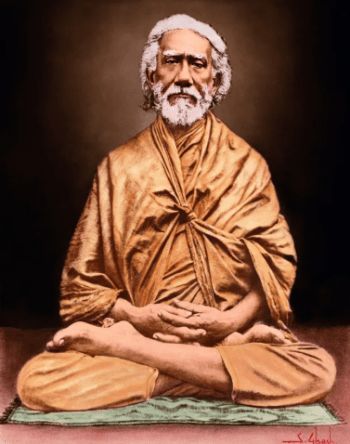
    “Learn to behave,” Sri Yukteswar admonished. I picture his stern countenance
    punctuating his words. We don’t know if “Learn to relax” is something he also said, but
    that would have been another key piece of advice, an unsung part of learning to
    behave. He might even have said it with a smile.

    That last part is important for another reason, too. Relaxation helps a lot in our later
    years when proficiencies begin to pale or disappear altogether. If you have reached
    middle age, you have already started surrendering bits of your short-term memory to
    temporary oblivion, and within a couple of decades, more of that oblivion will no longer
    be temporary. It’s what happens. The machinery wears out.

    Long-term memory isn’t immune either. The farther away we are from when a memory
    was made, the blurrier or less certain it becomes. I have memories that my imagination
    may have partially manufactured – I suspect we all do – especially the ones of a talent
    or achievement, wistfully inflated in recollection.

    With gradual mental slippage, we are dealing with a condition that tests our self-image,
    patience and composure. Ya gotta love it or it hurts.

    Speaking from personal experience, these lapses are sometimes an invitation to a
    peculiar stream of  cerebral activity that is difficult to explain. Unrelated thoughts,
    randomly selected by my subconscious librarian, tumble into and through the movie
    being screened in my brain, leaving my objective critic to wonder what’s going on. The
    script seems out of control, as if invaded by one from some other movie that wasn’t on
    the playbill.

    If any of this sounds familiar, the trap to avoid is trying to make sense of the
    unannounced movie’s plot. It’s strange. So what? Let it be. Elderhood tends to include a
    slow loosening of our grip on our mind’s projections. Better to enjoy the mystery of it
    and its entertaining chimera.

    The best way to oppose this occasional onset is without tension or mourning, focusing
    on what is before us, the countless marvels of life and the blessing of you being one of
    them, a pilgrim in the vast, amazing dream of it.


    More of our best memories will remain accessible that way too, whether accurate or
    wishful, and we will come to our flight from here in spirited readiness, assured that when

    we’ve moved on to wherever is next, all that we have been, unabridged, will be archived
    for our light body to file and carry forward in total remembrance. Regret nothing and the
    next movie will be even better than this one.

  • Who Knows?

    Who Knows?

    “Knowledge is power,” said Napoleon. Was he right?

    Well, that depends on what you know, as opposed to what you think you know, and whether you use it wisely. 

    Worldly power is acquired mainly of influential position and forceful personality. There is no guarantee, however, that a person of power has the will or capacity to see things correctly or act wisely. When power goes rogue, as it often does, its relationship to knowledge goes away. 

    Knowledge and power simply do not equate, at least not in the world as we know it. If they did, our human history would be dramatically different. We would not be witness to its endless repetition of our foolish ways and follies. 

    Either knowledge has been devalued as a virtue, or we do not understand what true knowledge is. Big hint: the latter is a pretty safe bet. In the tug-of-war between our egoic desires and higher awareness – from which true knowledge is received – it is our higher awareness that tends to lose its footing and land in the moat. 

    True knowledge is not what’s acquired of books or internet searches. It is not a reflection of intelligence, an accumulation of factual information, or the result of data analysis. Nor is it even a product of the conscious mind. It is an experiential awareness consistent with the principles and ways of how the cosmos works. It is received in a moment of superconscious, intuitive connection, which is how, in a flash, Einstein received the Theory of Relativity. 

    Needless to say, not every intuitive message is of such monumental importance, but that is how it works, and that is why the art and practice of meditation is a key to its acquisition and game-changing application. 

    True knowledge cannot be created. It’s a gift of grace that yields its treasure only of our attunement to the flow of divine wisdom. No other cipher unlocks it. True knowledge speeds one’s spiritual growth. It has no ulterior mission. Its centeredness in God is sufficient to its worth.

    In his magnificent poem Samadhi, the great Indian master Paramhansa Yogananda refers with divine recollection to the true meaning of knowledge as power: “… the storm of maya [delusion] stilled by magic wand of intuition deep.” 

    Samadhi by Nayaswami Jyotish

    Knowledge is not power until it delivers the capacity to see and dispel the storms we unleash by our delusional thinking. It is not power until it comes from clarity born of divine communion. And power is not power if not of self-control. 

  • We Who Measure 

    We Who Measure 

    Do you judge? Of course, you do. Judging is how we compare and contrast, how we choose between this and that. It’s a habit as automatic as breathing. Every action, thing, person and experience is measured against what was, wasn’t or might have been. 

    Consciously or not, we spend our waking hours measuring what enters our sensory world: the flower that is lovelier than the one beside it, the haircut that looks much better since it grew out, the athlete who should have retired at the top of his game, the mind that isn’t as facile as it once was.

    The egoic self is host to an endless stream of thoughts, and each of them, to some degree, gets a thumbs up or down. Our attitude and outlook at any given time is largely a reflection of our conditioning, preferences, and wishes. 

    Why is it that we feel punished or deprived when something we want doesn’t come to us, or when something we prize is taken away? Isn’t freedom, as the song says, just another word for nothing left to lose? The key, as our gurus counsel, is to recognize that we are freer when finding less to judge, worry about or tether us to delusion. 

    How much do you possess? How much more do you want? The less the better. When we don’t have much, there is more of us for everything else: life, love, and the precious moment at hand. 

    But what if the moment at hand isn’t likeable?  Many of those that come to us uninvited and unexpected are unwelcome. Yet, as devotees seeking the highest within us, we need to realize and appreciate that nothing is unlikeable except as we miss the point of it.

    Spiritual growth is a measure too. It’s an overcoming of biases and desires that suppress the soul’s emergence, binding it to the vagaries of the world and its troublesome dual nature. Lao Tzu praised as noble in spirit the person of self-awareness who strives more each day to be free of impeding judgments, accepting things as they are and thus rising above the pull of attachments and their disappointments. Such is the process of inner renunciation that our gurus have urged us to adopt, for it is also the measure of our love of God more than His finite gifts.

    There’s a lot working against us, to be sure. Society does not cheer us on as we turn away from its acquisitive urgings, seeking to meet our needs alone while rejecting its material emphasis and unfulfillable promises. 

    It is rightly said that everyone wants to be happy and avoid pain. We must only go about these objectives wisely, for there is nothing here to decipher that isn’t essentially simple. As we accept more, judging and measuring less, we discover the happier difference.

  • Life and the Five “A’s”

    Life and the Five “A’s”

    My life, when it’s on track, adheres to a pattern of spiritual growth that guides me increasingly to the flow of grace. That is to say, good things happen when I’m true to what’s good, even when things may not seem so good at the time.

    This pattern, as I perceive it, falls neatly into five steps, all of which begin with the letter A: Attitude, Awareness, Acceptance, Attunement and Action.

    Before getting into each of these qualities a little, I have to mention, as I’m sure would be fairly assumed, that I haven’t always met the challenge of completing the five-A sequence. Acceptance and attunement are hurdles that one’s desires and attachments tend to resist surpassing. The phrase “Work in progress” continues to apply!

    So, how do we get from Awareness to a high-minded, positive approach to life? For starters, it helps to trust that God knows what He is doing, and that nothing delivered to our doorstep is by mistake. Having the right Attitude, even when tested severely, is essential to the journey of Self-realization. And this opens the door not only to further Awareness of why things are as they are, but to Acceptance of every challenge as a gift from God for our spiritual evolution.

    Acceptance of that reality then serves to raise our consciousness to in-sync Attunement with the Spirit that is implicit in all that is. And that brings us to Action. Up to now, we have set the stage for things unresolved to resolve, but this is not going to happen merely because we have our ducks in a row. Understanding an issue, no matter how complex, is essentially just information until it is translated to an actual expression of will power and energy. 

    Every situation comes with a choice. What am I aware of, and what is my attitude toward it? Have I read its meaning correctly, and do I accept the reality of its message? Am I attuned to my highest self as I face into it, and what is the action I am willing to undertake to make the most of the opportunity?

    When this five-step sequence becomes our way of being, it is no longer just a descriptive pattern. It is who, as seekers, we allow our soul to lead us to be.

  • First Things First

    First Things First

    Jesus said, “Seek ye first the kingdom of God, and all these things shall be added unto you.” He didn’t mean earthly stuff, he meant much more.

    Thankfully, there are several first ways to seek that divine realm. We know about prayer and meditation. At least we know that, along with devotion, they’re the first things we’re told to put first. But we can also apply them to our practice of everything else, even our menial tasks and mundane routines.

    Seeking first the kingdom of God is less about behavior than it is about a consciousness. It doesn’t require hours of formal sadhana, but it does require taking God with you wherever it’s your karma to be. There’s a subtlety to that that we express in qualities such as love, kindness, generosity, self-offering, and a readiness to answer the call of need when and where we are called.

    Swami Kriyananda wrote, “As above, so below, for that which works best on one level of life is often the best guide to what will work best on every other.” 

    To illustrate, I often think of a four-word reminder that was the motto of my friend Bill Grady, also known as Premdas. “Look for the good,” he would say. 

    What could be simpler or more profound. Look for the good and see God’s presence in all. Is there a better “first” than that?

    In the course of our lives, challenges arise that in some cases test us severely, and at Spiritual Renewal Week this past summer, Shurjo gave an exceptional talk with this in mind. He told a number of stories whose conclusion was not a conclusion, because nothing ever really is. What comes next? “We’ll see,” he reminded us. 

    Is it a terrible blow if a broken leg keeps a runner out of a gold medal race? We’ll see. Maybe it keeps him out of being called to fight in a war in which countless others will die. Or conversely, we’ll see if someone’s good fortune in winning the lottery turns out to be financially or spiritually ruinous.

    First things first also includes the practice of humility, the simple recognition that God is the Doer. God acts through instruments, the humblest ones especially, because humility helps to overcome our sense of “I” and “mine.” We suffer in this world only when our sense of possessiveness intrudes, because what we want or call our own is mortal and must eventually be taken from us.

    Swami Kriyananda emphasized first things first in his song The Secret of Laughter. “Sing when the sun shines, sing when the rain falls, sing when your road seems strange. In a tempest, seize the lightning flash and ride the winds of change.”

    Seeking first the kingdom of God has no “We’ll see” to regret or fear. It takes us beyond the duality and disappointments of outward activity, into the inner sanctum of peace and calmness, and into its gathering bliss. What of this world could be better than that?

  • Learning to Count What Counts

    Learning to Count What Counts

    Does it count as a “been there, done that” if you don’t remember much of anything about it? If it’s something you’ve read or watched, remembering only that you did and almost nothing more, is it still part of you?

    Aging takes a lot away. There’s no getting around it. When our auto-save is no longer saving where we’ve been and what we’ve done, except perhaps in scraps of random detail, a calm adjustment is in order, lest we suffer the loss as an aggravation or sadness.

    Do you remember enjoying what you read or watched, that where you were was inspiring? Isn’t that more important than a play-by-play description?

    We assimilate more than we realize. A “wraith of memory” remains, as named by neuroscientist Maryanne Wolf, and it helps to shape the attitude and manner of the self we become.

    Now, what was I about to write along that same line? It has suddenly fled my brain to Who Knows Where!

    I could dwell on that, and I have, but to what use? We set ourselves up to be troubled when expecting our brain to manage more than it can. Its cells gradually lose population like a city adversely affected by a changing climate. With or without our approval, cell-citizens leave. 

    Sometimes our missing connections return for a while when the moment of needing them has passed – a name to go with a face, a title to go with a book – but accepting the disappearance is the greater need. We are not less for the loss, because none of that storage speaks to why we are here. Memory gaps and even mental decline are superficial events that matter not to the soul.

    What counts is our attunement. Our love, expressed without reservation. Our being the best we can be.

    When a devotee remarked that it was hard to see Kamala Silva in the last years of her life with significant dementia, Swami Kriyananda put this in divine perspective. “It’s only her mind,” he said matter-of-factly, seeing who she truly was in spirit and sweetness. As she is seen by God.

    Let us not count on what doesn’t. What counts is the true nature of our being, and our only real job here is to bring it into sync with our soul’s purpose. Remembering to live from our essence requires no recollection of anything else.

  • Make Haste Slowly

    Make Haste Slowly

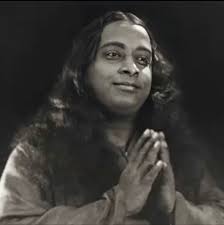
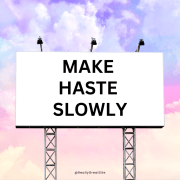
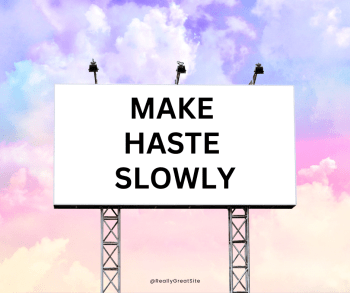
    The pace of life is ours to make. Whether fast or slow on the outside, our attitude on the inside is ours to choose: anxious, unruffled or an adjective in between. Paramhansa Yogananda would remind his disciples to “make haste slowly.” In other words, strive to be “actively calm and calmly active,” and in a manner that is “even-minded and cheerful.”

    Yet, most folks turn this life into a rat race. Busy is the norm, and that can be good, but when busy is more about adding stress, competing for perks, or keeping up with the crowd, where’s the calmness? Where’s the joy?

    Most of us have much that requires our attention every day, and things can pile up. Sadly, though, our approach to meeting the challenge is often merely out of habit and routine. Getting things done is without a sense of in-the-moment freshness. The goal is to get our have-to’s out of the way so that we can get on with our want-to’s. 

    Thus, it is not surprising that our social conditioning, aimed at getting ahead and getting what we want, tends to block us from our greater creative potential and solution consciousness. And for what? The world appears to be in a rush for what mostly remains out of reach, and is not fulfilling even when attained.

    In short, we seem to be running around for little more than the sake of running around. 

    Those of us in the West in particular have been trained to be impatient, on the premise that it drives us to succeed sooner than later, but it can also lead us into decisions that would fare better if based on a patient perspective. When we rush into relationships, or into choices that lure us with more comfort and convenience, the result is likely to speed us into what we have sought to avoid.

    Do you ever worry? Rushing and worry are joined at the hip. We want things to be certain, and when something is not, we commonly hit the accelerator to get beyond it, worried about the outcome if we don’t. People today even rush through their good times – “It’s been lovely, but I have to go.” – because habit says we need to find out what’s next.

    The oddity in all of this is that none of us wants to be as we are when rushing. It’s exhausting. But instead of slowing down and living more from within, the majority turn their hectic pace into a source of pride, a kind of consolation prize for continuing to endure pressure, tension and worry.

    Trial and error reveals what we are here to learn: how to live well, both spiritually and successfully in this world. We just need to learn it. Thank you, Master, for your divine patience in guiding us onward and upward to that learning. 

    Make haste slowly. The snappier, the better.