Author: Surendra James Conti

  • God Is There. So Is Someone Else.

    God Is There. So Is Someone Else.


    “I just couldn’t help myself.”

     I suspect we have all resorted to that excuse at one time or another. It is even an established courtroom defense, known as  “irresistible impulse,” presented as a mitigating circumstance and a plea for mercy. 

    I was remembering this from my year in law school, aware of how difficult it is to resist an intense temptation. Or an urge to get even for an act of abuse. 

    Though I’ve never had to contend with a lurking nemesis like Moriarity to Sherlock Holmes, it struck me that someone in my life has bothered me since I was a kid. Oddly enough, he thinks of himself as my best friend, because admittedly we’re very close. He is my own Ego, and out of genuine admiration for his persuasive methods and relentless nature, I have named him with a capital E.

    I owe the Ego my thanks for much of my motivation, yet he’s also the cause of most of the trouble I have gotten into. Even today he can catch me off guard when his counsel is what my urges are wanting to hear. “Trust me,” he says, “I know what you like and I’m here to help you get it.”

    The Ego’s steady presence in my life raises a number of questions: Is he merely a mischief-maker that God has planted in me for amusement, or does he offer qualities that would serve me to develop? Am I stuck with him forever, or is there a way to lose him?

    It turns out the Ego in history is an ancient player, whose origin dates to India’s epic saga, the Mahabharata. Long before he was known to Freud and others by his three-letter name, the Ego was born to royalty as Bhishma, the noblest of princes. His is a story of great inspiration…until one fateful choice led him to the side of delusion, thus leading us also into our own battle with it.

    Bhishma in the Mahabharata

    The Ego means well and would be glad if we never suffered from following its advice. But its perspective is finite, short-sighted and fleeting, sure to result in a measure of letdown or worse. 

    So, what are we to do? How are we to coexist without its influence messing things up? Our teachings and practices clearly offer more than the Ego can: lasting inner peace, love and joy. But the tasks they require us to undertake are huge, such as replacing what we want with wanting what we get, and serving others in the spirit of nishkam karma, non-attachment to the fruits of our labors. 

    A large part of our job in this life is to unlearn much of what we have been conditioned to accept. The more we do this, the more we gain against the Ego’s sway, for it has a nemesis too: our self-control. As we apply it, the Ego yields to its leash. Lifetimes more may be needed to undo its grip, but even the Ego itself, born of nobility that unwittingly went astray, secretly roots for its demise, the day it surrenders to the greater good of the soul. May we disidentify with it and help that happen.


     

  • Real or Not?

    Real or Not?

    We see, and we believe, isn’t that right? Look, there’s a chair. Yep, right over there, that’s a chair. We can sit in it too. But is that enough to say that it is real?

    Real or not, it would be extremely unwise to ignore the possibility that chairs and other perceived objects exist. An oncoming train will quickly dispatch both you and your quantum theory if you choose to stand in its way, expecting its atomic particles to suddenly behave as waves. Better to believe that a train is a real train.

    But there is a greater reality than what our senses can experience, and failing to adhere to it causes problems that nag and never quit. This greater reality is the spectrum of the soul. Yet, our tendency is to overlook it. 

    The material world cannot be denied. As we are to live on earth, the material world is where that living must be. But here’s the rub: To abide in material consciousness, as society has trained us to do, is to fear an end to what it can offer, and end it will. 

    Moreover, this state of mind kindles material desires, which flare into attachments, which spur the creation of possessive habits, which encourage more of the same. Hence, the snare of suffering’s web that we stumble into. What a choice to make! But who of us, more or less, has not made it?

    One of the lessons of the Bhagavad Gita is that none of us shrinks, but rather expands, in ousting these inclinations. Ingrained as they may seem to be in our egoic perceptions, they are merely expressions of energy which, when directed inward instead of outward, diminish our suffering and add to our joy. The self is not lost, it is lifted.

    Likewise, it should motivate us that life on earth is but a series of lessons that lead us higher to the promise of infinitely more. We cannot die except to the millions of wishes that stand in our way. It is hardly sane to hold fast to their fleeting amusements, to endure with disappointment their limitations. And yet that is what we incline to do, ready to excuse with reason the reason why.

    Wrestling with our restless thoughts goes on. But as every saint and avatar has assured us, a willingness to engage more deeply, to seek and follow the guidance of God’s inner call, guarantees a life of no regrets. 

    For each of us, regardless of where we are stuck, the direction is one, the destination is one. Let us at least understand where we are headed: out of our heads, into the wilds of the soul’s inner world, into the kingdom of Oneness. The sooner we turn our focus to that awareness, the sooner it graces us with its blessings. Like all who wander delusion’s desert in search of the Promised Land, we are destined to find our way out, arriving at last at the realization of Self. We are headed Home, the sooner the better.

  • Facing Into the Hard Stuff

    Facing Into the Hard Stuff

    A friend who is prone to depression asked me a question that is difficult to answer
    easily. It’s a common question: How do we get through a difficult loss without becoming
    depressed when depression is our conditioned response?
    The uneasy part of the answer is that no easy answer exists. In truth, it is going to
    include a dose of even more difficult news that is best absorbed before the loss occurs.
    Nothing lasts.
    I should state here that I am not a therapist. I have studied grief, lived with some of it
    myself, taught workshops on death and dying, and listened as a spiritual counselor to
    many who were feeling overwhelmed by the anguishing loss of loved ones or promising
    dreams. I can only share what I’ve learned from experience along the way.
    Okay, to the uneasy truths… We need to prepare for certainties that are preordained.
    Life happens according to its agenda, not ours. Furthermore, everything finite – people,
    our pets, our own bodies too – comes with an expiration date engraved somewhere
    inside it. This isn’t personal, so don’t make it that.
    If we know these truths going in, we can get through the toughest blows without losing
    our balance, and get out at the end with gratitude and a loving smile for all that life has
    given us, blessings and adversities alike. Because all are blessings to grow on.
    Grief, as many have observed, is not a just-get-over-it experience. No one gets a free
    pass. But how do we keep it from becoming a ball and chain? Again, it isn’t a personal
    afront or punishment. Grief is meant to be absorbed, uplifted and assimilated calmly
    over time. When you give it a resting place in your heart, gratefully embraced, it stops
    beating you down.


    We are emotional creatures who tend to let outward events whirl us around.
    Circumstances are neutral, Paramhansa Yogananda said. It is we who submit to the whirl of meaning we
    give them. This can be exhausting when the meaning given is akin to assault and
    battery. “Don’t do that,” we tell ourselves, but often we’re unable not to. Our habit
    overrides our will.
    I shared in a recent piece that it helps to see things as already broken. That includes
    relationships, the mortal aspect of which is bound to end sooner or later because
    nothing mortal doesn’t. Is that cause for paralyzing grief, or could the truth of it add a
    deeper dimension to our enjoyment of what it is while it is?
    Loving that people, pets and things are with us for only a while is a way of setting them
    free and ourselves even more so. The longer we live, the more death we must accept.
    The alternative has no upside. It just hurts.
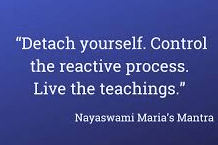
    As Maria Warner said to her loving husband Devarshi as she prepared them for her
    departure, “Detach [from the hard stuff ahead]. Control the reactive process. And live
    the teachings.”


    Love never dies. Why let its transition to another plane of being drive us into an agony
    that holds us hostage? Grieve, yes, but lovingly guide its pain to where it can soften.
    That’s where the upside lies, where wishing for what used to be can move to a sweeter
    place. Not easy, but suffering long is harder and worse.

  • Remember to Self-Forget

    Remember to Self-Forget

    I am of a “certain age,” as they say, when memory becomes less reliable. This can be hard to gracefully accept and adjust to. I can recollect in my youth having almost photo recall, when I could bring all kinds of information from storage to speech in an instant. Not so today. I depend more on writing notes and lists, which works fairly well when I remember where I’ve put them!

    I try to make light of these lapses – failing to think of a person’s name or where I left my keys – and I’m pretty good at letting them go. But the inconvenience can be… well, inconvenient. If you’re young and not yet dealing with this condition, trust me, your chance will come! 

    Driving around these days, we are likely to see a now familiar sign: “Road work ahead. Expect delays.” This is precisely the message I receive when slowing down to fix a cranial connection that has come apart. Suddenly there’s a flagger in the path of my mental acuity with a sign that says, “Stop,” and there I am, waiting for the signal to proceed, while the workers in my brain try to repair the link to wherever my thought was going.

    Most of us view the decline of memory with a measure of distress. Although it is largely a natural phenomenon, we tend to bemoan it, often with twinges of anxiety and vexation. Yet, even when a bit embarrassing, how important is this to our spiritual welfare and growth? Truly, it is not. 

    Several years ago I was returning from a month-long stay in India, bringing with me many things that belonged to my wife and me when we lived there. I was traveling alone with two 50 lb. suitcases, a 20 lb. carry-on, and a shoulder bag with wallet, money, cell phone, passport and boarding pass. 

    Getting from our ashram in Gurgaon to the Delhi airport at midnight became an awkward juggling act, made more problematic when five miles into the drive, I discovered that my cell phone was missing. Despite being almost compulsively careful to avoid such oversights, I had left it on a table where I was writing a thank-you note to my housemates before heading to the street and my waiting cab. On the way back to retrieve it, we hit some heavy traffic, and my nerves began to riot over the chance of missing my flight. 

    When I finally woke up what I was doing to myself, my focus shifted. Even if stranded for another day at the airport, how unfortunate would that be? Where would this episode fit in the longer rhythm of my life? Would I even remember it except as a story to share for a good laugh?

    What we really need to remember is to forget the voice inside us that causes us to lose our peace. 

    When I think of Swami Kriyananda, the trials of illness and betrayal he endured, and his enormous creative output in the very midst of them, what comes to mind above all is that none of that was ever about him. His self-forgetful attunement to God and Guru gave him what he needed when he needed it, and freed his inner peace from the onset of any disturbance. What he modeled for us was bliss under every circumstance. 

    It is tempting to excuse ourselves from that level of consciousness, to say that Swamiji was simply more advanced than any of us. Maybe so. But wouldn’t we like to be as he was? Remembering to forget ourselves is the “how to.”

    When “Road work ahead” causes cognitive delays or detours that take extra time and are out of the way, put it in perspective, and just give it a smile.

  • See It As Already Broken

    See It As Already Broken

    Have you noticed how often you fight with yourself? It’s usually over wanting to do what know that you shouldn’t, or should do and really don’t want to. If you step back and watch from a neutral corner, the battle that ensues can get pretty amusing.

    “I really want to do this.”

    “But you should be doing that other thing instead.”

    “But I really want to do this, and I’m sure it will be okay.”

    “No, it’s a bad idea, and you know it.”

    “Yeah, well, I’m going to do it anyway, because if I don’t, I will be in a lousy mood, and that would be worse than not doing it.”

    We may not be masters of Self-realization, but most of us are pretty good at rationalizing the pursuit of an urgent desire in spite of what our higher awareness can see as a karmic mistake.

    Renunciation – turning away from what we really want – can seem like a terrible austerity, especially if self-discipline is not one’s strongest suit. But in matters of worldly distraction, it’s the most important action we can take. Swami Kriyananda viewed renunciation as a great spiritual investment that would accumulate in value far beyond that of ordinary wealth. All we have to do, he said, is “spurn the tempting magic” of things finite and fleeting.  

    Spurn? Couldn’t he have just said to make a sensible attempt? Spurn is not a word that offers any slack. If you’re going to spurn what you really want, you’re going to need plenty of willpower to do it, more than most of us are accustomed to mustering up. 

    “Do you like nice things?” 

    “Yeah, I do.”

    “Lots of nice things?”

    “Yeah, absolutely.”

    “How many nice things do you need?”

    “Well, I don’t know. Maybe I need to keep acquiring more until I figure that out!”

    Isn’t that the answer that most folks would give today? Renunciation is the easiest thing in the world to put on hold.

    “Yeah, I’ll get around to it one of these days, but I’m having kind of a tough time lately, and a little ‘tempting magic’ would really hit the spot.”

    So here’s the burning question: What is going to persuade us that spurning our compulsive tendencies will pay off like he says? The answer, of course, is to prove it to ourselves, one compulsion at a time, the easier ones first. Note the inner peace and joy that each victory brings.

    In moving from attachment to letting go, there’s a Zen way of looking at things that I find very helpful. Picture yourself holding your favorite cup. Feel how perfectly it fits in your hand, and say to it, “You are my favorite cup… and you are already broken.” Because someday it will be broken, or lost to you, or you will be lost to it. 

    Renunciation, whether of things, certain relationships, even the body you inhabit, is about accepting their ultimate impermanence. Truly enjoy your life and its countless gifts, think about doing more with less, and see what you have as already broken. In so doing, you free yourself of the stress, sadness and regret that might otherwise trouble your emotional state. 

    Agonizing over a loss is like punishing yourself twice for what you told yourself was yours and no longer is. Where is the value in that?

    I don’t mean to imply that letting go of a difficult loss should be easy. We know that it isn’t. But be aware that the suffering we invite is mostly due to seeing things as ours, when in truth, nothing is ours except to borrow and give back. Adopting an “already broken” point of view makes every setback more even-mindedly manageable.

    And just to finish where we started, the next time you get into one of those fights with that noisy voice in your head, pause and look farsightedly at what it wants you to do. Might it not be wiser to avoid the tangle and tribulations of where its advice tends to lead? 

  • Noble Is As Noble Does

    Noble Is As Noble Does

    In my years at our Ananda Pune ashram, we followed each day’s group meditation and breakfast with a morning circle. My wife and I, with our staff and guests, would discuss the day’s projects and assignments, and then we would all affirm together, loudly at first and then more inwardly, “I will do my work thinking of Thee, Lord. I offer to Thee the very best that is in me.” 

    Imagine if governments and corporations did something like that. We wouldn’t need millions of laws and thousands of agencies to enforce them. The Golden Rule would preside, because in offering to God the best that is in us, it becomes our nature to serve our neighbors in that same spirit. 

    The real work of living well is not about building or fixing things, it’s about building and fixing ourselves. Attitudes, relationships, and commitments are the greater construction projects involved in creating a successful community, which creates a more successful you and me. A house is not a home if it is just a structure, even if it is a palace. You have to fill it with love and joy, otherwise it is a place of bare shelter only. 

    Likewise, a body is not a home if the person inside is unhappy, lazy, angry, greedy, or selfish. When that is the case, there is work to be done, and who of us can be called a finished product? We sometimes refer to ourselves as “works in progress.” What we need to keep in mind is that a work in progress implies that we are investing actual work in making the changes necessary for progress to occur! 

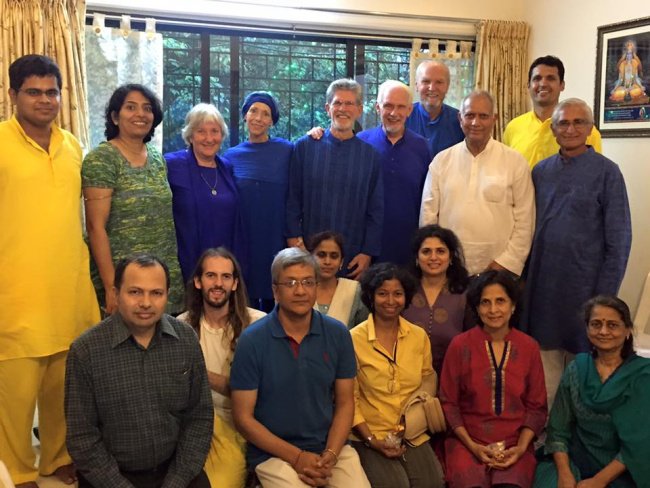
    Surendra with devotees in Pune

    Building a spiritual community, as we were endeavoring to do in Pune, is a gradual, ongoing process too. But in truth the idea of community does not require an actual community to exist. You can have it in spirit wherever you are. Community is serving and supporting each other for the welfare of all. It is doing the noble work of clearing away our egoic motivations. It is offering the best that is in us. 

    But what about those days when working with the right attitude seems like the most resistant work of all? Sometimes work gets in the way of how we would rather be spending our time, and we don’t exactly give it the best that is in us. 

    Years ago, Edgar Bergen was a popular on-stage ventriloquist, whose sidekick was a little wise cracker called Charlie McCarthy. Charlie was like the voice of the ego that chatters inside our head. As part of their comedy routine, Bergen was always making appeals to Charlie’s better nature, usually to no avail. Once, in urging Charlie to do a particular job, he said, “Charlie, a little work never killed anyone.” Charlie replied, “Yeah, but why take a chance!” 

    This life is a playing field on which we are opposed by our lesser nature. Working to overcome it is not only the way to reach our highest potential, it is also the way to a happier life. Good work drives out our pettiness, our moodiness, our worries. 

    I am reminded often of a quote from Thomas Jefferson, who was asked if he believed in luck. He replied that yes, he did. He said he had studied the law that luck obeys and attuned himself to it, with this pleasing result: “The more good work I do, the more good luck I have.” 

    We know of this life on earth that it’s been designed, not by accident, as a test of will, a test of courage, a test of attitude and behavior. Every day arrives with a new set of challenges, although most of them are simply repackaged versions of ones we have faced many time before, yet to be put behind us. 

    Does doing our best mean we’re bound to get what we work for? If that were true, we would be seduced – as many are – into thinking that lasting happiness is possible on earth. God’s intent in thwarting our ambitions from time to time is to lead us from that delusion to the realization that our ultimate freedom and contentment lie in seeking Him above all.

    “I will do my work thinking of Thee, Lord. I offer to Thee the very best that is in me,” because in that noble effort lies inner peace, joy and freedom’s way, and in nothing else will we find this to be true.

    The Noble New, painting by Nayaswami Jyotish
  • The Angel in the Tree

    The Angel in the Tree

    Are you your body-mind? It would certainly seem so. Every sensation we experience – taste, touch, sight, smell and hearing – reinforces that perception. But is there more to the answer than a yes or no can provide?

    We are raised for good reason to believe in the physicality of the reality that surrounds us, and our senses confirm its existence every minute of the day. Objects appear at different locations in space, and it takes time to move from one to another. You are there, I am here, and between us is a distance that can be measured. Everything appears to be separate. 

    But just as the body-mind is an object also, it needs a witness other than itself to verify it as such. Thus, as we set forth on our spiritual journey, and as this question of identity arouses our curiosity, the quest begins to discover who or what this mysterious witness could be. 

    But right off the bat there’s a catch. The witness is subjective. There is no “thingness” to find, and the body-mind struggles with what to make of its formless nature. Hmmm. Nonetheless, you’ve become intuitively aware of a possibility beyond your human reach. It feels like an identity that is not yet fully rendered. 

    As you think about where to look next, a second setback intrudes. Your ego makes a play to take the lead. “I am the body-mind,” it announces. “I am all you need or need to know. Trust me, and I will guide you to the good life.” Hmmm, again. The ego has been promising this for as long as you can recall, but in its pledge of many pleasures, disappointment and regret have never lagged far behind either.

    Looking around, you wonder if you have been hypnotized to accept a limited reality that is not having the happy effect you were seeking. 

    Then, out of the blue, a vivid childhood memory comes to light. You remember being given the picture of a tree and told that an angel was hiding somewhere within it. At first you saw only the tree: its branches and leaves and texture, until suddenly, as if by magic, the angel’s shape appeared in a layout of the leaves like a secret revealed. The angel had been there all along, merely hidden from ordinary vision. 

    An idea begins to dawn in you. The angel is like the witness, watching and awaiting discovery. It is your hidden nature, the consciousness at the core of your being. Your body-mind is merely its latest means of transportation, which you have fitted with various features and self-definitions. 

    Once you have seen the angel in the tree, your whole world looks different too.  The witness is seen as a higher aspect of yourself. Infinite possibilities continue to unfold. 

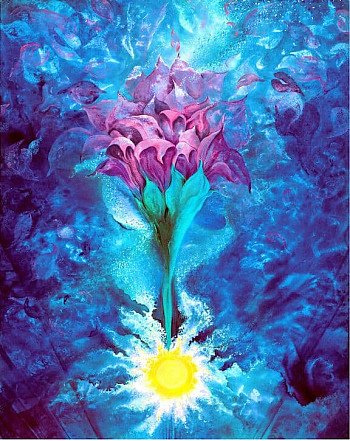
    Crown Chakra Blossoming, by Dana Lynne Andersen

    This entire new perspective is an invitation to a new and greater experience of truth and happiness too. It is an offer to enter the realm of the Self, where all becomes transparent, where the temporal is rendered eternal. 

    Yet, letting go of the ego’s point of view can still seem scary. We have attachments and unresolved fears that are deeply rooted in the dream of ourselves as all of those sensory features and self-definitions. Now, though, clarity and hope are in focus also, for in seeing the angel, we have learned to question the limits of our conscious awareness. 

    We are nothing if not divine. The depth and breadth of our latent awareness is inexpressibly vast, and it, as we allow, like the angel in the tree, is there to lift our spirits to discoveries of endless delight.

  • It’s Complicated. Or Maybe Not.

    It’s Complicated. Or Maybe Not.

    Our skills are many, which we acquire over time with dedicated study and practice. These are generally useful to us and others, but among the ones we are especially good at, unfortunately, is the setting of traps for ourselves in the judgments we make. 

    The question of how much we like or dislike a person, object, feeling, experience or idea, is certain to color our reaction as it unfolds. Our judgments can be as mundane as an attitude about a Paris fashion or as serious as a matter of dire concern. The result is either pleasing or it isn’t.

    Westerners in particular, it seems, tend to see in black or white. A person not viewed as a winner, for instance, is apt to be branded a loser. Or at least as someone worthy of little interest. 

    Likewise, we obsess over good and bad, subconsciously guided to one label or the other, affixing it here and there automatically. Simple issues of personal taste can quickly turn a dialogue into a feud. We have different ideas about everything under the sun. Is it any wonder these days that complication and polarization prevail?

    As a further complication, our certainties are not always certain. Think about how we think of war and peace. When we are not at war, are we at peace? Hardly. War and peace exist as relative values on the wheel personal experience. The fabric of our lives is woven of both. 

    Love is another virtue that is often misrepresented. So much gets confused with emotion. It is said that every human act is either an expression of love or a cry for help. Where emotion runs deep, however, even a so-called act of love is tinged with insecurity as well. 

    And although we are loathe to admit it, romantic love is transient, a form of emotional attachment. Its passion is bound to diminish. Complication, over time, tends to encumber even our most ardent relationships. Love of God and the grandeur of God’s creation is the only love that is ever truly expansive, for it alone is unaffected by circumstance, condition or result. It alone is free of personal motive.

    But is love of God a practical response to the whirl of our daily lives. Does it make sense to accept, without judgment, whatever comes our way? St. Francis gave thanks for all he received, no matter how meager or rude, as exactly what God had in mind for his spiritual growth. Was he just a good-hearted fool?

    I doubt there is anything more difficult than letting go of one’s emotional investments, living without attachment to the outcome of our endeavors, and learning to surrender our likes and dislikes for the sake of our higher welfare. Yet, how else can we escape the sway of our fears? What chance do we have of that if we continue to give a thumbs up or down to every person, item and event that enters our field of awareness? 

    As duality ordains, every plus requires a canceling minus. Like night and day, every want must include its twin, whether in actual occurrence or the apprehension of same.

    Of all the options we face, there is really but one that matters. Either we roll our emotional investments into a more refined portfolio of divine stocks and bonds – compassion, forgiveness, introspection, meditation and simple living – or we keep falling short of the capital needed for inner peace, contentment and unconditional love.

    Could it be that faith in God is, after all, the most practical choice before us?

  • I and Other

    I and Other

    Life is a dance. You’ve heard that before. Every moment offers a new set of rhythms and flows to interpret. Sometimes the dancing is done with beauty and grace, and sometimes not. The question is, in this tango of the intertwined, who is the one who leads when the tune is called? Is it I or Other?

    In the ballroom of human experience, attunement and trust are essential. This is not achieved, however, when the ego is in control. Unfamiliar with when, why and how to make the right moves, it can quickly turn the tango into an ungainly tangle instead. As comic relief, this can be entertaining, but not in a way that serves the choreography as designed.

    I have been amazed at times at how many of us, myself included, still find it hard to surrender the floor, even to the Other who knows better, namely the Guru. Thus, when resistance occurs, the dancing is apt to quickly devolve from smooth to painfully awkward.

    When we were kids, most of us were probably afraid of the dark. In bed alone, cringing under the covers at the slightest unfamiliar sound, we might have imagined the worst: an unseen presence that was out to get us. Our thoughts would race like stampeding horses, and turmoil would churn inside us until rescued by the soothing comfort of a loving parent.

    Darkness, in some ways, may frighten us more as we advance in years. In the shadows of our imagination, monsters of a different sort may gather, worries that we could lose what we treasure most: loved ones, our mental abilities and physical health. Maybe we worry, too, that death will find us unprepared to meet it. Only in daring to confront these unruly intruders do we come to understand what is really going on: that instead of trying to get us, something in our experience is trying to get us out! That is when Other, who knows the moves that can glide us again into grace, needs our unqualified trust.

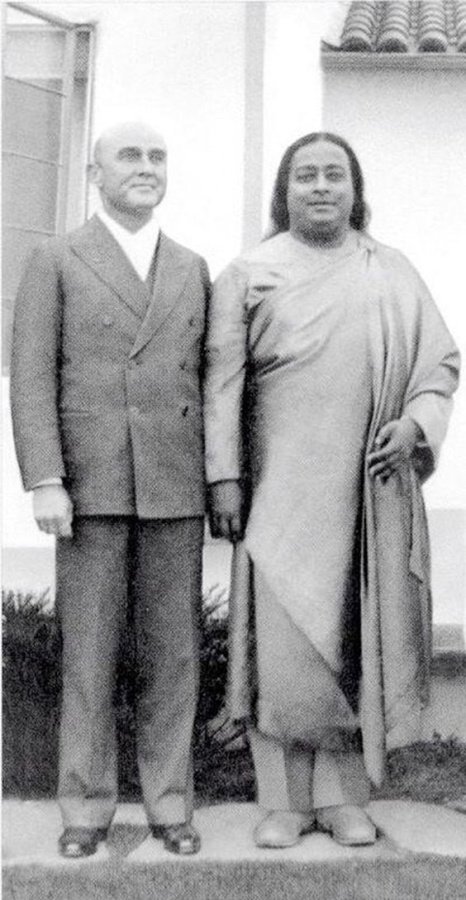
    Paramhansa Yogananda with his most spiritually advanced disciple James Lynn (Rajarsi Janakananda) 

    Ultimately the object of the dance is for Other and I to unite, becoming a seamless expression of blessing and communion. Saints and ascended masters have assured us that in this life or later on, we are all destined to reach that final state of Divine Bliss, more swiftly attained when Other is given the lead, helping us to become the dance itself.

    A true story in just a few sentences captures the essence of this more eloquently than any long treatise could. “This year began badly,” a woman wrote in her journal. “One day I woke up and started having seizures. They got worse and worse. It looked like a brain tumor, but it turned out to be epilepsy. Serious epilepsy. Now I am on medication for the rest of my life. It makes me clumsy. It makes me forget things. It makes me throw up.”

    The author slumped into a pall of self-pity. She stopped dancing altogether. And then in a single epiphany, she turned the whole experience right side up. “Now I realize this was a great year. It was the year I didn’t get a brain tumor.” What she got instead was a deeper love of life and all that it offers. With understanding and acceptance, she transformed her disease from a dreaded Other into the gift of a new, expansive I, and it took her to a place within herself of peace and light.

    Life is a dance. You’ve heard that before.

  • Be Thou a Yogi

    Be Thou a Yogi

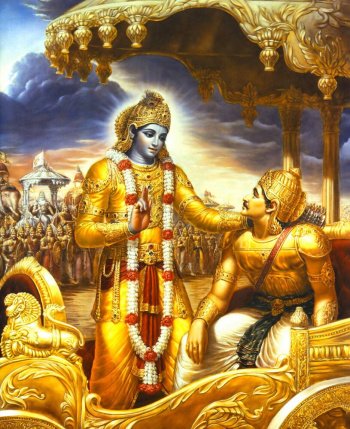
    In the Bhagavad Gita, India’s magnificent scripture, there’s a mystical verse, the meaning of which is not easily understood. Lord Krishna, speaking to his disciple Arjuna, says, “That which is night for the unenlightened is day for the yogi. And that which is day for ordinary people is night for the yogi-seer.”

    These words present us with a puzzle, and we have to look beneath their surface to solve it. Krishna is saying that what may seem real to us – we who see the world mainly with our limited senses – becomes unreal at a higher level of consciousness.

    As you and I move through our days, we rely on our conscious mind to analyze and navigate the course of what we encounter. The yogi, however, has little interest in such mental or physical gymnastics. He (or she) looks to the “inner reality” for the guidance and answers needed.

    Well, that’s interesting, but is it practical for people like you and me? Is it even possible? You and I live in a world that demands our daily attention and our outward activity if we expect to sustain ourselves. We are not so advanced that we can ignore the needs of our bodies, the need to put food on the table for ourselves and our families, the need to provide for the education and welfare of our children. We have responsibilities. Night and day for us are busy times of striving to make ends meet.

    Behind closed eyes, the yogi sees light. Does he lose his worldly bearings? On the contrary, he is able to relate effectively to every facet of his life, both inward and outward, because nothing pulls him out of his superconscious knowing what this life is about. It’s about accepting and loving all that is – everything – as coming from God.

    Krishna, in the next verse, then tells us what we have to do to rise above the ordinary and into the yogi’s realm. “Contentment is his who, like the vast ocean, absorbs into himself all rivers of desire.”

    Acting on this awareness is plainly what we find most difficult, because all of our habits, attachments and desires are certain to conspire against us, distracting us from the inward, meditative process that is the way forward. Yogas chitta vritti nirodh (from the Yoga Sutras of Patanjali), the neutralization of the vortices of our worldly likes and dislikes, remains incomplete.

    Well, that’s a bit depressing. What about all those movies we like, our favorite foods and the pleasures of getting away on vacation? Can’t we be content to be contented just part of the time? What’s wrong with that?

    Well, there’s nothing wrong with that except for what follows: some measure of letdown, or worse, when the temporary pleasure we experience comes to its finite end, as it must.

    I grant you, we’ve been highly conditioned to believe that our worldly pursuits are the best means to our happiness. But Krishna repeatedly reminds us not to be fooled by that kind of thinking. Think not to get, but to give. Think not to possess, but to enjoy and let go. It’s all a dance of the four A’s: Attitude, Attunement, Acceptance and Action.

    We are charged with learning to discriminate between what is spiritually progressive and what isn’t. “Resolutely I quell my inclinations that my mind be open to the wisdom-guidance of my soul.” That spot-on affirmation, offered by Swami Kriyananda, is ideal for calling upon our discriminative powers.

    The path to becoming a yogi is a lot about neti, neti: not this, not that. Can we still enjoy the things of this earth? Yes, of course, and we should, but with the love of God, with discrimination, with right attitude and non-attachment.

    Therein lies the key to entering the yogi’s luminous “inner reality.”  It’s the key to finding contentment in every circumstance. And it’s the key to knowing that what we outwardly see as day is a dream, a dream that cannot begin to compare with the Light that shines like a thousand suns behind the closed eyes of one whose ultimate desire is to realize God.