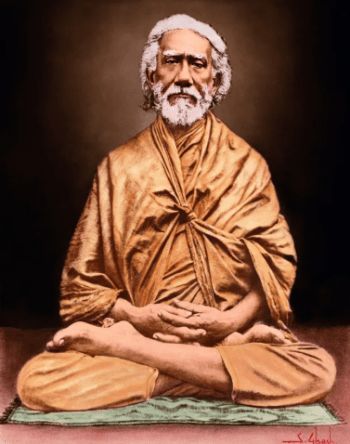
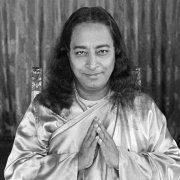
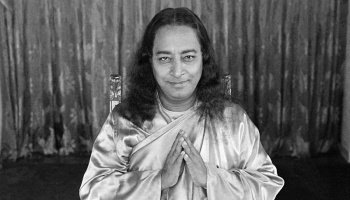
“Learn to behave,” Sri Yukteswar admonished. I picture his stern countenance punctuating his words. We don’t know if “Learn to relax” is something he also said, but that would have been another key piece of advice, an unsung part of learning to behave. He might even have said it with a smile.
That last part is important for another reason, too. Relaxation helps a lot in our later years when proficiencies begin to pale or disappear altogether. If you have reached middle age, you have already started surrendering bits of your short-term memory to temporary oblivion, and within a couple of decades, more of that oblivion will no longer be temporary. It’s what happens. The machinery wears out.
Long-term memory isn’t immune either. The farther away we are from when a memory was made, the blurrier or less certain it becomes. I have memories that my imagination may have partially manufactured – I suspect we all do – especially the ones of a talent or achievement, wistfully inflated in recollection.
With gradual mental slippage, we are dealing with a condition that tests our self-image, patience and composure. Ya gotta love it or it hurts.
Speaking from personal experience, these lapses are sometimes an invitation to a peculiar stream of cerebral activity that is difficult to explain. Unrelated thoughts, randomly selected by my subconscious librarian, tumble into and through the movie being screened in my brain, leaving my objective critic to wonder what’s going on. The script seems out of control, as if invaded by one from some other movie that wasn’t on the playbill.
If any of this sounds familiar, the trap to avoid is trying to make sense of the unannounced movie’s plot. It’s strange. So what? Let it be. Elderhood tends to include a slow loosening of our grip on our mind’s projections. Better to enjoy the mystery of it and its entertaining chimera.
The best way to oppose this occasional onset is without tension or mourning, focusing on what is before us, the countless marvels of life and the blessing of you being one of them, a pilgrim in the vast, amazing dream of it.
More of our best memories will remain accessible that way too, whether accurate or wishful, and we will come to our flight from here in spirited readiness, assured that when
we’ve moved on to wherever is next, all that we have been, unabridged, will be archived for our light body to file and carry forward in total remembrance. Regret nothing and the next movie will be even better than this one.
“This above all: to thine own self be true, And it must follow, as the night the day, Thou canst not then be false to any man.”
This well-known phrase from Act I of Shakespeare’s Hamlet is spoken by the king’s minister, Polonius, as part of a blessing and advice to his son departing for university. But what does it mean to be true to one’s own self? And how does one go about it?
Paramhansa Yogananda aligned his mission and life’s work with the term “Self-Realization.” This is the highest expression of the word “self,” used to denote the oneness of the individual soul-self with the infinite Divine Self. Yoga philosophy and practice provide us with an experiential framework to test Self-Realization—both scientifically and spiritually. Those who know, know: this is the only purpose of life. Yogananda described it this way:
“Self-realization is the knowing in all parts of body, mind, and soul that you are now in possession of the kingdom of God; that you do not have to pray that it come to you; that God’s omnipresence is your omnipresence; and that all that you need to do is improve your knowing.”
Improving one’s knowing is a mystical, challenging journey that pays rich spiritual dividends. Practically speaking, daily meditation is the indisputable foundation of this journey—but more is needed. Let’s consider three essential keys to deepening our knowing of the divine Self:
Remembering the Self
Everyone in the world is suffering from a profound case of spiritual memory loss. A pathologist might treat memory loss with cognitive training and lifestyle changes. Devotees, by contrast, use japa, chanting, affirmation, and other yoga practices to reawaken the divine memory latent in the soul. Yogananda advised:
“Dwell always in the Self. Come down a little bit when you have to—to eat, or talk, or do your work; then withdraw into the Self again.”
Loving the Self
God is Love and must be sought through love, the most powerful force in creation. Swami Kriyananda explained that love and kindness are Satcitananda (ever-existing, ever-conscious, ever-new bliss) in motion. As we expand our sense of self, our actions and relationships will increasingly reflect divine love—through deep respect, compassion, and kindness toward God in all beings, everywhere.
Serving the Self
Life is full of unavoidable activity. Sri Yukteswar taught that all who live in this world are obligated to “render grateful service.” When we combine our service to others with our loving remembrance of God, it is we ourselves who receive the greatest blessing. As Yogananda said:
“Never neglect to do what you can for yourself in the form of others.”
This world is complex and chaotic. Our own consciousness—our self—is the only thing we truly have agency over. Life will bring joys and sorrows, heartbreak and deep love. In the birth of a child, in the loss of a loved one, in the pain and suffering of others, the one Self remains. To quote the great saint Anandamayee Ma:
“…Though the dance of creation changes around me in the hall of eternity, I shall be the same.”
By remembering, loving and serving God always, it must follow, as the day the night, that we will know our own true Self.
“Knowledge is power,” said Napoleon. Was he right?
Well, that depends on what you know, as opposed to what you think you know, and whether you use it wisely.
Worldly power is acquired mainly of influential position and forceful personality. There is no guarantee, however, that a person of power has the will or capacity to see things correctly or act wisely. When power goes rogue, as it often does, its relationship to knowledge goes away.
Knowledge and power simply do not equate, at least not in the world as we know it. If they did, our human history would be dramatically different. We would not be witness to its endless repetition of our foolish ways and follies.
Either knowledge has been devalued as a virtue, or we do not understand what true knowledge is. Big hint: the latter is a pretty safe bet. In the tug-of-war between our egoic desires and higher awareness – from which true knowledge is received – it is our higher awareness that tends to lose its footing and land in the moat.
True knowledge is not what’s acquired of books or internet searches. It is not a reflection of intelligence, an accumulation of factual information, or the result of data analysis. Nor is it even a product of the conscious mind. It is an experiential awareness consistent with the principles and ways of how the cosmos works. It is received in a moment of superconscious, intuitive connection, which is how, in a flash, Einstein received the Theory of Relativity.
Needless to say, not every intuitive message is of such monumental importance, but that is how it works, and that is why the art and practice of meditation is a key to its acquisition and game-changing application.
True knowledge cannot be created. It’s a gift of grace that yields its treasure only of our attunement to the flow of divine wisdom. No other cipher unlocks it. True knowledge speeds one’s spiritual growth. It has no ulterior mission. Its centeredness in God is sufficient to its worth.
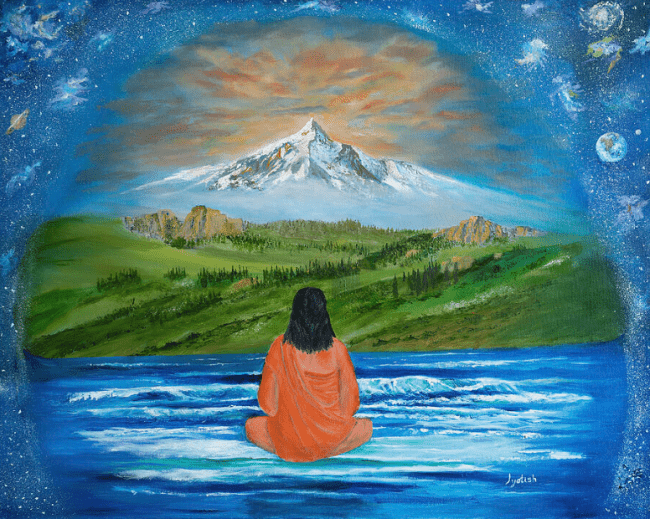
In his magnificent poem Samadhi, the great Indian master Paramhansa Yogananda refers with divine recollection to the true meaning of knowledge as power: “… the storm of maya [delusion] stilled by magic wand of intuition deep.”
Samadhi by Nayaswami Jyotish
Knowledge is not power until it delivers the capacity to see and dispel the storms we unleash by our delusional thinking. It is not power until it comes from clarity born of divine communion. And power is not power if not of self-control.
I don’t remember much from my childhood, but I have a clear memory of being a young, starry-eyed boy of about 7 or 8 years old, thinking that the age of 40 was a really mature and grown-up age where adults really have everything all figured out. I know that I retained this memory because when I turned 40 myself a few months ago, the image I had in my mind of what I thought being a 40-year-old would be like made me laugh out loud. While I’d imagined having a real grasp of what life is all about, and knowing how to operate effectively in this world, a big part of me still feels like that little boy: full of curiosity and unanswerable questions about the bigger questions in life without a clue of what I’m actually doing.
But instead of feeling inadequate because of this, I feel gratified, because I soon realized that these adults only seemed to have everything figured out because they had become, as Yogananda calls them, “psychological antiques.” This means they had all their opinions and ideas already formed, their regrets and longings on a loop, and their childlike sense of wonder and curiosity all but left by the wayside. And while that kind of psychological certainty looked good to me when I was a child, having been on the spiritual path for a decade and a half I see things a bit differently now.
And sitting here at this moment, thinking about what society says a 40-year-old ought to be like, I’m actually very proud of myself because of one very silly little thing I just learned how to do recently: maintain our community pool. In fact, I was sent to an all-day seminar put on by top-tier pool professionals who explained, in all the glorious scientific detail you’d expect from an all-day pool seminar, what exactly was going on between the various chemicals in my pool. And maybe it’s because I’m at the age where bird watching inexplicably becomes interesting, or maybe these guys were actually just great presenters, but I actually found the topic fascinating, like a complex real-world puzzle that I was now in charge of solving.
After a couple weeks of handling these various chemicals and processes, I started to notice something interesting: Our spiritual lives are a lot like a chlorine pool. There are various environmental factors working to change the pool every day, and in order to maintain the optimal state of a pool it needs constant care and attention, just like our sadhana and spiritual practices. We can often get caught up in thinking our spiritual well-being is somehow a reflection of our worth, that if we’re not doing well in our spiritual practices it must be because there’s something wrong with us. But the professional pool maintainer doesn’t see the pool that way, he just sees simple problems of water chemistry that require simple adjustments and fixes.
Yogananda said that Kriya yoga plus devotion is like “spiritual mathematics” and it cannot fail. Pool chemistry works in much the same way as mathematics, in that 1+1=2, and certain chemicals are needed to maintain optimal levels of other chemicals. For example, did you know if you just add chlorine to a pool of water it will quickly burn off from the sun? You actually need something called Cyanuric Acid in order to stabilize the chlorine and keep it from quickly dissipating. This reminds me a lot of the qualities cultivated in meditation, like inner Peace, Bliss, or Calmness. Without a bulwark like mental discrimination, or simply being careful about the environmental influences you subject yourself to, these inner qualities can very quickly be dissipated. Whereas carefully cultivating right environment can help maintain and grow these inner qualities much more effectively.
Similarly with pH of the water, there’s an acceptable range of acidity or basicity but not necessarily one perfect level required. This is a lot like our mental state, where we can be a bit more “happy” or “sad” depending on the moment, but keeping in the range of “even-minded and cheerful” is always the goal. Letting our emotions swing too far in either direction can be problematic in different ways, just like water that is too basic or too acidic. And whereas in our pool we can add an acid or a base to maintain a proper pH level, we can add in extra practices whenever our “spiritual pH” is a bit off. When we feel too excited, doing some grounding exercises can help us interiorize and focus our energy back into the spine, and when we feel depressed or down, some affirmations, chants, or spiritual satsang can be just the thing we need to come back into balance.
Now while a chlorine “shock” to a pool isn’t quite the same as the “liberating shock of Omnipresence” as Yogananda calls it, I could still go all day with this metaphor. However, I hope to leave you with the simple reminder that your spiritual development should be treated at times as impersonally as you would treat a chlorine pool. Just like a daily pH and chlorine check, you can do a daily Joy check, or Peace check, and see where you may need to add in a bit more sadhana, or service. Each pool is slightly different though, so make sure your introspection is filled with grace and compassion for all the karma you’ve built up to get to this point. And when we invite the Master to swim in our pool of consciousness, He helps take care of everything in even better ways than we could imagine. May His presence in your life bless you today and every day.
At Ananda, we often speak of the blessings that come from living in intentional communities rooted in high ideals and simple living. Paramhansa Yogananda envisioned these “world brotherhood colonies” as models for sustainable living in Dwapara Yuga. As he prophesied, “World brotherhood colonies will spread like wildfire!”
Community creates social connections that have a measurable impact on our health and wellbeing. Small, intentional communities allow for greater shared resources and a lesser impact on the environment. Intergenerational communities make caregiving less isolating and nurture friendships between the young and the old. For Ananda, community most especially supports our desire to center God in our lives.
Rarely will you hear one of us at Ananda speak of the challenges that community living brings to our lives. And yet we know as seekers of Self-realization that challenge is an important catalyst for spiritual growth. So, what are the hardest parts of living in a community? What can we learn from them? How can we overcome them?
Othering
This is one of the more recent criticisms of communities by scholars on the subject. Critics argue that communities, by nature, draw boundaries that create insiders and outsiders. While there’s some truth to this, it’s equally true of families, cultures, or any form of group identity.
Othering is something we must overcome if we are to experience our oneness with the Divine, which is the whole purpose of yoga. In his series of speeches titled, A World Without Boundaries, Paramhansa Yogananda lays out the road map to overcoming this human tendency. We begin, he suggests, within our own selves. We shed light on the prejudices that our personal experiences, family and society lodged within us. We release them in the realization that we are all children of God. Next, we expand our love until we love all the world as our family. To do this, we meditate to expand and uplift our consciousness.
In creating Ananda Village, Swami Kriyananda made it an early order of business to create a retreat center for people to stay and receive what we have to share. This was no accident. Ananda’s early and lasting emphasis on sharing the teachings is a positive, outward pulling force that helps our communities constantly seek to serve others beyond our ‘membership.’ Swami traveled the world, wrote books, lectured publicly, and touched everyone he met with his warm smile. He encouraged us to start schools, businesses, and philanthropic endeavors.
Here in Ananda Portland, we do this through our seva with local nonprofits and, like Swami, with our events, writings, classes and by supporting interfaith events aimed at uplifting consciousness. Community, by its nature, has a boundary yes, but that does not mean we cannot consciously expand ourselves to include others in meaningful and uplifting ways. As Swami says in his book Education for Life, maturity is,”the ability to relate appropriately to other realities than one’s own.”
Collective Over Individual
As a highly individualistic society, the idea that one might place the collective good ahead of our own self interest is seen as oppressive and absurd. And yet, the consequences of this extreme adherence to individual interest is a root cause of our social and environmental crisis today.
I study and teach wild horse behavior for precisely this reason. By understanding the social structure of horses, I see more objectively how a healthy community thrives when the collective good is placed first. Horses have roles, but not hierarchy. The roles exist for the health and safety of the herd. When a lead horse is injured or needs to rest, another will graciously take its place until the original horse is ready to serve. How is leadership assigned? By consensus, the herd follows the horse with the most consistent good judgement.
As with all things, the Buddha’s wisdom applies here, “the middle path is the way.” Through trial and error, those of us living in community learn that we cannot and should not suppress our individuality or abandon our own inner knowing. But we also learn that if we do not consider the impact our decisions have on the collective, for better or worse, we soon find ourselves walking away from our community entirely.
I recall a time when I was working with a mentor in my equine assisted learning practice who said to me, “when you talk about your life, it’s as if Ananda is another person in your nuclear family.” This was an astute observation. What we learn, if we are to make community living last, is that we do well to consider how our personal choices impact the whole because they do. The more we live in that knowing, the more we live congruent with this Divine truth: we are one.
Harmony Over Conflict
When we enter the social contract of community, much like marriage, we discover that what we say matters. There are no take backs. With our spouses and children, we learn very quickly that there are times to speak up, times to listen, and times to live and let live. An excellent rule of thumb offered by Swami Kriyananda when deciding whether to say what you see is this, “Is it true? Is it helpful?”
Through the course of community living we find ourselves faced with opportunities to decide what we will say, to whom, and how. It may be something small, like an annoyance from a neighbor. It may be more significant, like the observance of someone’s risky behavior.
During the pandemic, I sometimes received calls from fellow community members concerned about my choices. My family had created a small pod with a few other households to care for our young children. Though we kept public contact minimal, some still viewed our approach as risky and let us know. I didn’t love receiving those calls—but I reminded myself: this was a friend, afraid. I, too, was afraid. I made the best choices I could for my family, took precautions, and did my best to respond with kindness.
Another horse wisdom mentor of mine once said, “harmony is the resolution of conflict, not its absence.” This hit home as a balance point to the desire to maintain harmony over honesty. It is okay to disagree and have challenging conversations. Just pick your battles with discernment and remember that harmony is the goal. To achieve resolution, we should listen with an open mind and speak with an open heart.
The wedding vows that Swami Kriyananda wrote sum this up exceptionally well, “I will respect your right to see truth as you perceive it, and to be guided as you feel deeply within yourself.”
Do you judge? Of course, you do. Judging is how we compare and contrast, how we choose between this and that. It’s a habit as automatic as breathing. Every action, thing, person and experience is measured against what was, wasn’t or might have been.
Consciously or not, we spend our waking hours measuring what enters our sensory world: the flower that is lovelier than the one beside it, the haircut that looks much better since it grew out, the athlete who should have retired at the top of his game, the mind that isn’t as facile as it once was.
The egoic self is host to an endless stream of thoughts, and each of them, to some degree, gets a thumbs up or down. Our attitude and outlook at any given time is largely a reflection of our conditioning, preferences, and wishes.
Why is it that we feel punished or deprived when something we want doesn’t come to us, or when something we prize is taken away? Isn’t freedom, as the song says, just another word for nothing left to lose? The key, as our gurus counsel, is to recognize that we are freer when finding less to judge, worry about or tether us to delusion.
How much do you possess? How much more do you want? The less the better. When we don’t have much, there is more of us for everything else: life, love, and the precious moment at hand.
But what if the moment at hand isn’t likeable? Many of those that come to us uninvited and unexpected are unwelcome. Yet, as devotees seeking the highest within us, we need to realize and appreciate that nothing is unlikeable except as we miss the point of it.
Spiritual growth is a measure too. It’s an overcoming of biases and desires that suppress the soul’s emergence, binding it to the vagaries of the world and its troublesome dual nature. Lao Tzu praised as noble in spirit the person of self-awareness who strives more each day to be free of impeding judgments, accepting things as they are and thus rising above the pull of attachments and their disappointments. Such is the process of inner renunciation that our gurus have urged us to adopt, for it is also the measure of our love of God more than His finite gifts.
There’s a lot working against us, to be sure. Society does not cheer us on as we turn away from its acquisitive urgings, seeking to meet our needs alone while rejecting its material emphasis and unfulfillable promises.
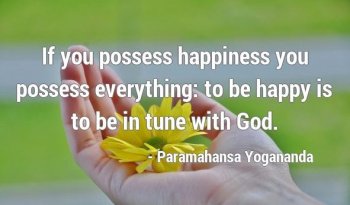
It is rightly said that everyone wants to be happy and avoid pain. We must only go about these objectives wisely, for there is nothing here to decipher that isn’t essentially simple. As we accept more, judging and measuring less, we discover the happier difference.
“Never the twain shall meet.” This well-known line from Rudyard Kipling’s 1889 poem The Ballad of East and West depicts incompatible differences. The poem tells a story of a British colonel’s daughter kidnapped by an Afghani bandit and rescued by a brave soldier. The two adversaries fight a fierce battle, and despite their opposition, develop a mutual respect for one another’s honor and bravery. This is an important spiritual value: we can find common ground even amongst incompatible circumstances.
We are living in an age of political and social turmoil, which ebbs and flows according to the mass karma of the globe, its nations, populace, and leaders. The term and concept of politics comes from ancient Greece, referring to the affairs of “polis,” meaning cities or states. From a spiritual perspective, the functions of government powers and policies—despite their many real and lasting impacts on individuals—are relatively superficial compared to the far greater and more lasting work of raising one’s consciousness and that of the world. How can we reconcile human suffering and problems with lofty spiritual ideals?
Ananda is a spiritual family, community, and organization devoted to the mission and teachings of Paramhansa Yogananda, as expressed by his direct disciple Swami Kriyananda. This path of Self-Realization is universal because absolute: it transcends every definition of religion, race, credo, or other separating factor. Thus, Ananda is inherently non-political in the traditional sense of directly endorsing or engaging with any political party or dialogue. God is love, truth, and bliss—far beyond any conceivable human construct. “Never the twain shall meet” except to find a harmonious blend of living right spiritually in this imperfect world.
Within this modern arc of national and global politics and karma, we are now looking down the barrel of an extended turbulent, possibly even violent period. People everywhere, especially those lacking strong moral and spiritual foundations, are being swept up in powerful currents of polarized thinking and behavior. By many objective accounts, this karma will get worse before it gets better.
The other side of the coin reveals that such karmic periods are accompanied by profound spiritual opportunity. If we keep our spiritual practices and principles in order, we can maintain our inner peace and act rightly in every circumstance. Some twenty-five years ago, during another period of karmic unrest, Swami Kriyananda outlined a powerful yet simple list of priorities for Ananda:
1. Our inner relationship with God and Guru
2. Our service to them
3. The friendship we have with one another
4. Our need to meet dharmically the tests life has given us
5. Yogananda’s advice “You must be practical in your idealism” *Adding that while practicality is important, faith is the most practical thing of all.
This little blueprint gives us the Ananda recipe for not just weathering but thriving through a difficult time. There will always be exigencies and personal hardships to bear, but it is helpful and important to keep coming back to these essential priorities. In a way, these are the Ananda “politics” that guide the governance of our organization, communities, and members. As long as we stay true to these essentials, Ananda will always be a divine light shining in whatever darkness prevails and a safe haven for storm-tossed spiritual seekers everywhere.
Paramhansa Yogananda influenced many powerful people in his life and beyond it, including politicians and business magnates, scientists and artists, and mystical saints of east and west. Yet his power of influence was beyond anything of this world, directly from God. That same supreme power continues to guide and influence all those who, avoiding the many lesser streams of influence of this world, seek and strive to be in tune with God.
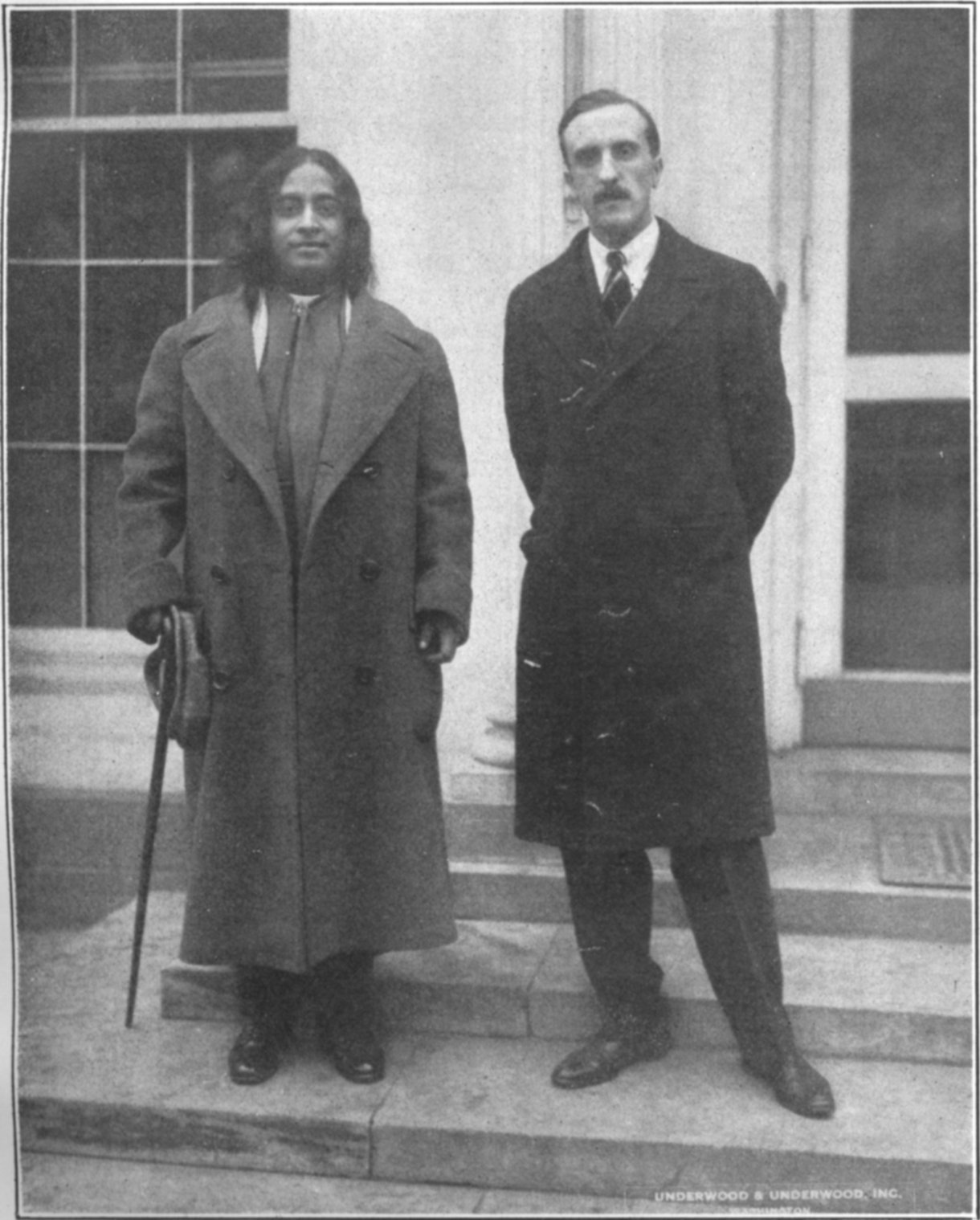
Yogananda at the White House during a 1927 visit with US President Calvin Coolidge
If we quell the cross-currents of news headlines, social media, and politics, we are left with the simple fact that these are human issues concerning the well-being of individuals. Ananda too is concerned above all, spiritually, with the well-being of the individual. Ananda’s spiritual politics are not a dismissal or means of negating the many important and challenging issues we are faced with. They simply provide a framework of priorities for how to successfully navigate, individually and collectively, through the political tempest.
We celebrate Easter to remember the resurrection of Christ–a sybmbol of the hope and transcendent power of Spirit over every human suffering and hardship. “Seek ye first the kingdom of God, and all these things shall be added unto you.”
In a certain sense, Ananda is doing the greatest political work of all: raising mass consciousness by wholehearted dedication to the spiritual welfare of individuals everywhere. This is a divine ray of out great gurus including Paramhansa Yogananda, Jesus Christ, and our founder and guiding light Swami Kriyananda. Our mission finally is simple but not easy, unwavering through every possible karmic challenge: to bridge the gap of living above all in attunement with God through this ray, and meeting the challenges of the day with the right spirit.
“In every life we have some trouble, but when you worry you make it double, so don’t worry… be happy!” (Bonus points if you heard the tune in your head)
There’s a good chance that every red-blooded American over the age of 20 has had this song stuck in their head at least once or twice in their lifetime, and as I was finding myself with this timeless tune echoing in my own brain cells the other day I was reflecting on the deeper spiritual meaning behind this song. The repeated phrase of “don’t worry, be happy” might seem to many people to be a silly proposition, when in reality it’s a wonderful reminder to the yogi of our own inner power to choose our state of consciousness. Whether you think it’s silly or instructive depends entirely on your awareness of the underlying realities at play.
I was also reflecting on the dichotomy between the ease of grasping certain mental concepts, like “don’t worry,” and the difficulty of maintaining that state of consciousness in the face of the habit-driven monkey mind. As a concept, “when you worry you make it double” makes perfect sense. If I already have troubles, they’re not changing or getting better just because I worry. But at the same time, often the reason these “troubles” are so troublesome is because of what they portend to happen in the future. How could I think about the trouble of losing my job without the obvious implication that I will soon run out of money? I may not be out of money now, but I can’t stop myself from worrying what will happen when that occurs.
Then I realized what this all really is: an opportunity. Paramhansa Yogananda stated very clearly that every obstacle we encounter in our lives is an opportunity; and that we are on this planet to be educated and entertained. But it’s hard to be entertained by worrisome things, and it’s equally hard to be educated when you’re only looking at each situation in one way. The worldly mind loves to think of worst-case scenarios, and analyze things from a contractive point of view, so the opportunity here is to replace old ways of thinking with new, expansive attitudes towards life.
So what to do with this opportunity of a worrisome life event? Practice. This, I realized, is the key to the whole lockbox of worries: practice. We are not here on this planet to develop the things we’re already good at–those are gifts to be shared with the world. No, the thing we’re here to do is develop and grow. So where do we start?
Awareness. If the only thing we do is become more and more aware, we will reach our ultimate spiritual goal of Self-realization. How do we let go of things that hold us back? By becoming aware that they exist, and that we can let them go. How do we change our perspective? By becoming aware of the possibility of new perspectives. And so on…
As yogis, we know the ways to practice this already: meditation, introspection, and contemplation. But the reason these “opportunities” still exist in your life, even after years or decades of practice in these areas, is because there’s more to unravel in the karmic weave of our lives, and more unlearned lessons that God and the Masters are helping us to learn.
Finally, there are also “partially-learned” lessons that we can continue to work with for our entire lives at varying levels, like trusting in the divine plan for our lives. We must already have a certain level of trust to be on a spiritual path so deliberately in the first place, but when we find ourselves worrying about life or world events it becomes clear where the line of that trust ends and our ego’s desire to control things begins. But as the awareness of that line grows, and as we move closer to God by giving Him our worries and fears, we look back and see that the process works. The practice works.
The only thing we need to do is keep practicing. So as you inevitably find yourself worrying about the future, or the outcome of certain events, remember not to judge yourself for your ego’s benevolent desire to protect you. Your mind, while at times untamed and wild, has been a great tool to get you to the point you’re at. Now the only thing you need to do is keep following the Great Ones, their words and practices, and continue to grow your awareness of Truth. With a higher perspective comes greater peace. With new knowledge comes new possibilities. And with increasing awareness comes the remembrance of what we are in Truth: beloved children of God who can never be lost to His sight. Blessings to you on this sacred journey that we walk together.
“You get your bachelor’s degree and think you know it all. Then you earn your master’s and realize you know only a little. But when you get your PhD, you understand you know nothing.”
One of my professors shared this with me long ago, and it struck such a chord that I both laughed and pondered it often in the years that followed. Over time, I began to wonder: what if we applied this same concept to the spiritual path?
In the pursuit of Self-realization, it might go something like this: You get initiated into Kriya Yoga and think enlightenment is just around the corner. Then, after a decade of daily practice, you know the technique, but your inspiration has run dry. If you remain determined, you seek further training, take deeper vows, redouble your efforts, and absorb all the wisdom you can find, only to realize you’ve been practicing just 1% of what your guru recommended, and even that imperfectly.
And then, finally, you smile. Because you understand that this is the Soul’s work, an undertaking that spans the vast cycles of time. It will take as long as it takes.
The journey to Self-realization is long, but the path becomes increasingly sprinkled with joy as we begin to experience life through the lens of Spirit. Many of us are empaths, deeply attuned to the suffering in the world: fear, anxiety, cynicism, and rage, often for good reason. Walking this path requires tenderness: to move through the suffering with an open heart while recognizing that each person is a fellow soul on their own journey. Some may be more lost than you. Others have found a better way—follow them. As Maya Angelou wisely said, “Do the best you can until you know better. Then when you know better, do better.”
Paramhansa Yogananda’s Psychological Chart offers profound insight into this journey, mapping the development of human consciousness on the path to enlightenment. It is a powerful tool for Swadhyaya (introspection) , an essential step in Patanjali’s eightfold path of yoga. Certain qualities, he teaches, indicate an elevating consciousness. Some of them may surprise you:
Dutifulness—out of love, out of respect
Acting in accordance with the suggestions of superior minds
Quiet
Faithful
Patient
Amiable
Having a sense of propriety
At first, I wondered—why these? While undeniably noble, some might be perceived as weakness in certain contexts. But as I reflected, I saw their deeper significance. These qualities mirror the wisdom in my professor’s words: the more we learn on the spiritual path, the more we realize how little we truly know.
Ultimately, our own willpower and experience will take us far—but not all the way to liberation. To reach ultimate freedom, we need a guide. And to accept such guidance—to surrender to Divine wisdom—we must cultivate great humility.
My life, when it’s on track, adheres to a pattern of spiritual growth that guides me increasingly to the flow of grace. That is to say, good things happen when I’m true to what’s good, even when things may not seem so good at the time.
This pattern, as I perceive it, falls neatly into five steps, all of which begin with the letter A: Attitude, Awareness, Acceptance, Attunement and Action.
Before getting into each of these qualities a little, I have to mention, as I’m sure would be fairly assumed, that I haven’t always met the challenge of completing the five-A sequence. Acceptance and attunement are hurdles that one’s desires and attachments tend to resist surpassing. The phrase “Work in progress” continues to apply!
So, how do we get from Awareness to a high-minded, positive approach to life? For starters, it helps to trust that God knows what He is doing, and that nothing delivered to our doorstep is by mistake. Having the right Attitude, even when tested severely, is essential to the journey of Self-realization. And this opens the door not only to further Awareness of why things are as they are, but to Acceptance of every challenge as a gift from God for our spiritual evolution.
Acceptance of that reality then serves to raise our consciousness to in-sync Attunement with the Spirit that is implicit in all that is. And that brings us to Action. Up to now, we have set the stage for things unresolved to resolve, but this is not going to happen merely because we have our ducks in a row. Understanding an issue, no matter how complex, is essentially just information until it is translated to an actual expression of will power and energy.
Every situation comes with a choice. What am I aware of, and what is my attitude toward it? Have I read its meaning correctly, and do I accept the reality of its message? Am I attuned to my highest self as I face into it, and what is the action I am willing to undertake to make the most of the opportunity?
When this five-step sequence becomes our way of being, it is no longer just a descriptive pattern. It is who, as seekers, we allow our soul to lead us to be.