Category: Uncategorized

  • Meditation Micronutrients

    Meditation Micronutrients

    Yogananda advises using good habits to replace our bad habits. With this in mind, I use an app to track my food intake. The app has a library of thousands of food items with nutritional information, including information about macronutrients and micronutrients. Macronutrients are food components we need in large quantities to maintain our body systems and structures (fats, carbohydrates, protein).

    Within the macronutrients are micronutrients – vitamins and minerals needed by the body in very small amounts. According to the World Health Organization, micronutrient deficiencies can cause dangerous health conditions, but they can also lead to less dramatic, but “noticeable reductions in energy level, mental clarity and overall capacity.” 

    While physical health and the food I eat is certainly important, as a meditating yogi whose goal is freedom from delusion, my spiritual health is even more important. So I wondered, “Are there vital micronutrients in meditation? Could I find deficiencies that may be affecting my energy, spiritual clarity and overall capacity?”

    I quickly identified six meditation macronutrients that I believe are universal: prayer, asana, eye position, breath, joy, and stillness.  In addition, within each meditation “macro” are numerous micronutrients that are more subtle and personal to the individual devotee.  

    Lengthening our meditations beyond our usual routine is also advised by Yogananda,  however, meditation micronutrient deficiencies need only micro adjustments and micro amounts of time. I found countless ways to refine and deepen my practice that didn’t require more time commitment.  Don’t try to deal with every deficiency in one meditation. I examined each one separately and looked carefully at my current practice, making small adjustments, with immediate and noticeable effect. 

    Nayaswami Jyotish once wrote a blog about The 1% Solution, in which he told of a British cycling team that changed their national ranking to #1 by focusing on improving everything they did by just 1%. Meditation micronutrients is another way of looking at small adjustments that can have major effects in our spiritual health.  

    Prayer: Our prayer sets the stage for our meditation. Can your prayer be improved? Try speaking aloud to command the attention of your mind and heart. If you invoke our gurus, looking at their pictures may help. Look for habits that have become unconscious and stop them immediately. Prayers don’t have to be fancy or long – alert and sincere is good. Let your devotion speak wordlessly.

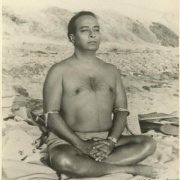
    Asana: Swami Kriyananda said asana means to be seated in a firm, pleasant, and relaxed position. Yogananda said the purpose of posture is to rise above or stop the motions of the body which cause restlessness to the soul. Try micro adjustments to your meditation posture to attain this state of relaxation with spine erect, shoulders back, chin level and energy flowing smoothly.  I keep this picture on my altar as a reminder of correct asana: 

    (Master meditating on the beach.)

    Eyes: The eyes should be gently uplifted to the point between the eyebrows, to draw the energy, heart and mind up to the seat of omnipresence. This gaze at the spiritual eye continues throughout our meditation. Anytime sleepiness or restlessness comes, check the position of your eyes. This simple practice will change everything about your meditation – whether you are sitting for 5 minutes or 5 hours. 

    Breath: Each breath should be felt in the belly, not the chest. Make sure to do one or two  simple pranayams, such as even-count breathing, to prepare for your meditation technique. Cutting these out may save you 30 seconds, but they are meditation gold – don’t underestimate their power. 

    Joy: If we meditate with joy, we invite God’s joy in. However, this is not always simple to do. I borrow a phrase from the Bhagavad Gita, where Krishna speaks, “as if smiling”. Meditating with a big grin is not realistic or very relaxed, but I can meditate “as if smiling”. It’s a secret smile I share with God. Those meditations are always touched by joy. 

    Stillness: Once you settle into your meditation asana, command your body to be still. Do the best you can to wrap yourself in stillness and never leave your meditation without tapping into stillness. Start with physical stillness and that will lead you to a stillness of spirit. No matter how restless or pitiful you think your meditation was, you can always offer yourself on the altar of stillness for 30 seconds before you leave.  

    If you pay attention, you will find micronutrients that you can build up in every meditation practice. Every micronutrient deficiency found is an opportunity to meditate with more awareness and correcting deficiencies can be fun and spiritually fulfilling. Ask God and Guru to show you how to improve your meditation diet and you will find greater energy, spiritual clarity and limitless capacity for divine awareness. 

  • You’re Not Here for That…

    You’re Not Here for That…

    I’ll admit that there are times when I wish I could just speak to God directly, like having a little device in my ear where I could get a clear message, in plain English, any time I want. Maybe when I’m faced with a tough decision I could just ask God “Hey, should I go with the fries or salad with my sandwich?” And he’d say something profoundly helpful like “The fries will taste better now, but your body will feel better after the salad.” But, as most of you spiritual seekers know, messages from Spirit are rarely so straightforward.

    When I look around at the world with so much uncertainty and chaos, I frequently get the feeling that something (outward) should be done about “this,” whatever it is, and that maybe I can help. But then my amazing wife said something that struck me so profoundly I thought Master had to be speaking through her:

    She said “You’re not here for that, you’re here for the fallout from it.” And since I’ve been sitting with those words echoing in my head, it’s brought me a tremendous amount of peace. I don’t need to fix all of the many overarching problems of the world now, which is a relief because I’m not in a position to fix any of them… But when hard times come I will go forth and do more of the work I came to Earth to do. And I strongly believe this is what the Ananda communities are on the planet for: to offer spiritual succor and divine clarity to confused and hurting souls, as the world they put their faith in inevitably disappoints them.

    In my previous blog entitled “Who Did God Vote For?” I discussed Yogananda’s statement from the Autobiography of a Yogi that Babaji and Christ have planned the spiritual salvation of our age, and are working tirelessly to help in the upliftment of consciousness on the planet. I also discussed how, with all the bad news of the world, it can be easy to get caught up in wanting to change the world itself for the better and lose track of the point of this life.

    And it’s more important now than ever to remember some of Yogananda’s teachings, like “take care of the minutes, and incarnations will take care of themselves” and “environment is stronger than willpower.” If we are so focused on what happened in the past, or worried about what will happen in the future, it’s pretty hard to take care of the minutes. And if we’re surrounding our mind with thoughts of what’s wrong with our society or government, then that mental environment will make it nearly impossible to go deep in the inner silence.

    So I think about a question that Asha asked of Swamiji many years ago, which is basically the universal question of “In a moment of crisis, how will I know what God wants me to do?” to which he answered “Practice when it’s easy.” In other words, don’t wait for things to get really bad to find inner strength, bravery, or calmness, start cultivating those things now using any chance you get.

    And it is hard to think about the world today as “the easy part,” but when we look at history, and what exactly we’re repeating right now, we know it can get a whole lot worse, and likely will. But it’s important to remember, as a devotee, unless you’re already highly placed in such a way as to directly affect the current trajectory of the planet, then the MOST important thing to do is look within and work to uplift and purify your own consciousness.

    We don’t know what tests lie ahead of us, or for our country, or the world. That much is certain. But if the chaos, uncertainty, and fear inspire us to do anything, let it be to go inward, to pray more, serve more, and especially to love more. Take inventory of your life right at this moment, and look for ways you can increase the Light, the Love, and the Joy of God, wherever you are.

    In this way, you will be building up spiritual Power in order, as Master encourages us, to “stand unshaken amidst the crash of breaking worlds.” And until the worlds are actually crashing around us, let us use our time and energy to practice, and grow, and find Peace where we can. Because whatever happens from here, soon enough we’ll all meet up again in the astral world, with Master and Swamiji there to greet us, and we can say for certain “It was a good show.”

  • Hope For A Better World: Spiritual Community

    Hope For A Better World: Spiritual Community

    When:

    Friday, April 11th | 7:00pm: Free

    Where:

    New Renaissance Bookstore
    1338 NW 23rd Ave. Portland, OR 97210


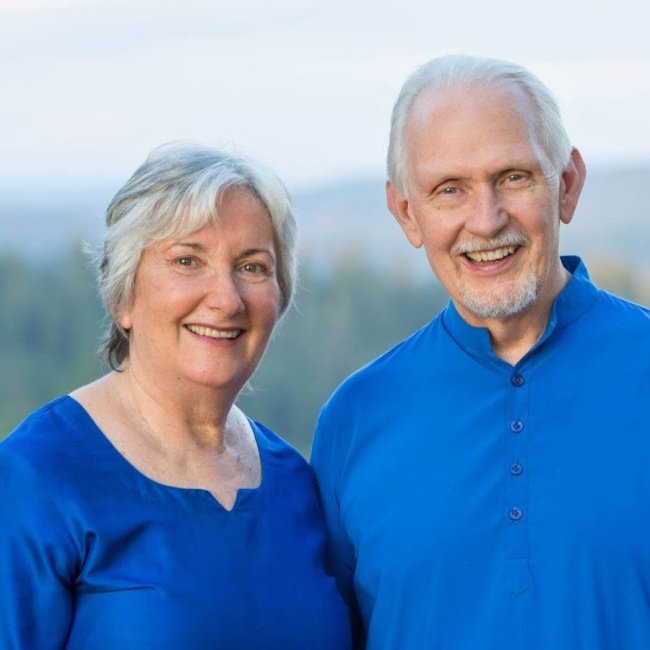
    Join us at New Renaissance Bookshop for an evening of music, inspiration, and deep spiritual wisdom as we welcome Jyotish & Devi, the spiritual leaders of Ananda, for a special gathering. This free event offers a chance to explore how spiritual community can uplift our world, bringing hope, connection, and divine light into our lives.

    Inspiring Talks
    🎶 Uplifting Music
    Q&A with Jyotish & Devi

  • Small Things

    Small Things

    In Michelle Obama’s most recent book The Light We Carry she recalls how she dealt with the early days of the pandemic. The world had suddenly jerked off course and nothing felt safe. At that moment, she began to knit for the first time. Knitting, she explained, was a way to keep her hands busy doing something small when everything else felt too large to handle. And, bonus, she made some great gifts for friends and family! I recall her words at times like these, when everything seems too large to handle. Small, intentional actions, whether knitting or meditating or washing the dishes, can bring us back to the present and help us reclaim inner peace.
    Paramhansa Yogananda taught continuously the usefulness of meditation to dispel fear and find peace, especially when things seem too large to manage. I wove these two seemingly different threads of wisdom and discovered: the most powerful small thing we can do is focus on the daily refinement of our meditation practices. One day it may be putting more focused attention on energization exercises. The next day, it may be sitting an extra ten minutes in silence. Yet another day, it might be more prayers for the healing of others. The list of ways to bring attention to daily sadhana is endless and with every microadjustment, you will find your mind and heart returning to peace. 

    “Meditation is the real panacea by which you can permanently cure yourself of the daydream of matter and all its evils, and realize yourself as pure Spirit,” Yogananda explains.  

    We can focus on the small things off the meditation cushion as well, of course. We legitimately need ways to unwind and relax when the day is done. Preferably activities that support our desire to find inner joy and rejuvenate us when the day’s work is done. 

    Returning to Michelle’s choice of knitting with her abundance of free time imposed by the pandemic, there are two deeper reasons that this small thing brought her solace. First, knitting is a creative endeavor and true creativity requires attention to the present moment. Swami Kriyananda, a direct disciple of Yogananda once explained, “One of the secrets of creativity is to live in the moment, and in the work of the moment. A work of art must be a projection outward from one’s center within.”

    Secondly, knitting is an act of service because the completed project is likely a useful item for yourself or someone else be it socks, hats, gloves, scarves, or blankets. And when we feel overwhelmed or fearful, Yogananda explains that an act of service is often key to redirect our energy into a positive direction. 

    “Life should be chiefly service. Without that ideal, the intelligence that God has given you is not reaching out toward its goal. When in service you forget the little self, you will feel the big Self of Spirit. Rather than always striving for personal happiness, try to make others happy,” Yogananda explained.  

    On service, let us also keep the counsel of another great saint, Ramana Maharshi, “Your own Self-realization is the greatest service you can render the world.”

  • Through The Storms

    Through The Storms

    Recent years and present times have seen the storms of the pandemic, natural and manmade disasters, political and economic upheaval, global unrest and many more such challenges. A mighty natural storm might uproot trees, destroy homes and lives, and lash the seas to heaving. And so today might seem like the breaking point of something significant, and maybe it is. When will it let up? Will it get better or worse? What is going to break down and when? We can speculate but cannot answer these questions; the real power we have is to exercise our “rights” of self-control, centeredness in God, and sharing God’s light in thought, will and activity.

    These recent storms are new but not unprecedented difficulties facing our nation, our globe, and the human race. On an individual level there must be some coping mechanisms to weather the storms of life. A certain dynamic tension is unavoidable, even necessary for progress and growth, but excessive stress left unchecked on a system or an individual will ultimately be detrimental and destructive.

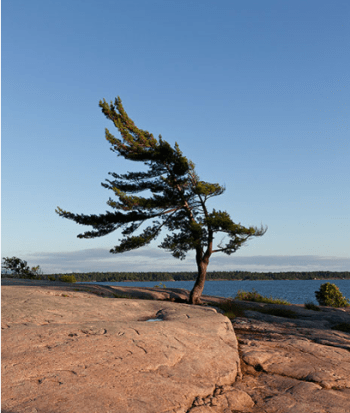
    We learn valuable lessons from the elements and features of nature, Spirit expressed through the phenomena and beauty of the natural world. The same powerful storms which batter and break even the mightiest trees will strengthen them, even as the great American environmentalist John Muir observed, “some pines six feet in diameter will bend like grasses before a mountain gale”. Swami Kriyananda expresses this power of the trees in another way in the song Channels: 

    Trees standing firm hold the secret of inner power

    Give us when tested, strength to endure

    The tree that grips tightly to the earth, yet sways flexibly through even the most raging winds, will bend and shake but never break. Strength is needed, ultimately through the grace of God, to weather the mightiest storms of life. The Ananda Yoga affirmation for garudasana or eagle pose is perhaps most apt for these times: “At the center of life’s storms, I stand serene.”

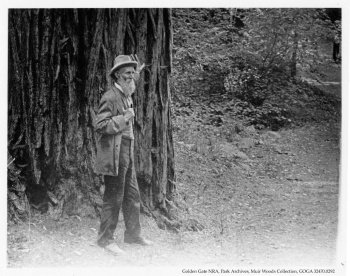
    John Muir with a mighty redwood tree

    Sometimes we may need to embrace these storms like John Muir in one of his many daring adventures (what he playfully called scootchers) when he famously climbed a 100-foot pine tree to revel for hours in a furious windstorm, drinking in it’s power and glory. (A Windstorm in the Forest, 1984) . There are many more subtle, and less risky ways to turn the storms of difficulty into opportunities for spiritual adventures of courage and joy. In another of his countless melodic poetries, Kriyananda illustrates this carpe diem sentiment vitally:

    Sing when the sun shines, sing when the rain falls, sing when your road seems strange;

    In a tempest seize the lightning flash, and ride the winds of change!

    In many ways we must simply accept the fate and karma of the world, and ourselves, with the serenity as Paramahnsa Yogananda advised to let “what comes of itself, let it come”. The yoga principles and practices give us the tools then to make the most of what comes, and ultimately to find freedom and joy in the process.

    There is unmistakable hope, peace and joy in this world, battered and broken though it is. We must look and listen beyond the problems and chaos for the strains of the divine music that pervades all creation and its myriad happenings.  To quote the great John Muir once more, perhaps at least as much enlightened mystic as environmentalist:

    “This grand show is eternal. It is always sunrise somewhere; the dew is never all dried at once; a shower is forever falling; vapor is ever rising. Eternal sunrise, eternal sunset, eternal dawn and gloaming, on seas and continents and islands, each in its turn, as the round earth rolls.”

    May the sunrise of God’s presence always shine on, and bless us. And may we remain centered, courageous and spiritually adventuresome in the face of all the comes.

  • When We Lose

    When We Lose

    This is day two of a devastating fire event in Southern California. As I watch the suffering on the tiny screen in my palm, my heart aches for the tens of thousands affected directly as well as the millions of us with secondary levels of impact. Homes, businesses, churches, schools, all gone. People fleeing down windy canyon roads, sometimes on foot, sometimes with a dog, a cat, a child, or a horse in tow. 

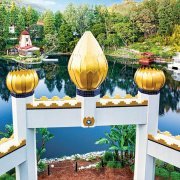
    This fire has a particular pain for the millions who love Paramhansa Yogananda. The Palisades Fire, the first of several to break out on that windy, dry day in January, is home to a pilgrimage destination for Self-realization aspirants – Lake Shrine. 

    Long before Yogananda dedicated Lake Shrine, Native Americans recognized the sacred energy of this land. Later, in the 1920s, it became a movie studio project before falling into disrepair during the Great Depression. In 1949, Yogananda acquired it, dedicating it as a ‘Church of All Religions’—a sanctuary for seekers of every faith. For thousands, it has been a place of peace, reflection, and spiritual renewal. For me, it was a place of refuge and spiritual support during the seven years that I lived nearby.

    You don’t have to be a disciple of Yogananda to love Lake Shrine. More than anywhere, Lake Shrine is a physical manifestation of Yogananda’s vision for world unity. The site hosts a beautiful memorial to Mahatma Gandhi, including some of his ashes. The gardens are sprinkled with uplifting quotes, symbols, and statues from all the major religions. Tucked within the glory of mother nature, it seems easier for the visiting throngs to receive his message of the universal one-ness of all truth. 

    At a time when the world feels so divided, Lake Shrine stands as a reminder of what unites us: our shared humanity, our quest for truth, and the beauty of nature as a reflection of the divine.

    In 2002, after graduating from nearby Pepperdine University, I had the great blessing to live in the closest possible apartment to Lake Shrine. Nestled on the southeastern edge of the property, I could walk from my apartment to the temple for services in less than 5 minutes. 

    Watching the Palisades Fire swallow everything in its path, including all of the classic Pepperdine haunts, and lap angrily at the edges of Lake Shrine has forced me to sit with the fear of its potential loss. The loss of something sacred, something I thought was invincible. 

    As I lean into the possibility, I am reminded of a truth that: loss is not a condemnation, it is part of the natural cycle of life. The temple in Israel fell, the Parthenon was bombed, Notre Dame burned viciously. Out of these tragedies, the human spirit rose to meet the day. 

    Whether or not the fires consume Lake Shrine, what it represents cannot be destroyed. Yogananda’s vibrations will endure, just as the message of universal truth has outlasted temples, cathedrals, and sacred sites throughout history. From loss comes renewal, and from ashes, beauty can rise. 

    May the tragedies of these fires be softened by the outpouring of love, unity, and support—reminders that no fire can ever consume the sacred within us.

  • Who Did God Vote For?

    Who Did God Vote For?

    Author’s Note: Any opinion expressed in this article is solely and entirely the opinion of the author, and in no way whatsoever reflects any opinion on the part of Ananda.

    It’s one thing to find a true spiritual teacher who explains the nature of life to you, it’s quite another to be able to hold onto those beliefs in the face of overwhelming societal opposition. After 15 years on the spiritual path with the teachings of my guru Paramhansa Yogananda, but almost 40 years growing up in this society, I’m still discovering new ways that this is true.

    I often think of the story of Narada, a wise sage who, proud of his wisdom, once asked Lord Krishna “How is it that human beings are so easily caught up in delusion?” to which the Lord replied “That is a big question Narada. Before I answer, would you get me a cool glass of water?” So Narada dutifully goes in search of the water. He comes to the house of a young maiden, who he immediately falls in love with. He asks her to marry him, they grow up and have a whole life together, kids, grandkids and all, until one day a terrible flood comes to the village and washes away everything: his home, his family, and everyone he loves. Narada narrowly survives, and in his anguish he cries out “Krishna!” and immediately the Lord appears to him and says “Narada, what are you doing? I sent you for a glass of water an hour ago, and here you are sleeping!”

    This classic Hindu tale is a beautiful illustration of how easily even the most advanced disciples can get caught up in the delusion of maya, and this story was given to us to help us remember that no matter how much we gain, or grow, or realize on the spiritual path, maya or delusion is not to be trifled with.

    Even though Yogananda told us in the Autobiography of a Yogi that Jesus and Babaji have planned the spiritual salvation of this age, it seems that every four years I still succumb to fear and worry about the fate of our country due to who will be leading it. And because, like many others, this worry is mostly rooted in compassion for all beings rather than a mere personal preference, I can justify my worry instead of realizing it as a lack of trust.

    But a strange thing happened to me in a conversation with an internet stranger, and it humbled me the same way that the power of maya humbled Narada. This man was saying that he voted for one candidate, but that he didn’t actually like the idea of him becoming president. So I asked him, why did he vote for him then? And he said, I asked God who I should vote for, and that’s what he said to do. And then it hit me… I hadn’t even thought to ask God who He would vote for, I was only thinking of which candidate I thought was best.

    In the Festival of Light every week, we hear the words “In God, all are equal. Not only Jesus Christ, Lord Krishna, and great saints everywhere, but even in essence those on earth who have sinned most greatly.” Equal, in this case, also means equally loved. Yet how often we are quick to judge the actions of others, and forget that God equally loves his naughty children as much as his good children, and that karma is a perfect system that needs neither our judgement nor our reactivity.

    Since that conversation with the internet stranger, I’ve been thinking a lot about the idea of “Who did God vote for?” and the answer always comes: Whoever won. In other words, in every situation, whatever is happening is exactly what God wanted to happen. Nayaswami Asha often tells the story of hearing a divine voice in her head once that asked “Do you think any of this is happening outside the will of God?” And to that question, no matter how difficult, I’ve never been able to answer “yes,” about anything. Even when I don’t like what is happening, or I can’t see how it could possibly be a good thing, I still find comfort in the fact that I’ve asked Master to take charge of my life, and this is what He and Divine Mother have given me to work with, so it must be what’s best for my spiritual salvation.


    It also helps to remember that we are in a new age of energy, and with that new age comes new forms of society. And for new forms to rise, the old forms have to fall. Destruction and upheaval are rarely fun for those involved, but we would do well to remember that this is exactly what Jesus and Babaji have planned for the upliftment of the consciousness of the entire planet. And that we chose this time to incarnate, not because of the ease and pleasure we would have for this incarnation, but for the spiritual gain we would achieve through these experiences.

    So in closing I’ll share with you the practice that has helped me most when fear and worry take over my thoughts: I remind myself that I am a beloved child of God, that Master told me not to worry, and I do my best to completely accept the moment exactly as it is. Then, in thinking of how to go forward, I ask myself “How can I love more?” and “How can I serve more?” and whatever happens from there seems to always work out for the best. I pray that we as spiritual seekers can all do the same, for then God has ever-more hands and hearts to bring His light into this world.

  • First Things First

    First Things First

    Jesus said, “Seek ye first the kingdom of God, and all these things shall be added unto you.” He didn’t mean earthly stuff, he meant much more.

    Thankfully, there are several first ways to seek that divine realm. We know about prayer and meditation. At least we know that, along with devotion, they’re the first things we’re told to put first. But we can also apply them to our practice of everything else, even our menial tasks and mundane routines.

    Seeking first the kingdom of God is less about behavior than it is about a consciousness. It doesn’t require hours of formal sadhana, but it does require taking God with you wherever it’s your karma to be. There’s a subtlety to that that we express in qualities such as love, kindness, generosity, self-offering, and a readiness to answer the call of need when and where we are called.

    Swami Kriyananda wrote, “As above, so below, for that which works best on one level of life is often the best guide to what will work best on every other.” 

    To illustrate, I often think of a four-word reminder that was the motto of my friend Bill Grady, also known as Premdas. “Look for the good,” he would say. 

    What could be simpler or more profound. Look for the good and see God’s presence in all. Is there a better “first” than that?

    In the course of our lives, challenges arise that in some cases test us severely, and at Spiritual Renewal Week this past summer, Shurjo gave an exceptional talk with this in mind. He told a number of stories whose conclusion was not a conclusion, because nothing ever really is. What comes next? “We’ll see,” he reminded us. 

    Is it a terrible blow if a broken leg keeps a runner out of a gold medal race? We’ll see. Maybe it keeps him out of being called to fight in a war in which countless others will die. Or conversely, we’ll see if someone’s good fortune in winning the lottery turns out to be financially or spiritually ruinous.

    First things first also includes the practice of humility, the simple recognition that God is the Doer. God acts through instruments, the humblest ones especially, because humility helps to overcome our sense of “I” and “mine.” We suffer in this world only when our sense of possessiveness intrudes, because what we want or call our own is mortal and must eventually be taken from us.

    Swami Kriyananda emphasized first things first in his song The Secret of Laughter. “Sing when the sun shines, sing when the rain falls, sing when your road seems strange. In a tempest, seize the lightning flash and ride the winds of change.”

    Seeking first the kingdom of God has no “We’ll see” to regret or fear. It takes us beyond the duality and disappointments of outward activity, into the inner sanctum of peace and calmness, and into its gathering bliss. What of this world could be better than that?

  • Heavenly Fatherhood

    Heavenly Fatherhood

    The clock said 1:41 am, but it might as well have shown alien symbols for all my sleep-deprived brain could comprehend. In fact, I could hardly remember any details about my life outside of that hospital room other than the unforgettable fact that a baby was coming, and we had no choice but to keep going.The mental picture I had of how this delivery would go was long-ago destroyed in a flurry of doctors recommendations and unexpected happenings, with each element of our carefully thought-out birthing plan falling like dominoes one after another, hour after hour.

    But even at the lowest point of this entire process, when our reality seemed only to consist of pain, torment, and deep rhythmic breathing, we never lost faith that God was guiding us, and that this baby would be delivered healthy.  And 50-something hours after we got to the hospital, on the evening of Krishna’s birthday, our own baby Krishna was born and our lives, and relationship to God, would never be the same.

    Most parents will tell you that there is no more life-changing moment than having a child, and I would have to agree. But I had no idea that one of the ways my life would change would be my relationship with God and Guru. So why do I share this story? Because I’ve learned that the more we can live in the right relationship to our Divine Mother, the more calmness and confidence we can bring to every situation, and after 9 years of parenting as a disciple of a great Master, I’ve learned a few things I can share.

    By this time in my life of having children I had been living and participating in Ananda Palo Alto for maybe four or five years, so I had at least the foundations of a spiritual life and a relationship with God and Guru. I prayed fervently to my “Heavenly Father, and Divine Mother,” and I thought that I understood these concepts, but only from the experience of being a child. On the other side of the coin, through the experience of parenthood, I came to the realization that we are indeed God’s beloved children, and that God treats us just like we treat our children when we are at our most loving.

    The first time I realized this was in the post-birth baby bliss that all new parents experience after bringing home their first little bundle of Joy. The feeling of love was so strong I thought that my heart might explode out of my chest, and in that moment it dawned on me: How could I ever think to understand how much God loves us when my limited human heart is already filled to capacity over just one tiny person?

    Before this I could never fathom what it would feel like to look over and see a living, breathing piece of my heart just lying there, but upon gazing at my newborn son I immediately understood what that French saint meant when he said “If you knew how much God loved you, you would die for Joy,” and what Yogananda meant when he said to his disciple “How can a little cup hold the whole ocean?” And I can look back on those moments and realize that God is always looking at us with pure Love, and trust that He too only wants the best for us.

    Then as my son grew up, as children tend to do, he became curious about the world around him. As a loving parent who wants him to grow up happily, I wanted to let him explore his world without limits, but when he came upon dangerous things like the stove, or our altar candle, there were moments that I had to step in. And even though I wanted to give him everything he asked for, I also had to deny him things like too much candy, or too much TV for his own well-being. 

    From those experiences I realized that often when God is denying us what we want in any given situation, often He is protecting us from pain, or worse. And just like my children did, sometimes I would throw a fit because God must not understand how much I want this, and how happy I think it would make me. And just like I did, God held firm that He loved me too much to let me fulfill those harmful desires.

    When we are open to God’s guidance, we must also trust that, like a loving parent, He has our long-term best interests in mind. But instead of being denied toys and candy, we are denied things like certain jobs or certain relationships. At the time, it may feel like a tragedy, but for me personally when I look back on my life I am so grateful for all the times I was denied what I thought I wanted because I now see, from a closer connection to Spirit, that those things would have taken me away from that connection, and toward more material desires.

    So when life gets tough, as life tends to get on this planet, just remember that your Heavenly Father and Divine Mother love you more than you could comprehend, and are doing all that they can to help you turn back toward their loving embrace. Then, the only thing we need to do in the midst of our trials is be open to that Love, and know that we are being guided back home with every step we take in that direction.

  • Learning to Count What Counts

    Learning to Count What Counts

    Does it count as a “been there, done that” if you don’t remember much of anything about it? If it’s something you’ve read or watched, remembering only that you did and almost nothing more, is it still part of you?

    Aging takes a lot away. There’s no getting around it. When our auto-save is no longer saving where we’ve been and what we’ve done, except perhaps in scraps of random detail, a calm adjustment is in order, lest we suffer the loss as an aggravation or sadness.

    Do you remember enjoying what you read or watched, that where you were was inspiring? Isn’t that more important than a play-by-play description?

    We assimilate more than we realize. A “wraith of memory” remains, as named by neuroscientist Maryanne Wolf, and it helps to shape the attitude and manner of the self we become.

    Now, what was I about to write along that same line? It has suddenly fled my brain to Who Knows Where!

    I could dwell on that, and I have, but to what use? We set ourselves up to be troubled when expecting our brain to manage more than it can. Its cells gradually lose population like a city adversely affected by a changing climate. With or without our approval, cell-citizens leave. 

    Sometimes our missing connections return for a while when the moment of needing them has passed – a name to go with a face, a title to go with a book – but accepting the disappearance is the greater need. We are not less for the loss, because none of that storage speaks to why we are here. Memory gaps and even mental decline are superficial events that matter not to the soul.

    What counts is our attunement. Our love, expressed without reservation. Our being the best we can be.

    When a devotee remarked that it was hard to see Kamala Silva in the last years of her life with significant dementia, Swami Kriyananda put this in divine perspective. “It’s only her mind,” he said matter-of-factly, seeing who she truly was in spirit and sweetness. As she is seen by God.

    Let us not count on what doesn’t. What counts is the true nature of our being, and our only real job here is to bring it into sync with our soul’s purpose. Remembering to live from our essence requires no recollection of anything else.