Category: Uncategorized

  • Yogananda in California

    Yogananda in California

    Last week twenty-five pilgrims from Oregon and Washington (plus one who snuck in from Texas) embarked on a journey to visit six holy sites of Paramhansa Yogananda in California over three days: Encinitas Hermitage, Mt Washington, Forest Lawn, Biltmore Hotel, Hollywood Temple and Lake Shrine. Yogananda spent a great deal of time in these places and countless spiritual lessons, stories and memories reside there. Rather than present a timeline or historical review of this powerful pilgrimage, the following is a brief flow of inspiration relevant to each location, along with a few stories and extraordinary blessings received.
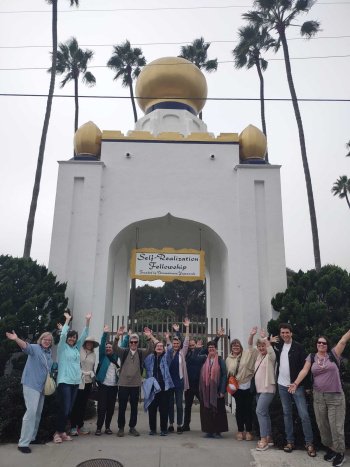
    Encinitas Hermitage

    Encinitas Hermitage: This idyllic spiritual hermitage, with it’s stunning gardens overlooking the edge of sixty million miles of ocean, is a kind of paradise of serene loveliness and peace. Yogananda wrote his unparalleled masterpiece Autobiography of a Yogi here, along with such priceless spiritual jewels as Cosmic Chants and Whispers from Eternity. Thousands upon thousands of visitors come here to meditate, bathe in natural beauty, and gaze upon one of Master’s own favorite phenomenon: the horizon meeting of infinite sea and sky.

    Although a spiritual master far beyond ordinary human comprehension, Yogananda also had a happy, wise and playful human nature as well. A local resident in Encinitas recounted his father’s brief tale, who lived in Yogananda’s time as a young boy. The hermitage swimming pool in those days was one of the only pools for miles around, and sometimes intrepid children would sneak onto the property for a swim. This 10-year-old boy stole onto the grounds one night and approached the pool; Yogananda emerged quietly from nearby and said simply, “Jump!” and the boy ran off, never to encounter the master again. Although a trivial story, it reminds us of the bold and childlike spirit which can balance the mighty scales of a great saint’s spiritual magnetism and power.
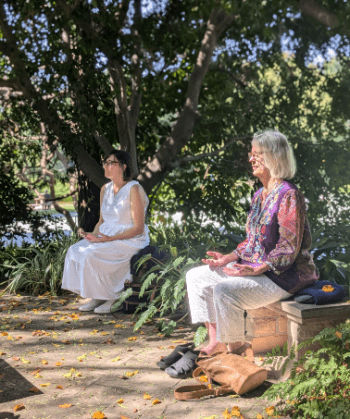
    in the glorious Temple of Leaves where Yogananda meditated and encouraged others to do so

    Mt Washington: this Los Angeles hilltop serves as the all-important international headquarters of Self-Realization Fellowship. Yogananda’s residence, spiritual power and work are powerfully embedded in the main building and beautifully landscaped grounds. Devotees may be permitted to visit Yogananda’s carefully preserved bedroom and sitting room upstairs, where many experience powerful spiritual vibrations beyond adequate description. Although the spirituality and divine work continue as the main focus here, there is also a museum-like quality to the atmosphere, where firm guidelines of quiet, no pictures or loitering, no chanting or singing are maintained. Despite these impositions, which SRF is somewhat notorious for, seeming to oppress Yogananda’s ebullient blissful spirit, there yet remains an otherworldly beauty and peace everlasting. All who visit are blessed.

    devotion at Yogananda’s great mausoleum

    Forest Lawn: Paramhansa Yogananda’s physical body was interred here in 1952, first in a crypt for twenty years, and then (as now) in a great marble mausoleum. Twenty days after his passing his body had not decayed, nor had it deteriorated notably after those first twenty years! These strange mystical phenomena may take place in the life and death of a saint, and hint at the supernatural state of the soul or the body in which it resided. Regardless of any outer form, the sincere disciple who sings softy with devotion in this place, meditates on Yogananda’s ever-living presence, and places his forehead to the cold stone only inches from the master’s physical form, once again cannot but feel, or depart without, some magnificent spiritual blessing from God.
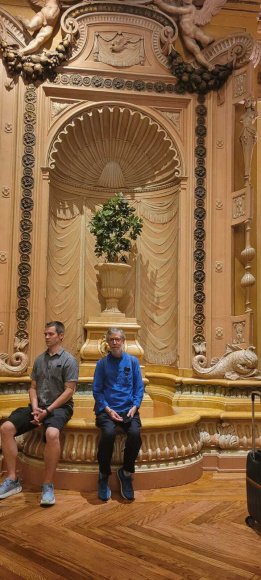
    meditation at the Biltmore Hotel site of Yogananda’s mahasamadhi

    Biltmore Hotel: Yogananda like many great mystical beings anticipated, and essentially planned out, the exact nature of his death. Instead of making some grandiose spiritual exit from this world, such as entering into silent fasting and supernal meditation in some remote temple or cave, Yogananda died of a heart attack at a banquet in downtown LA. Like a Hollywood movie the elements of drama were all in place, but a much deeper and more conscious screenplay was also perfectly executed by the Heavenly Director-Producer God. Visiting the 100-year old hotel, which retains is elegant grandeur, one now sits innocuously in the place of Yogananda’s passing where a remodeled lobby now greets hotel guests and visitors. This is another strange testament to Yogananda’s mysterious greatness: his humility and divine role is beyond comprehension, and yet perfectly natural and at ease in our everyday midst.
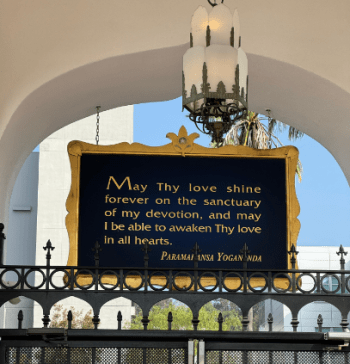
    Yogananda’s prayer enshrined at Hollywood Temple

    Hollywood Temple: Here again we find a pillar of Yogananda’s great spiritual work and presence in the most unlikely of places: Sunset Boulevard in Hollywood, California, the entertainment capital of the world. Visiting this humble and beautiful temple, its gardens and grounds, and the adjacent India Hall is a looking glass into another fascinating portal. Yogananda did unthinkable things here, transporting the temple building itself from some twenty miles away and completely retrofitting it during the dark and difficult years of World War II. He had the monks dig—by hand!—an entire basement below the India Hall café building to create Lower India Hall where events and ceremonies are held. And he mixed and mingled with all manner of Los Angelenos here, sending his blissful smiles and blessings into hearts and minds near and far from this unusual locale. The man and spirit called Yogananda defy all logic and form, preferring instead to forever emanate creative spiritual energies of joy and dynamism from center everywhere, circumference nowhere.
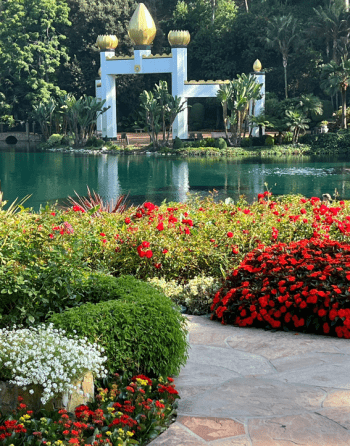
    a glimpse of Lake Shrine’s splendor

    Lake Shrine: Like Encinitas Hermitage this place sits like a flawless jewel of Yogananda’s crown for countless visitors and spiritual seekers to enjoy. It’s stunning gardens and pretty features are a source of endless peacefulness and serene beauty to appreciate. But once again there is more than meets the eye: here too Yogananda consciously and powerfully implanted extraordinary spiritual blessings of universal love and God-consciousness. One chilly day in February long ago, he swam out into the middle of the lake and entered Samadhi (a profound spiritual state beyond body and mind) for some forty-five minutes. He said on more than one occasion that the waters and surrounding areas there were forever sanctified for all to come and be blessed by. The curious origins of the Lake Shrine came when the property’s previous owner, a Texas oil magnate had a powerful dream that the place was to be a universal center for all religious faiths. Looking up SRF in the phone book, he somehow encountered Yogananda over the phone who was expecting his call, and graciously received the extraordinary property by donation. Yogananda’s vision is exemplified there: a place of deep spiritual power, beauty and a symbol of universal religious spirit.

    One thing that becomes apparent on a pilgrimage of this magnitude is that the veils of time and space become thinner. The physical and spiritual journey creates a sort of timeless process, where the busyness of travel fades into the background of powerful spiritual energies coursing through and around the pilgrim. And although visiting the pilgrimage sites yields potent blessings, the pilgrim becomes aware that these spiritual forces are not limited by any physical location, time or circumstance. These blessings live on and course through our lives like the ebbing and flowing tide, affected by some greater energy and power than our own. Let us then, like Yogananda in California, live for some greater purpose and power, dedicated to Self-realization and the united temple of divine love in all hearts, everywhere.

     

  • Alone Together

    Alone Together

    Everyone is alone. Alone with their thoughts, problems, joys and sorrows. Everyone is born alone and helpless, and leaves this world in similar fashion. And yet, everyone is together in this aloneness: sharing experiences, ideas and support. We are born into a family, move through life with friends, and leave with the support of our loved ones at the end. These two realities of aloneness and togetherness are completed by a third, all-pervading reality of oneness in Spirit.

    Spirit is the link between energy and matter. Spirit is also the underlying connection between aloneness and togetherness. One can be completely and utterly alone, but perfectly happy and at peace. Or one can be together with others and feel miserably lonely. In his poem, I Am Lonely No More Paramhansa Yogananda writes “I am not lonesome in the chamber of loneliness, for Thou are always there. I am lonely amidst an uproarious crowd where Thy Silence slips away in noise like a fast-footed, startled, large-eyed deer.”


    The perfect balance of being “alone together” is the blend of living, serving and worshiping God with others doing likewise. Then all spiritual practices, experiences, karma and aspirations are all blessed by the combined strength of our mutual efforts. All of life is happier, stronger and better with friends seeking God.

    This week some 24 Ananda Portland friends completed Paramhansa Yogananda’s 9-Day Diet Cleansing and Revitalizing Diet. Instead of being together on a retreat, we all went about our busy lives, connecting on Zoom and Whatsapp to share the experience together. Obviously the abundance of fresh, whole foods plus abstinence from the usual suspects like sugar, starches and caffeine yields many healthy benefits. But some of the deeper blessings of this practice include: an increased feeling of lightness and energy in body and mind, strength of discipline and power of will, and freedom from attachments and habits. 

    The experience of doing something “alone together” has been a unique and enjoyable blend of self-effort and will, with the conscious, tangible support and encouragement of friends. Although our circumstances vary, together we find ourselves stronger, more joyful and increasingly aware of greater realities than our own. Together in Spirit is the greatest reality of all: to see oneself in others, to feel their realities deeply inside, and to behold the one spirit of God shining through every form. Then, no matter our circumstances, we feel the presence of God guiding and blessing every footfall.

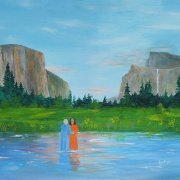
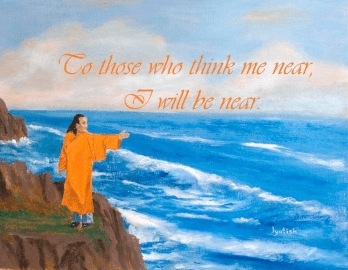
    painting by Nayaswami Jyotish

    In the last analysis we are never alone. Paramhansa Yogananda promised “to those who think me near, I will be near”. Jesus said “I will be with you always, until the end of time.” (Matthew 28:20) And Sri Krishna offers these precious words in the Bhagavad Gita: “One who beholds My presence everywhere, and all things dwelling equally in Me, he never loses loving sight of Me, nor I of him, through all eternity.” (Chapter 60, stanzas 30-32)

    So often alone, but at last together with God we march on to final freedom and bliss. In his divine life, music, and writings Swami Kriyananda emphasized the need to “go on alone” seeking and living for God, holding nothing back. When we seek and love God this way, with all our heart, mind, soul and strength, we blaze the final trail to oneness in Spirit alone, but ever together in Spirit.

  • God Is There. So Is Someone Else.

    God Is There. So Is Someone Else.


    “I just couldn’t help myself.”

     I suspect we have all resorted to that excuse at one time or another. It is even an established courtroom defense, known as  “irresistible impulse,” presented as a mitigating circumstance and a plea for mercy. 

    I was remembering this from my year in law school, aware of how difficult it is to resist an intense temptation. Or an urge to get even for an act of abuse. 

    Though I’ve never had to contend with a lurking nemesis like Moriarity to Sherlock Holmes, it struck me that someone in my life has bothered me since I was a kid. Oddly enough, he thinks of himself as my best friend, because admittedly we’re very close. He is my own Ego, and out of genuine admiration for his persuasive methods and relentless nature, I have named him with a capital E.

    I owe the Ego my thanks for much of my motivation, yet he’s also the cause of most of the trouble I have gotten into. Even today he can catch me off guard when his counsel is what my urges are wanting to hear. “Trust me,” he says, “I know what you like and I’m here to help you get it.”

    The Ego’s steady presence in my life raises a number of questions: Is he merely a mischief-maker that God has planted in me for amusement, or does he offer qualities that would serve me to develop? Am I stuck with him forever, or is there a way to lose him?

    It turns out the Ego in history is an ancient player, whose origin dates to India’s epic saga, the Mahabharata. Long before he was known to Freud and others by his three-letter name, the Ego was born to royalty as Bhishma, the noblest of princes. His is a story of great inspiration…until one fateful choice led him to the side of delusion, thus leading us also into our own battle with it.

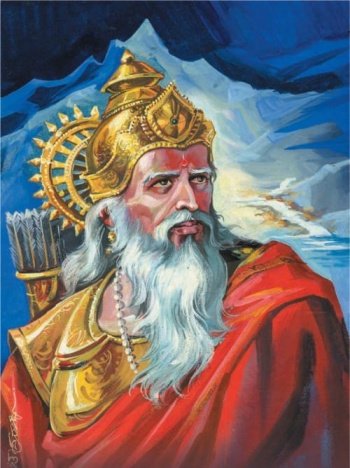
    Bhishma in the Mahabharata

    The Ego means well and would be glad if we never suffered from following its advice. But its perspective is finite, short-sighted and fleeting, sure to result in a measure of letdown or worse. 

    So, what are we to do? How are we to coexist without its influence messing things up? Our teachings and practices clearly offer more than the Ego can: lasting inner peace, love and joy. But the tasks they require us to undertake are huge, such as replacing what we want with wanting what we get, and serving others in the spirit of nishkam karma, non-attachment to the fruits of our labors. 

    A large part of our job in this life is to unlearn much of what we have been conditioned to accept. The more we do this, the more we gain against the Ego’s sway, for it has a nemesis too: our self-control. As we apply it, the Ego yields to its leash. Lifetimes more may be needed to undo its grip, but even the Ego itself, born of nobility that unwittingly went astray, secretly roots for its demise, the day it surrenders to the greater good of the soul. May we disidentify with it and help that happen.


  • Real or Not?

    Real or Not?

    We see, and we believe, isn’t that right? Look, there’s a chair. Yep, right over there, that’s a chair. We can sit in it too. But is that enough to say that it is real?

    Real or not, it would be extremely unwise to ignore the possibility that chairs and other perceived objects exist. An oncoming train will quickly dispatch both you and your quantum theory if you choose to stand in its way, expecting its atomic particles to suddenly behave as waves. Better to believe that a train is a real train.

    But there is a greater reality than what our senses can experience, and failing to adhere to it causes problems that nag and never quit. This greater reality is the spectrum of the soul. Yet, our tendency is to overlook it. 

    The material world cannot be denied. As we are to live on earth, the material world is where that living must be. But here’s the rub: To abide in material consciousness, as society has trained us to do, is to fear an end to what it can offer, and end it will. 

    Moreover, this state of mind kindles material desires, which flare into attachments, which spur the creation of possessive habits, which encourage more of the same. Hence, the snare of suffering’s web that we stumble into. What a choice to make! But who of us, more or less, has not made it?

    One of the lessons of the Bhagavad Gita is that none of us shrinks, but rather expands, in ousting these inclinations. Ingrained as they may seem to be in our egoic perceptions, they are merely expressions of energy which, when directed inward instead of outward, diminish our suffering and add to our joy. The self is not lost, it is lifted.

    Likewise, it should motivate us that life on earth is but a series of lessons that lead us higher to the promise of infinitely more. We cannot die except to the millions of wishes that stand in our way. It is hardly sane to hold fast to their fleeting amusements, to endure with disappointment their limitations. And yet that is what we incline to do, ready to excuse with reason the reason why.

    Wrestling with our restless thoughts goes on. But as every saint and avatar has assured us, a willingness to engage more deeply, to seek and follow the guidance of God’s inner call, guarantees a life of no regrets. 

    For each of us, regardless of where we are stuck, the direction is one, the destination is one. Let us at least understand where we are headed: out of our heads, into the wilds of the soul’s inner world, into the kingdom of Oneness. The sooner we turn our focus to that awareness, the sooner it graces us with its blessings. Like all who wander delusion’s desert in search of the Promised Land, we are destined to find our way out, arriving at last at the realization of Self. We are headed Home, the sooner the better.

  • I’m Only Human

    I’m Only Human

    To be human is commonly associated with lack, mistakes and failure. Habitual expressions referring to the human condition include “I’m only human”,  “to be human is to err” and excusing any manner of human foible or fault as  “just human nature”. But what if the truth is that being human, in essence, is to be divine?

    Paramhansa Yogananda was a man who was born in India in 1893 and died in California in 1952, but he was (and is) also a divine being, fully awakened in Self-realization. Once, a great disciple found himself in the presence of the Yogananda, contemplating this paradox of his human form and his divine stature. Sensing this student’s deep consideration but inability to comprehend–”how can the little cup hold the whole ocean?”–Yogananda approached the disciple and, smiling, gave him an apple. In a subtle yet playful way, he was imparting the unthinkable wisdom of an enlightened Guru who is one with God: that the highest form of humanity is divinity. Yogananda’s definition of Self-realization explains that within each human form dwells the divine:

    “Self-realization is the knowing in all parts of body, mind, and soul that you are now in possession of the kingdom of God; that you do not have to pray that it come to you; that God’s omnipresence is your omnipresence; and that all that you need to do is improve your knowing.”

    To ‘improve our knowing’ is the only goal of life. Lesser teachings and teachers will convincingly reason that it is sufficient to simply accept and love oneself as one is, or that a little self improvement is enough. But the ultimate, beautiful goal of life is to know God, and the human who recognizes and yearns for this knowledge will be satisfied with nothing less. In the words of the great saint Sister Gyanamata “see nothing, look at nothing, but your goal ever shining before you”.

    There is a little flame of Spirit in every human soul in creation. Many humans remain ignorant or naive, barely acknowledging the divinity so readily apparent within and without. But the human being who fans and feeds the spiritual flame feels its inner warmth and light, gradually spreading everywhere. Meditation and especially Kriya Yoga are the highest forms of art and science available for the little flame to become spirit, for the little soul to know God. The natural expansion of consciousness that follows, hand in glove, leads to loving awareness and perception of, and joyful service to God in everyone, everywhere. But everything starts with the little human being who seeks God, pulling on that thread of seeking tirelessly, lovingly, without end.

    Remarkably, and never revisited enough by the inspired disciple, is the statement by Yogananda that the enlightened state of jivanmukta is attainable in this very lifetime. The illumination of great saints and sages is not the stuff of far off spiritual legends, but the essence of our own lives here and now. Every human heart holds the universal current of Divine Love, beating eternally through the cosmos and in the hearts of all. Every human experience is an invitation to awaken that love. Some humans will pine for the “good ole days” that will never come, because the real good days come each and every day, when no matter what comes we do our best to love God, seeking and serving God, thankful for these countless divine blessings of being human.

  • Noble Is As Noble Does

    Noble Is As Noble Does

    In my years at our Ananda Pune ashram, we followed each day’s group meditation and breakfast with a morning circle. My wife and I, with our staff and guests, would discuss the day’s projects and assignments, and then we would all affirm together, loudly at first and then more inwardly, “I will do my work thinking of Thee, Lord. I offer to Thee the very best that is in me.” 

    Imagine if governments and corporations did something like that. We wouldn’t need millions of laws and thousands of agencies to enforce them. The Golden Rule would preside, because in offering to God the best that is in us, it becomes our nature to serve our neighbors in that same spirit. 

    The real work of living well is not about building or fixing things, it’s about building and fixing ourselves. Attitudes, relationships, and commitments are the greater construction projects involved in creating a successful community, which creates a more successful you and me. A house is not a home if it is just a structure, even if it is a palace. You have to fill it with love and joy, otherwise it is a place of bare shelter only. 

    Likewise, a body is not a home if the person inside is unhappy, lazy, angry, greedy, or selfish. When that is the case, there is work to be done, and who of us can be called a finished product? We sometimes refer to ourselves as “works in progress.” What we need to keep in mind is that a work in progress implies that we are investing actual work in making the changes necessary for progress to occur! 

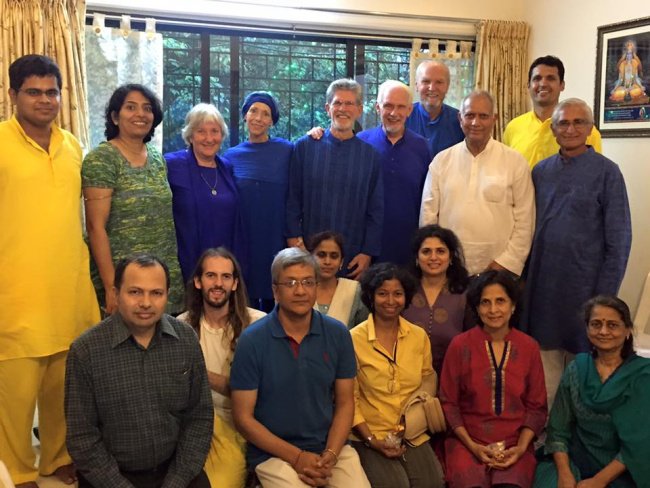
    Surendra with devotees in Pune

    Building a spiritual community, as we were endeavoring to do in Pune, is a gradual, ongoing process too. But in truth the idea of community does not require an actual community to exist. You can have it in spirit wherever you are. Community is serving and supporting each other for the welfare of all. It is doing the noble work of clearing away our egoic motivations. It is offering the best that is in us. 

    But what about those days when working with the right attitude seems like the most resistant work of all? Sometimes work gets in the way of how we would rather be spending our time, and we don’t exactly give it the best that is in us. 

    Years ago, Edgar Bergen was a popular on-stage ventriloquist, whose sidekick was a little wise cracker called Charlie McCarthy. Charlie was like the voice of the ego that chatters inside our head. As part of their comedy routine, Bergen was always making appeals to Charlie’s better nature, usually to no avail. Once, in urging Charlie to do a particular job, he said, “Charlie, a little work never killed anyone.” Charlie replied, “Yeah, but why take a chance!” 

    This life is a playing field on which we are opposed by our lesser nature. Working to overcome it is not only the way to reach our highest potential, it is also the way to a happier life. Good work drives out our pettiness, our moodiness, our worries. 

    I am reminded often of a quote from Thomas Jefferson, who was asked if he believed in luck. He replied that yes, he did. He said he had studied the law that luck obeys and attuned himself to it, with this pleasing result: “The more good work I do, the more good luck I have.” 

    We know of this life on earth that it’s been designed, not by accident, as a test of will, a test of courage, a test of attitude and behavior. Every day arrives with a new set of challenges, although most of them are simply repackaged versions of ones we have faced many time before, yet to be put behind us. 

    Does doing our best mean we’re bound to get what we work for? If that were true, we would be seduced – as many are – into thinking that lasting happiness is possible on earth. God’s intent in thwarting our ambitions from time to time is to lead us from that delusion to the realization that our ultimate freedom and contentment lie in seeking Him above all.

    “I will do my work thinking of Thee, Lord. I offer to Thee the very best that is in me,” because in that noble effort lies inner peace, joy and freedom’s way, and in nothing else will we find this to be true.

    The Noble New, painting by Nayaswami Jyotish
  • A Lesson In Swadhyaya

    A Lesson In Swadhyaya

    In the midst of today’s chaotic world, I find solace in the practice of introspection, a tool that not only grants self-awareness but also fosters a deeper understanding of others. Known in Sanskrit as swadhyaya, meaning “self-study”, introspection is one of the steps along the eightfold path of yoga taught by Patanjali. 

    Introspection has saved me in the face of conflict many times. In moments when I want to react to someone with a smart quip and a sharp tongue, it is the practice of introspection that has taught me to pause, notice my reactivity, and allow the time needed before deciding how to act. I’m by no means perfect at this, but concerted effort is bearing fruit, just ask my family!

    In this practice, there are a few essential qualities that I have found invaluable to unlocking higher potential. Those qualities include self compassion, acceptance, calmness, humility, and honesty.  

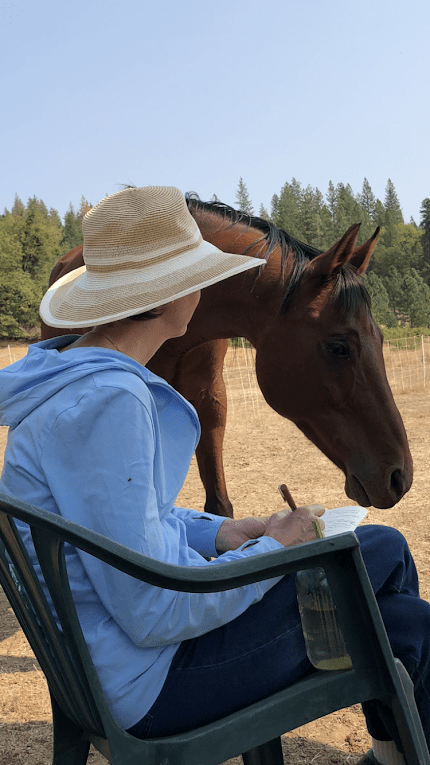
    A few years ago, I got a lesson in the importance of these qualities to unlock truly transformational introspection. I stood across a horse arena, quietly observing my equine coaching client as she walked a horse around the circle. She talked as she walked, explaining to the horse her feelings of jealousy, judgemental thoughts, and her constant striving and failing at perfection. The horse said nothing of course, he just walked calmly by her side. 

    When she stopped, he offered her a gentle exhale with his big head resting against her chest. She quieted and they stood there for some moments. I watched her shoulders soften, her breathing slow. She turned to me, tears in her eyes and explained that she’d never felt so loved and accepted by another, even as she shared her most shameful thoughts and feelings. She left feeling resolved to work on her issues with greater determination. 

    In observing this interaction, it was crystal clear how self honesty, paired with these benevolent qualities embodied by the horse, made all the difference in the world. Applied in our daily lives, this practice of swadhyaya invites us to notice our thoughts, feelings, and behaviors honestly. In noticing, we must fight the temptation to judge ourselves and instead see with the eyes of the Divine Mother, letting her compassionate heart give us the strength and the hope to improve ourselves. 

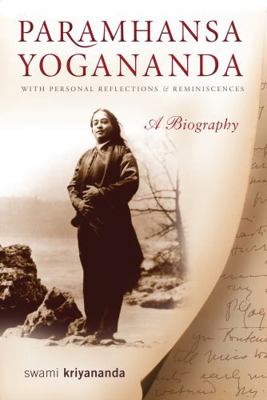
    As Swami Kriyananda explains in Paramhansa Yogananda: A Biography, “One who makes it a practice always to analyze his own motives, to catch any self-justification in the bud, and to accept always with an open mind the possibility that he has been wrong, will direct his footsteps unfailingly toward the ultimate Goal. Such a person will act always without personal motive, to please God.”

    Yogananda often counseled that to see yourself as a “sinner” is a greater sin than the negative actions themselves. The goal, after all, of Self-realization is to recognize one’s true Divine nature and live that truth wholly. The pitfall of introspection comes when we look through our human eyes alone and see only our imperfections. And as many will attest, what we focus our attention on will increase, not decrease. Let us, instead, view ourselves through the lens of the Divine. Only then can we embrace the entirety of ourselves with love, approach with humility and hope, and subsequently, find the freedom to change.

  • The Angel in the Tree

    The Angel in the Tree

    Are you your body-mind? It would certainly seem so. Every sensation we experience – taste, touch, sight, smell and hearing – reinforces that perception. But is there more to the answer than a yes or no can provide?

    We are raised for good reason to believe in the physicality of the reality that surrounds us, and our senses confirm its existence every minute of the day. Objects appear at different locations in space, and it takes time to move from one to another. You are there, I am here, and between us is a distance that can be measured. Everything appears to be separate. 

    But just as the body-mind is an object also, it needs a witness other than itself to verify it as such. Thus, as we set forth on our spiritual journey, and as this question of identity arouses our curiosity, the quest begins to discover who or what this mysterious witness could be. 

    But right off the bat there’s a catch. The witness is subjective. There is no “thingness” to find, and the body-mind struggles with what to make of its formless nature. Hmmm. Nonetheless, you’ve become intuitively aware of a possibility beyond your human reach. It feels like an identity that is not yet fully rendered. 

    As you think about where to look next, a second setback intrudes. Your ego makes a play to take the lead. “I am the body-mind,” it announces. “I am all you need or need to know. Trust me, and I will guide you to the good life.” Hmmm, again. The ego has been promising this for as long as you can recall, but in its pledge of many pleasures, disappointment and regret have never lagged far behind either.

    Looking around, you wonder if you have been hypnotized to accept a limited reality that is not having the happy effect you were seeking. 

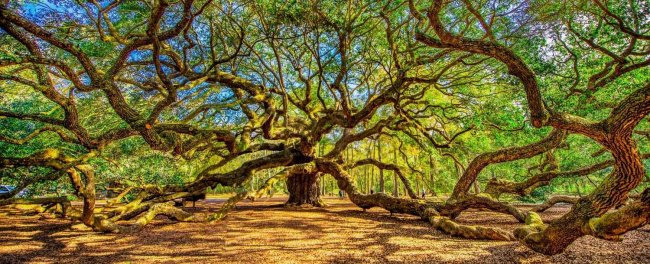
    Then, out of the blue, a vivid childhood memory comes to light. You remember being given the picture of a tree and told that an angel was hiding somewhere within it. At first you saw only the tree: its branches and leaves and texture, until suddenly, as if by magic, the angel’s shape appeared in a layout of the leaves like a secret revealed. The angel had been there all along, merely hidden from ordinary vision. 

    An idea begins to dawn in you. The angel is like the witness, watching and awaiting discovery. It is your hidden nature, the consciousness at the core of your being. Your body-mind is merely its latest means of transportation, which you have fitted with various features and self-definitions. 

    Once you have seen the angel in the tree, your whole world looks different too.  The witness is seen as a higher aspect of yourself. Infinite possibilities continue to unfold. 

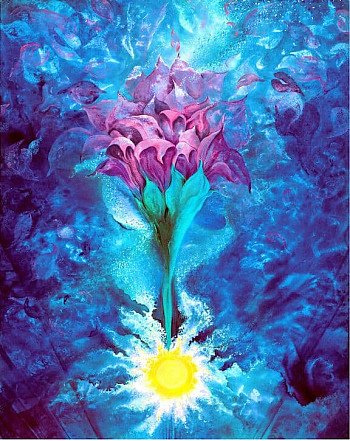
    Crown Chakra Blossoming, by Dana Lynne Andersen

    This entire new perspective is an invitation to a new and greater experience of truth and happiness too. It is an offer to enter the realm of the Self, where all becomes transparent, where the temporal is rendered eternal. 

    Yet, letting go of the ego’s point of view can still seem scary. We have attachments and unresolved fears that are deeply rooted in the dream of ourselves as all of those sensory features and self-definitions. Now, though, clarity and hope are in focus also, for in seeing the angel, we have learned to question the limits of our conscious awareness. 

    We are nothing if not divine. The depth and breadth of our latent awareness is inexpressibly vast, and it, as we allow, like the angel in the tree, is there to lift our spirits to discoveries of endless delight.

  • The Noble Taper

    The Noble Taper

    Meditation is the foundation of spiritual life. Like an engineer designing a structure to withstand certain physical forces, the spiritual seeker engineers himself to withstand certain forces in life. To this end, the single most powerful spiritual tool is a regular, scientific practice of meditation and devotion. 

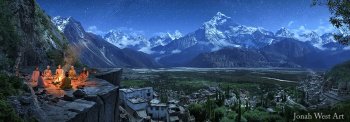
    In his poetic and divinely inspired ceremony The Festival of Light, Swami Kriyananda tells of a special meeting between two Avatars, enlightened masters destined to guide the spiritual evolution of life on planet earth:

    High in the Himalaya, eyes filled with divine love, Jesus appeared to the great master, Babaji. “The lights on the high altar of my church,” he said, “have been growing dim. Though still lit on lower altars of good works, the noble taper of inner communion with the Lord burns low, and is ill attended. Let us together, united in Christ love, set lights ablaze on that high altar once again!” Thus, a new ray of light was sent to earth through the great masters of this path.

    Babaji’s Cave, by Jonah West

    This noble taper of inner communion is a harmonizing, a restoration of the natural state of the soul and its oneness with Spirit. Paramhansa Yogananda said of the practice:

    “The soul loves to meditate, for in contact with the Spirit lies its greatest joy. If, then, you experience mental resistance during meditation, remember that reluctance to meditate comes from the ego; it doesn’t belong to the soul.”

    All too often we experience the reluctance of the ego before or during meditation, and not enough of the soul’s greatest joy in inner communion. It is important not to give way to discouragement however, but to press on consistently with zeal in the knowledge that our regular, sincere practices of meditation and devotion will yield tremendous benefits. Greater peace of mind and happiness in one’s life can seem intangible, but over time a definite spiritual foundation is established. The inevitable ups and downs of life yield to an increasingly unshakeable sense of deeper fulfilment, calmness and joy. 

    Devotion is the secret ingredient that alone can fully complement meditation. It is the natural love and passion of the human heart, directed to the fullest expression of the soul–God. When meditation or life is difficult, when everything else seems to fail, devotion is the answer. The simple words “Love God” express the highest calling, the greatest and only answer to every question of life. Everything comes back to Love, and the individual soul loving God finds the ultimate answer in Divine Love. So in meditation and in life, when it’s hard and when it’s easy, in the big moments and the countless little ones, Love God.

    Finally, we can take refuge in God, the supreme Spirit, because our aim must be no less than total soul liberation. Like an arrow shaft loosed from a bow, our devoted meditation practice will bring us there with unerring accuracy in the end. Then our part, simply stated, must be to never, ever lose heart. No matter where life takes us, let us keep the noble taper of inner communion alight, day in and day out, and together we will set lights ablaze on the high altar of our hearts forevermore.

  • Brother Bluebell

    Brother Bluebell

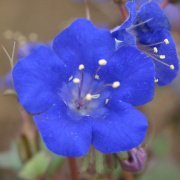
    “Hello there brother bluebell, sing me a tune today!” sings the opening line of one of Swami Kriyananda’s many delightful children’s songs, an ode to the joy and beauty of nature. The lyrics go on to welcome and sing praise to the lovely meadowlarks and dewdrops, monarchs and beetles, pebbles and laughing brooks. At the very end Swamiji, a superconscious composer, avoids ending on a traditional “down” note and the song soars upwards in it’s final lines: 

    God made us of his gladness: come, then, and sing.
    To cure the world of sadness: oh, ring, bluebell, ring!

    Indeed, of the countless inspiring pieces of Swami Kriyananda’s music, given to him by God, his children’s music can sometimes pierce the heart most readily. In the beautiful flowers and sunshine, in the play and laughter of children, we can easily relax our hearts and feel God’s joy, bubbling under the surface of our souls. And while it is good to stop and smell the bluebells, it is better when we first center ourselves in the presence of God within. Even the inevitable sorrows and sufferings of life can bring us sweetness, when we cultivate the deeper understanding, or at least the natural love, of the heart. So meditate a little deeper and longer, pray more sincerely in the silence of your soul, and then greet the days of spring with a full and open heart.

    With the traditional celebration of Easter comes the freedom and joy of the soul: the resurrection of Jesus brings a message of spiritual hope for every sincere heart. But the story can also serve as a bittersweet reminder that this world is a nest of troubles. Only by sincerely seeking and loving God can we overcome the trials and troubles of this world, and even then we may not understand, but we will be at peace. Paramhansa Yogananda often emphasized the words of Jesus, “Seek ye first the kingdom of God, and his righteousness: then all these things will be added unto you.” This is the real second coming of Christ that was promised, and that the life and spirit of Yogananda continues to inspire and fulfill.

    Join us for our Easter celebrations and many spring activities at Ananda Portland if you can. Next to a true master like Jesus or Yogananda, there is no greater blessing than spiritual fellowship with friends who love God. So while we revel in the singing blossoms and busyness of spring, let us meditate and seek the kingdom of God within above all else, and enjoy the season together despite the passing clouds and wind and rain. Remember: to cure the world of sadness: oh ring, bluebell ring!